




Filters
SORT
Product Availability –
Category –
Brand –
BTU Output –
Fuel Type –
Efficiency –
Vent Type –
Features –
Review Score –
 --%3E %3Csvg version='1.1' id='Fill' xmlns='http://www.w3.org/2000/svg' xmlns:xlink='http://www.w3.org/1999/xlink' x='0px' y='0px' viewBox='0 0 100 100' enable-background='new 0 0 100 100' xml:space='preserve'%3E %3Cpath fill='%23F15C02' d='M79.44,0.95H20.56C9.78,0.95,0.95,9.78,0.95,20.56v58.87c0,10.79,8.82,19.61,19.61,19.61h58.87 c10.79,0,19.61-8.83,19.61-19.61V20.56C99.05,9.78,90.22,0.95,79.44,0.95z M65.38,58.24l9.38,29.58L49.69,69.78L24.5,87.82 l9.34-29.6L8.8,39.6l30.73-0.17c0,0,6.98-19.61,10-28.93c0.54,1.36,9.88,29.1,9.88,29.1H91.2L65.38,58.24z'/%3E %3C/svg%3E)
 --%3E %3Csvg version='1.1' id='With-RB' xmlns='http://www.w3.org/2000/svg' xmlns:xlink='http://www.w3.org/1999/xlink' x='0px' y='0px' viewBox='0 0 100 100' enable-background='new 0 0 100 100' xml:space='preserve'%3E %3Cpath fill='%23FBC8B4' d='M79.44,0.95H20.56C9.78,0.95,0.95,9.78,0.95,20.56v58.87c0,10.79,8.82,19.61,19.61,19.61h58.87 c10.79,0,19.61-8.83,19.61-19.61V20.56C99.05,9.78,90.22,0.95,79.44,0.95z M65.38,58.24l9.38,29.58L49.69,69.78L24.5,87.82 l9.34-29.6L8.8,39.6l30.73-0.17c0,0,6.98-19.61,10-28.93c0.54,1.36,9.88,29.1,9.88,29.1H91.2L65.38,58.24z'/%3E %3C/svg%3E)
Price Range –
High Efficiency Gas Boilers


 --%3E %3Csvg version='1.1' id='No-RB' xmlns='http://www.w3.org/2000/svg' xmlns:xlink='http://www.w3.org/1999/xlink' x='0px' y='0px' viewBox='0 0 100 100' enable-background='new 0 0 100 100' xml:space='preserve'%3E %3Cpath fill='%23CECECE' d='M79.44,0.95H20.56C9.78,0.95,0.95,9.78,0.95,20.56v58.87c0,10.79,8.82,19.61,19.61,19.61h58.87 c10.79,0,19.61-8.83,19.61-19.61V20.56C99.05,9.78,90.22,0.95,79.44,0.95z M65.38,58.24l9.38,29.58L49.69,69.78L24.5,87.82 l9.34-29.6L8.8,39.6l30.73-0.17c0,0,6.98-19.61,10-28.93c0.54,1.36,9.88,29.1,9.88,29.1H91.2L65.38,58.24z'/%3E %3C/svg%3E)



 --%3E %3Csvg version='1.1' id='Half' xmlns='http://www.w3.org/2000/svg' xmlns:xlink='http://www.w3.org/1999/xlink' x='0px' y='0px' viewBox='0 0 100 100' enable-background='new 0 0 100 100' xml:space='preserve'%3E %3Cg%3E %3Cpath fill='%23F15C02' d='M30.05,70.23l3.79-12.01L8.8,39.6l30.73-0.17c0,0,6.98-19.61,10-28.93c0.54,1.36,9.88,29.1,9.88,29.1h1.58 L93.71,7.18c-3.58-3.82-8.66-6.23-14.28-6.23H20.56C9.78,0.95,0.95,9.78,0.95,20.56v58.87c0,5.41,2.22,10.32,5.79,13.88 L30.05,70.23z'/%3E %3C/g%3E %3Cpath fill='%23FBC8B4' d='M93.71,7.18L60.98,39.6H91.2L65.38,58.24l9.38,29.58L49.69,69.78L24.5,87.82l5.55-17.59L6.75,93.32 c3.55,3.54,8.44,5.73,13.82,5.73h58.87c10.79,0,19.61-8.83,19.61-19.61V20.56C99.05,15.4,97.01,10.69,93.71,7.18z'/%3E %3C/svg%3E)





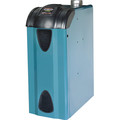
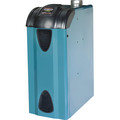
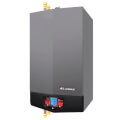

High efficiency gas boilers are condensing units that recover additional heat from flue gases before venting, letting them reach efficiency ratings well above standard atmospheric boilers used in older hydronic systems. Instead of venting hot exhaust straight out through a chimney, a condensing boiler runs that exhaust through a secondary heat exchanger, cooling it enough to condense water vapor out of the flue stream and capture the latent heat a standard boiler discards. The secondary heat exchanger lets the boiler modulate its firing rate to match actual heat demand rather than cycling on and off at full output, which reduces short-cycling wear and improves comfort across radiant and baseboard systems. Because condensate is mildly acidic, these boilers need a condensate drain and neutralizer rather than the simple flue-only venting a standard boiler uses. Matching heat load calculations to a unit's modulation range, rather than sizing to the boiler it replaces, is the starting point for choosing the right high efficiency gas boiler for a job.
Subcategories
- Wall-Hung Condensing Boilers: Compact units mounted directly to a wall, freeing floor space in mechanical rooms and closets where a floor-standing boiler would not fit. Contractors favor them for retrofits in tight utility closets and multi-zone residential systems.
- Floor-Standing Condensing Boilers: Larger-capacity units set on the floor, used where heat load exceeds what a wall-hung model can supply or where multiple zones draw from one boiler. These typically pair with a buffer tank in systems with wide swings in zone demand.
- Combination (Combi) Boilers: Provide both space heating and domestic hot water from a single unit, eliminating the need for a separate water heater tank. Combi boilers suit smaller homes where mechanical room space is limited and hot water demand does not exceed the unit's flow rate.
- Modulating Condensing Boilers: Adjust firing rate continuously across a wide turndown ratio instead of firing at one fixed output, matching heat delivery closely to real-time demand. Systems with radiant floor heat or long baseboard runs benefit most from this fine control.
Buying Guide
Selecting a high efficiency gas boiler starts with an accurate heat loss calculation for the building rather than matching the BTU rating of the equipment being replaced, since older boilers were frequently oversized under older sizing conventions. An oversized condensing boiler short-cycles more often, which undercuts both its efficiency and its service life, so right-sizing the unit to the calculated load matters more with condensing equipment than with standard boilers. Venting is the next major consideration: high efficiency gas boilers vent through PVC, CPVC, or polypropylene pipe at low temperatures instead of a metal chimney, so the installation needs a clear path to an exterior wall within the vent manufacturer's maximum run length. Condensate handling also needs planning before installation begins, since the mildly acidic condensate produced during operation requires a neutralizer cartridge and a drain routed to an approved discharge point rather than a bare floor drain. Boiler modulation range and turndown ratio matter for systems with radiant floor heat or many independently zoned loops, since a wide turndown ratio lets the boiler idle at low output during mild weather instead of cycling on and off. Water quality also affects long-term reliability: systems with older cast iron radiation or unknown piping condition often call for a dirt separator, and in some cases a low-loss header, to isolate boiler-side flow from system-side flow.
Frequently Asked Questions
What efficiency rating qualifies a boiler as high efficiency?
High efficiency gas boilers are generally the condensing models in a manufacturer's lineup, since they recover additional heat from flue gases instead of venting it straight out through a chimney. Checking the AFUE rating printed on the specific unit's data plate is the reliable way to confirm efficiency before ordering, since ratings vary across the product line.
Do high efficiency gas boilers require special venting materials?
Yes, most condensing boilers vent through PVC, CPVC, or polypropylene pipe rated for the lower flue gas temperatures they produce, unlike the metal venting a standard atmospheric boiler uses. Confirming the specific vent material and maximum run length listed in the installation manual before starting the job avoids a mismatched or non-compliant vent run.
Why does a condensing boiler need a condensate neutralizer?
The condensate that collects in the secondary heat exchanger is mildly acidic, so most local codes and manufacturer instructions require a neutralizer cartridge before the condensate reaches a drain. Skipping the neutralizer can gradually corrode metal drain piping over time, even though the boiler itself operates normally.
Can a high efficiency boiler be paired with old cast iron radiators?
Yes, condensing boilers can supply cast iron radiation, but the near-boiler piping design and control strategy need to account for the higher return water temperatures that older radiation systems often produce. Working with the boiler manufacturer's piping guidelines helps the unit condense enough to reach its rated efficiency instead of running in a partially condensing mode most of the season.
What causes a condensing boiler to short-cycle?
Short-cycling is most often caused by oversizing the boiler relative to the building's actual heat loss, since an oversized unit satisfies the thermostat call too quickly and shuts down before it reaches steady operation. Confirming the heat loss calculation and comparing it to the boiler's minimum modulation output helps rule out sizing as the cause before troubleshooting controls or wiring.
