




Combi Boilers


 --%3E %3Csvg version='1.1' id='Fill' xmlns='http://www.w3.org/2000/svg' xmlns:xlink='http://www.w3.org/1999/xlink' x='0px' y='0px' viewBox='0 0 100 100' enable-background='new 0 0 100 100' xml:space='preserve'%3E %3Cpath fill='%23F15C02' d='M79.44,0.95H20.56C9.78,0.95,0.95,9.78,0.95,20.56v58.87c0,10.79,8.82,19.61,19.61,19.61h58.87 c10.79,0,19.61-8.83,19.61-19.61V20.56C99.05,9.78,90.22,0.95,79.44,0.95z M65.38,58.24l9.38,29.58L49.69,69.78L24.5,87.82 l9.34-29.6L8.8,39.6l30.73-0.17c0,0,6.98-19.61,10-28.93c0.54,1.36,9.88,29.1,9.88,29.1H91.2L65.38,58.24z'/%3E %3C/svg%3E)

 --%3E %3Csvg version='1.1' id='No-RB' xmlns='http://www.w3.org/2000/svg' xmlns:xlink='http://www.w3.org/1999/xlink' x='0px' y='0px' viewBox='0 0 100 100' enable-background='new 0 0 100 100' xml:space='preserve'%3E %3Cpath fill='%23CECECE' d='M79.44,0.95H20.56C9.78,0.95,0.95,9.78,0.95,20.56v58.87c0,10.79,8.82,19.61,19.61,19.61h58.87 c10.79,0,19.61-8.83,19.61-19.61V20.56C99.05,9.78,90.22,0.95,79.44,0.95z M65.38,58.24l9.38,29.58L49.69,69.78L24.5,87.82 l9.34-29.6L8.8,39.6l30.73-0.17c0,0,6.98-19.61,10-28.93c0.54,1.36,9.88,29.1,9.88,29.1H91.2L65.38,58.24z'/%3E %3C/svg%3E)

 --%3E %3Csvg version='1.1' id='Half' xmlns='http://www.w3.org/2000/svg' xmlns:xlink='http://www.w3.org/1999/xlink' x='0px' y='0px' viewBox='0 0 100 100' enable-background='new 0 0 100 100' xml:space='preserve'%3E %3Cg%3E %3Cpath fill='%23F15C02' d='M30.05,70.23l3.79-12.01L8.8,39.6l30.73-0.17c0,0,6.98-19.61,10-28.93c0.54,1.36,9.88,29.1,9.88,29.1h1.58 L93.71,7.18c-3.58-3.82-8.66-6.23-14.28-6.23H20.56C9.78,0.95,0.95,9.78,0.95,20.56v58.87c0,5.41,2.22,10.32,5.79,13.88 L30.05,70.23z'/%3E %3C/g%3E %3Cpath fill='%23FBC8B4' d='M93.71,7.18L60.98,39.6H91.2L65.38,58.24l9.38,29.58L49.69,69.78L24.5,87.82l5.55-17.59L6.75,93.32 c3.55,3.54,8.44,5.73,13.82,5.73h58.87c10.79,0,19.61-8.83,19.61-19.61V20.56C99.05,15.4,97.01,10.69,93.71,7.18z'/%3E %3C/svg%3E)

 --%3E %3Csvg version='1.1' id='With-RB' xmlns='http://www.w3.org/2000/svg' xmlns:xlink='http://www.w3.org/1999/xlink' x='0px' y='0px' viewBox='0 0 100 100' enable-background='new 0 0 100 100' xml:space='preserve'%3E %3Cpath fill='%23FBC8B4' d='M79.44,0.95H20.56C9.78,0.95,0.95,9.78,0.95,20.56v58.87c0,10.79,8.82,19.61,19.61,19.61h58.87 c10.79,0,19.61-8.83,19.61-19.61V20.56C99.05,9.78,90.22,0.95,79.44,0.95z M65.38,58.24l9.38,29.58L49.69,69.78L24.5,87.82 l9.34-29.6L8.8,39.6l30.73-0.17c0,0,6.98-19.61,10-28.93c0.54,1.36,9.88,29.1,9.88,29.1H91.2L65.38,58.24z'/%3E %3C/svg%3E)


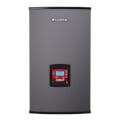


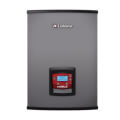




Combi boilers are single appliances that supply both space heating and domestic hot water without a separate storage tank, which makes them a common fit for tight mechanical rooms, condos, and multifamily retrofits where floor space is limited. Inside the cabinet, a heat exchanger shifts priority to hot water production the moment a fixture calls for it, then returns to space heating once that demand ends, so contractors are effectively installing one appliance instead of two.
Combi boilers modulate their burner output to track the load in front of them rather than firing at a single fixed rate, which helps them respond to a home's heating curve and to variable hot water draws from showers, faucets, and appliances. Choosing the right model matters because undersizing the domestic hot water side leaves occupants with weak flow at multiple fixtures, while oversizing the heating side can short-cycle the burner and shorten its service life.
Subcategories
- Gas-Fired Combi Boilers: Natural gas and propane combi boilers cover the majority of residential and light commercial installs, pairing a sealed combustion chamber with a modulating burner. Techs typically select fuel type based on what is already piped to the mechanical room, then confirm venting category before finalizing the model.
- Wall-Hung Combi Boilers: Wall-hung units mount directly to a structural wall, freeing floor space in utility closets and small mechanical rooms. Their compact cabinets still house the full heat exchanger, expansion tank, and circulator, so mounting hardware and wall bracing matter as much as clearance in front of the unit.
- High-Efficiency Condensing Combi Boilers: Condensing combi boilers extract additional heat from flue gases before they exhaust, which lowers return water temperature requirements and pairs well with radiant and low-temperature baseboard systems. Condensate drainage and neutralization need to be planned into the install alongside the venting run.
- Combi Boiler Replacement Parts: Circulators, expansion tanks, flow sensors, and diverter valves keep an existing combi boiler in service without a full swap-out. Matching parts to the specific model and production run avoids compatibility issues with the unit's control board.
Buying Guide
Sizing a combi boiler starts with two separate calculations that both have to be satisfied by the same appliance. The space heating side depends on the building's calculated heat loss, while the domestic hot water side depends on how many fixtures could realistically run at once and at what flow rate. A combi boiler sized only for heating load can leave a house with lukewarm water when two showers run together, so contractors typically size around the larger of the two demands rather than averaging them.
Fuel type and venting are the next decision points. Natural gas and propane units both work well, but propane installations need to account for a different orifice sizing and, in some cases, different regulator requirements. Venting category determines whether the unit can share an existing chimney liner or needs a dedicated PVC, CPVC, or stainless vent run to an exterior wall or roof termination.
Combi boilers rated for higher condensing efficiency generally need a lower return water temperature to hit their stated performance, which makes them a strong match for radiant floor systems and oversized baseboard, and a weaker match for older cast-iron radiator systems designed around higher supply temperatures. Matching the boiler's expected operating range to the emitter type already in the building avoids a mismatch that quietly erodes efficiency after installation.
Domestic hot water output is usually expressed as a flow rate at a given temperature rise, and that number should be checked against the home's actual fixture count and simultaneous use pattern rather than square footage alone. A two-bathroom home with a soaking tub and a multi-head shower has a very different draw profile than a one-bathroom home with standard fixtures, even if the two buildings are similar in size.
Serviceability is worth weighing alongside performance specs. Units with accessible unions, labeled wiring, and a control board that supports common diagnostic tools tend to be faster to troubleshoot in the field, which matters over the life of the appliance as much as the specifications on the day of installation.
Frequently Asked Questions
How is a combi boiler different from a standard boiler paired with a water heater?
A combi boiler combines both functions in one cabinet using a single heat exchanger, while a standard boiler only handles space heating and needs a separate water heater or indirect tank for domestic hot water. Combining the two functions saves floor space but means both loads draw from the same appliance.
Can a combi boiler run a shower and a heating zone at the same time?
Most combi boilers prioritize domestic hot water over space heating when both are called for, so heating output pauses briefly while a fixture is open. Once the hot water draw stops, the unit returns to satisfying the heating call.
What determines how many fixtures a combi boiler can serve at once?
The unit's domestic hot water flow rate at a given temperature rise sets the practical limit. Running two showers and a dishwasher simultaneously requires a higher flow rating than a home with a single bathroom.
Do combi boilers work with radiant floor heating?
Yes, and condensing combi boilers in particular tend to pair well with radiant systems because radiant loops operate at lower supply temperatures that keep the boiler in its efficient condensing range.
What maintenance does a combi boiler need after installation?
Annual inspection of the burner, venting, condensate drain, and expansion tank pressure keeps most combi boilers running reliably. Flushing the heat exchanger periodically also helps in areas with harder water.
