


'/%3E%3C/svg%3E)
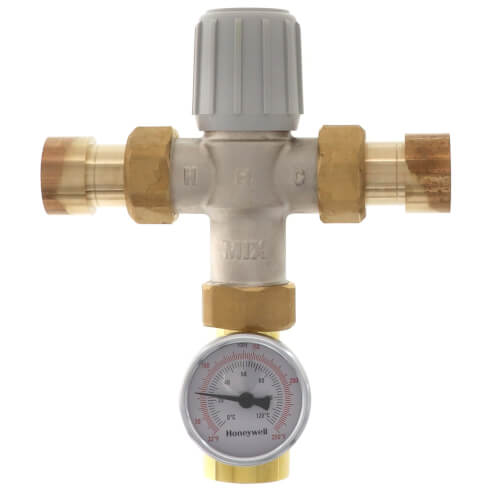
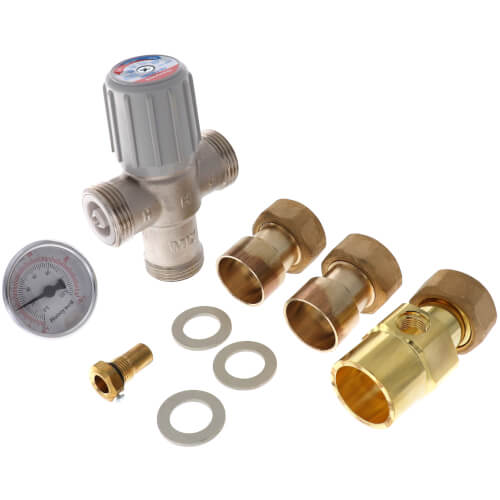
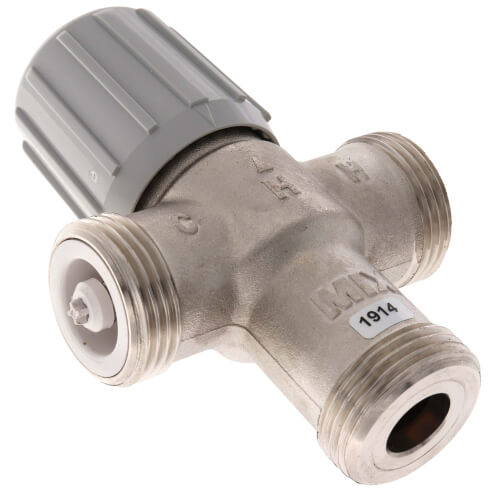
1" Lead Free Union Sweat Mixing Valve w/ Temperature Gauge (70-145F)
 --%3E %3Csvg version='1.1' id='Fill' xmlns='http://www.w3.org/2000/svg' xmlns:xlink='http://www.w3.org/1999/xlink' x='0px' y='0px' viewBox='0 0 100 100' enable-background='new 0 0 100 100' xml:space='preserve'%3E %3Cpath fill='%23F15C02' d='M79.44,0.95H20.56C9.78,0.95,0.95,9.78,0.95,20.56v58.87c0,10.79,8.82,19.61,19.61,19.61h58.87 c10.79,0,19.61-8.83,19.61-19.61V20.56C99.05,9.78,90.22,0.95,79.44,0.95z M65.38,58.24l9.38,29.58L49.69,69.78L24.5,87.82 l9.34-29.6L8.8,39.6l30.73-0.17c0,0,6.98-19.61,10-28.93c0.54,1.36,9.88,29.1,9.88,29.1H91.2L65.38,58.24z'/%3E %3C/svg%3E)


Product Highlights


Description
The AM-1 with Temperature Gauge allows for a fast & reliable way to complete installation, checkout and troubleshooting systems. The Honeywell AM-1 series accurately adjusts, maintains and limits the hot water temperature to a desired setting selected by the user. In domestic water applications it offers scalding protection and bacteria growth control. By installing a Honeywell AM-1 mixing valve and raising water heater storage temperature setting and limiting mixed outlet water temperature to safe temperature more usable hot water is available. In heating applications it provides comfort and protects the equipment.
- Union Sweat adapter for easy attachment
- 2" removable temperature gauge
- Readings in Celsius & Fahrenheit
- Dual purpose mixing or diverting valves
- Constant water temperature under changing operating conditions
- Reliable performance at minimum flow of 0.5 gpm
- Proportional valve (simultaneous control of hot and cold water)
- Temperature limit at any point
- Flow reduction in seconds if cold water supply is interrupted
- Nickel-plated brass construction, EPDM O-rings
- All brass proportioning shuttle
- Straight through design (hot and cold at the same level)
- Max. pressure 150 psi (1034 kPa)
- Max temperature 212 F (100 C)
- Designed for easy maintenance and element replacement. Teflon½ coated to prevent mineral build-up and extend life.
- Tamper-resistant design
- Valve trapping not required
- AM-1 Union STD & C and AM1070 Models include check valves(hot/cold ports)
- ASSE, CSA and IAPMO listed
- U.S. Patent No. 6,079,625
- Applications... Heat Pump Systems, Domestic water, Nursing homes, Public facilities, Automatic faucets, Radiant floor heating, Space heating, Combo systems, Solar hot water, Greenhouses, Industrial applications, Photo processing
- Connection Type: Union Sweat
- Pipe Size (inch): 1"
- Operating Temperature Range (F): 70 F to 145 F
- Operating Temperature Range (C): 38 C to 63 C
- Capacity (Cv): 3.9 Cv
- ASSE: 1017
Specs
| Connection Method: | Sweat |
|---|---|
| Connection Type: | C x C |
| Size: | 1" |
| Type: | Mixing Valve |
| Lead Free: | Yes |
| Application: | Point of Source Heating |
| Includes: | Gauge |
| Standards Met: | ASSE 1017 |
| Flow Capacity (Cv): | 3.9 |
| Min Temp (F): | 70°F |
| Max Temp (F): | 145°F |
| Temperature Range (F): | 70°F - 145°F |
| Material: | Nickel Plated Brass |
| Max Pressure (PSI): | 150 |

Questions?
Compare Similar Products
Heating
You May Also Need
Product Reviews
Most Liked Positive Review
This is our workhorse standard valve.
Most Liked Negative Review
 --%3E %3Csvg version='1.1' id='With-RB' xmlns='http://www.w3.org/2000/svg' xmlns:xlink='http://www.w3.org/1999/xlink' x='0px' y='0px' viewBox='0 0 100 100' enable-background='new 0 0 100 100' xml:space='preserve'%3E %3Cpath fill='%23FBC8B4' d='M79.44,0.95H20.56C9.78,0.95,0.95,9.78,0.95,20.56v58.87c0,10.79,8.82,19.61,19.61,19.61h58.87 c10.79,0,19.61-8.83,19.61-19.61V20.56C99.05,9.78,90.22,0.95,79.44,0.95z M65.38,58.24l9.38,29.58L49.69,69.78L24.5,87.82 l9.34-29.6L8.8,39.6l30.73-0.17c0,0,6.98-19.61,10-28.93c0.54,1.36,9.88,29.1,9.88,29.1H91.2L65.38,58.24z'/%3E %3C/svg%3E)
not the same size as old unit
Excellent replacement for old tempering valve
I would definitely purchase this product again
Always have what I need
mixing valve
Great buy
I would buy this again !!
Easy to install
Works fine.
great product!
Works well at low flow
Product Q&A
8 QuestionsQ: I can not figure out from description if AM100-US-1LF has built in check valve or not. Thank You
Asked by Dan 12 years ago
Add your answer
Yes in both cold & hot inlets.
Q: Does anyone know if the check valves in the NPT union version are removable?
Asked by Big Rob 12 years ago
Add your answer
Yes, They are white plastic and the come right out. They drop in under the rubber seals between valve body and threaded pipe fittings. Unless you are talking about the mixing valve that looks like the valve body itself is threaded; then I don't know.
I don't use the NPT version of the Honeywell AM 101. But I would say yes. Check valves fail and need to be replaced. I have had it happen.
Yes, they should be. Suggest you contact Honeywell technical support to find out how.
Q: I have one of these valves and need to re-do one of the sweat connections on it. I can't seem to find a compatible fitting or part number. Is there one? I can't imagine I have to replace the entire valve...
Asked by Chad 14 years ago
Add your answer
Verified Reply- PexSupply StaffPart AM08-039 is a set of three union nuts, tailpieces, and gaskets for this valve.
I don't see any listed in Honeywell's literature for the device. But larger plumbing supply stores such as F.W. Webb may carry such parts. Labor wise, it may be less expensive to buy another than chase down the parts or, when hard water compounds choke the valve, to clean it in vinegar with the attendant down time.
Q: What is the differance between the Honeywell AM 101-us-1, AM 101-us-lf, and AM 101-ut-1? The specs seem to be identical. Thanks
Asked by Fred 14 years ago
Add your answer
Verified Reply- PexSupply Staff-US models have sweat connections, -UT models have threaded connections, and -LF models are lead free and approved for use in California and Vermont.
I'm not sure about the AM-101-US-LF - it appears that it may have a lower lead content than the other two. It is probably best to check with Honeywell or Sparco if you are leaning towards this valve. With a little research, I was unable to find any specific information on this product. The difference between the other two is that the US-1 is a sweat union connection and the UT-1 is a threaded union connection. The AM 101-US-1 is standard fare for potable water tempering.
US = sweat union connections UT = threaded union connections LF = low lead
As I recall, these variations usually refer to either the interface connections (sweat, NPT, or gasket) or to the temperature range. There is a table somewhere on Honeywell's web site that defines the variants.
It is my understanding that US-1 equals sweat connection, US-LF equals low lead content (sweat connection), -UT-1 equals union threaded Bigshrub
Q: I notice that a 1" mixing valve with union has a capacity of 3.9Cv while one without a union has a capacity of 4.3Cv. Is this difference significant? The capacity of a 3/4" mixing valve without union is 3.8Cv. Does this mean that if I want the 1" mixing valve with unions, I am basically getting a 3/4" valve? Thanks.
Asked by Jim 15 years ago
Add your answer
Verified Reply- PexSupply StaffThat is correct. The Cv is the GPM at 1 psi.
Q: I have had the furnace company out several times and am severly frustrated with their response. "Buy a hot water heater. These mixing valves never work right.." I have a brand new Dunkirk Empire II Boiler with coil. The water coming out of the boiler is hot. Can barely touch the pipes coming out and into the mixing valve. Once it hits the mixing valve the pipes are luke warm at best. By the time they run their course and get to the shower or bath in question the water is luke warm at best if not cold. I have tried adjusting the temp of the furnace up with no improvement. The mix vavle is maxed out on the hot adjustment. I dodn't know what else to do. The furncae company has been out to replace mixing valve several times to no avail. Is there a solution? Will this mixing valve work better?? I believe they keep on installing the same Taco valve. Thanks, Matt
Asked by Matt in CT 15 years ago
Add your answer
Verified Reply- PexSupply StaffTaco mixing valves usually do not have such issues. You may not be making the adjustments to the temperature valve properly. You need to pull the green cap off the top of the Taco valve and use it as a key to turn the temperature adjustment part that sits beneath it.
Matt, My Brother lives in Sharon, CT so I have some experience with water in his area. Basically, on the domestic potable water side of his system, water treatment to prevent fouling of componentry is ESSENTIAL. He totally fouled the domestic side of his boiler's plate heat exchanger for heating his domestic water within just a month or two of having his water softener fail. If that is the situation where you are, failure of the mixing valve, regardless of maker, may happen in as little as a year. Having said that, I haven't myself used the Taco mixing valves, but their other products have proven to be quite good. We commonly use the Honeywell valves in our area because they've always proved reliable, and are readily available. Hope this helps.
Make sure you get the correct Honeywell mixing valve that allows adjustment up to 145F. I had the same problem as you and then found that I had received the "C" version with a maximum mix temperature of 120F. When set to the max of 120F by the time it reached my shower it was only warm and I like it hot. Replaced it with the 145F version, set it to 135F which is just right to my liking.
Q: How do you unlock the handwheel on the valve ?
Asked by Willy 16 years ago
Add your answer
Verified Reply- PexSupply StaffPlease have a look at page 2 of Honeywell's instruction manual: http://customer.honeywell.com/techlit/pdf/PackedLit/62-3075EFS.pdf .
Back off the screw on the cap and it will unlock for adjustment.
Q: I am currently using a Watts Series 70A mixing valve. It has not worked as expected and I believe it is because of its' flow rating. It requires a minimum 2 GPM to operate properly. I use lo-flow shower heads in my house that produce aprox 1 GPM each. As a result I am getting fluctuating water temps out of my shower heads. The Honeywell AM1 unit claims to operate with a flow of just .5 GPM. Has anyone experienced fluctuating temperatures with this unit?
Asked by Hot and cold 16 years ago
Add your answer
Verified Reply- PexSupply StaffWe have found that customers have been satisfied with this low flow mixing valve. It maintains a constant temperature with a minimal GPM.