




Filters
SORT
Product Availability –
Brand –
Size –
Review Score –
 --%3E %3Csvg version='1.1' id='Fill' xmlns='http://www.w3.org/2000/svg' xmlns:xlink='http://www.w3.org/1999/xlink' x='0px' y='0px' viewBox='0 0 100 100' enable-background='new 0 0 100 100' xml:space='preserve'%3E %3Cpath fill='%23F15C02' d='M79.44,0.95H20.56C9.78,0.95,0.95,9.78,0.95,20.56v58.87c0,10.79,8.82,19.61,19.61,19.61h58.87 c10.79,0,19.61-8.83,19.61-19.61V20.56C99.05,9.78,90.22,0.95,79.44,0.95z M65.38,58.24l9.38,29.58L49.69,69.78L24.5,87.82 l9.34-29.6L8.8,39.6l30.73-0.17c0,0,6.98-19.61,10-28.93c0.54,1.36,9.88,29.1,9.88,29.1H91.2L65.38,58.24z'/%3E %3C/svg%3E)
 --%3E %3Csvg version='1.1' id='With-RB' xmlns='http://www.w3.org/2000/svg' xmlns:xlink='http://www.w3.org/1999/xlink' x='0px' y='0px' viewBox='0 0 100 100' enable-background='new 0 0 100 100' xml:space='preserve'%3E %3Cpath fill='%23FBC8B4' d='M79.44,0.95H20.56C9.78,0.95,0.95,9.78,0.95,20.56v58.87c0,10.79,8.82,19.61,19.61,19.61h58.87 c10.79,0,19.61-8.83,19.61-19.61V20.56C99.05,9.78,90.22,0.95,79.44,0.95z M65.38,58.24l9.38,29.58L49.69,69.78L24.5,87.82 l9.34-29.6L8.8,39.6l30.73-0.17c0,0,6.98-19.61,10-28.93c0.54,1.36,9.88,29.1,9.88,29.1H91.2L65.38,58.24z'/%3E %3C/svg%3E)
Price Range –
Hose Barb Fittings



 --%3E %3Csvg version='1.1' id='No-RB' xmlns='http://www.w3.org/2000/svg' xmlns:xlink='http://www.w3.org/1999/xlink' x='0px' y='0px' viewBox='0 0 100 100' enable-background='new 0 0 100 100' xml:space='preserve'%3E %3Cpath fill='%23CECECE' d='M79.44,0.95H20.56C9.78,0.95,0.95,9.78,0.95,20.56v58.87c0,10.79,8.82,19.61,19.61,19.61h58.87 c10.79,0,19.61-8.83,19.61-19.61V20.56C99.05,9.78,90.22,0.95,79.44,0.95z M65.38,58.24l9.38,29.58L49.69,69.78L24.5,87.82 l9.34-29.6L8.8,39.6l30.73-0.17c0,0,6.98-19.61,10-28.93c0.54,1.36,9.88,29.1,9.88,29.1H91.2L65.38,58.24z'/%3E %3C/svg%3E)




 --%3E %3Csvg version='1.1' id='Half' xmlns='http://www.w3.org/2000/svg' xmlns:xlink='http://www.w3.org/1999/xlink' x='0px' y='0px' viewBox='0 0 100 100' enable-background='new 0 0 100 100' xml:space='preserve'%3E %3Cg%3E %3Cpath fill='%23F15C02' d='M30.05,70.23l3.79-12.01L8.8,39.6l30.73-0.17c0,0,6.98-19.61,10-28.93c0.54,1.36,9.88,29.1,9.88,29.1h1.58 L93.71,7.18c-3.58-3.82-8.66-6.23-14.28-6.23H20.56C9.78,0.95,0.95,9.78,0.95,20.56v58.87c0,5.41,2.22,10.32,5.79,13.88 L30.05,70.23z'/%3E %3C/g%3E %3Cpath fill='%23FBC8B4' d='M93.71,7.18L60.98,39.6H91.2L65.38,58.24l9.38,29.58L49.69,69.78L24.5,87.82l5.55-17.59L6.75,93.32 c3.55,3.54,8.44,5.73,13.82,5.73h58.87c10.79,0,19.61-8.83,19.61-19.61V20.56C99.05,15.4,97.01,10.69,93.71,7.18z'/%3E %3C/svg%3E)


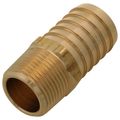


Hose barb fittings are connectors with a ridged, tapered end designed to grip the inside wall of flexible tubing, holding the connection in place under pressure once a clamp is tightened over the joint. The ridges bite slightly into the tubing's interior surface, resisting the tubing's tendency to slip off under vibration, pressure surges, or routine handling. These fittings show up across plumbing, HVAC condensate lines, irrigation setups, and general mechanical work wherever flexible tubing needs to connect to rigid pipe, a pump, or another fitting. Barb size has to match the tubing's inside diameter closely, since a barb that is too small will leak past the ridges and one that is too large can split the tubing during installation. Material selection, typically brass, plastic, or stainless steel, depends on the fluid being carried, the operating pressure, and whether the fitting will see outdoor exposure or chemical contact.
Subcategories
- Brass Hose Barb Fittings: Brass barbs offer strong corrosion resistance and hold up well under higher pressure and temperature than most plastic alternatives. They are a common choice for potable water, fuel lines, and general mechanical applications where durability matters. Threaded brass barb ends typically use standard NPT pipe thread for connecting to rigid piping.
- Plastic Hose Barb Fittings: Plastic barbs, usually nylon or polypropylene, cost less than metal options and resist corrosion from many chemicals that would degrade brass over time. They are common in irrigation, condensate drain lines, and lower-pressure applications where metal's added strength is not required. Plastic barbs are more prone to cracking under over-tightened clamps than metal equivalents.
- Hose Barb Elbows: Barb elbows change direction at a connection point, typically ninety degrees, letting tubing route around an obstruction or into a tight space without a sharp kink that would restrict flow. They use the same ridge-and-clamp design as straight barbs on each leg of the fitting. Elbow barbs are useful anywhere tubing needs to turn a corner close to a pump, tank, or appliance connection.
- Hose Barb Reducers: Reducing barbs step down from a larger tubing size to a smaller one within a single fitting, useful when connecting mismatched tubing diameters without adding a separate coupling. They maintain the same ridge design on each end, sized to its respective tubing diameter. Reducers are common where a pump or appliance outlet size does not match the tubing already run in a system.
Buying Guide
Matching barb size to tubing inside diameter is the first and most important step when selecting hose barb fittings. A barb sized too small for the tubing will not seal properly even with a clamp tightened down, while one sized too large risks splitting the tubing during installation, especially with stiffer or older tubing that has lost some flexibility.
Material selection should follow the application. Brass barbs handle higher pressure and temperature and resist corrosion well, making them the common choice for potable water and fuel line applications, while plastic barbs cost less and resist certain chemicals better, fitting irrigation and condensate drain applications where pressure and temperature stay moderate. Stainless steel barbs are worth the added cost in applications with aggressive chemical exposure or where corrosion resistance beyond brass is needed.
Clamp selection finishes the connection and should not be an afterthought. A worm-gear clamp works for most general-purpose barb connections, but higher-pressure or vibration-prone applications often call for a spring clamp or a crimp-style band for a more consistent, permanent hold. Checking that the clamp width matches the barb's shoulder, rather than sitting over the ridges themselves or too far back on plain tubing, keeps the connection from leaking under normal operating pressure.
Frequently Asked Questions
How is the correct hose barb size chosen for a given tubing?
Barb size should match the tubing's inside diameter as closely as possible, since a barb that is too small will not seal against the tubing wall and one that is too large risks tearing the tubing during installation. Measuring the tubing's inside diameter directly, rather than estimating from the outside diameter, gives the most reliable match.
Does a hose barb fitting need a clamp to hold under pressure?
Yes, in nearly every application a clamp is needed over the barbed section to keep the tubing from working loose under pressure, vibration, or temperature cycling. The barb ridges alone provide grip but are not typically rated to hold a pressurized connection without a clamp reinforcing the joint.
What is the difference between brass and plastic hose barb fittings?
Brass barbs handle higher pressure and temperature and resist general corrosion well, making them suitable for potable water and fuel line work. Plastic barbs cost less and resist many chemicals that would attack brass, which makes them common in irrigation and condensate drain applications with lower pressure and temperature demands.
Can a hose barb reducer replace a separate coupling when tubing sizes do not match?
Yes, a reducing barb connects two different tubing diameters in a single fitting, which is usually simpler than adapting with a separate coupling and two matched barbs. It is a common solution when a pump or appliance outlet size differs from the tubing already installed.
Why do plastic hose barbs sometimes crack during installation?
Plastic barbs are more brittle than metal, so over-tightening a clamp or forcing stiff, cold tubing over the ridges too quickly can crack the fitting. Warming the tubing slightly and using a clamp torqued to the manufacturer's recommendation reduces the risk of cracking during installation.
