




Photocontrols


 --%3E %3Csvg version='1.1' id='Fill' xmlns='http://www.w3.org/2000/svg' xmlns:xlink='http://www.w3.org/1999/xlink' x='0px' y='0px' viewBox='0 0 100 100' enable-background='new 0 0 100 100' xml:space='preserve'%3E %3Cpath fill='%23F15C02' d='M79.44,0.95H20.56C9.78,0.95,0.95,9.78,0.95,20.56v58.87c0,10.79,8.82,19.61,19.61,19.61h58.87 c10.79,0,19.61-8.83,19.61-19.61V20.56C99.05,9.78,90.22,0.95,79.44,0.95z M65.38,58.24l9.38,29.58L49.69,69.78L24.5,87.82 l9.34-29.6L8.8,39.6l30.73-0.17c0,0,6.98-19.61,10-28.93c0.54,1.36,9.88,29.1,9.88,29.1H91.2L65.38,58.24z'/%3E %3C/svg%3E)



 --%3E %3Csvg version='1.1' id='No-RB' xmlns='http://www.w3.org/2000/svg' xmlns:xlink='http://www.w3.org/1999/xlink' x='0px' y='0px' viewBox='0 0 100 100' enable-background='new 0 0 100 100' xml:space='preserve'%3E %3Cpath fill='%23CECECE' d='M79.44,0.95H20.56C9.78,0.95,0.95,9.78,0.95,20.56v58.87c0,10.79,8.82,19.61,19.61,19.61h58.87 c10.79,0,19.61-8.83,19.61-19.61V20.56C99.05,9.78,90.22,0.95,79.44,0.95z M65.38,58.24l9.38,29.58L49.69,69.78L24.5,87.82 l9.34-29.6L8.8,39.6l30.73-0.17c0,0,6.98-19.61,10-28.93c0.54,1.36,9.88,29.1,9.88,29.1H91.2L65.38,58.24z'/%3E %3C/svg%3E)


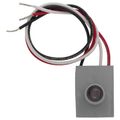





Photocontrols are light-sensing devices that automatically switch outdoor lighting on at dusk and off at dawn by responding to the ambient light level around a photocell sensor. Electricians install them on area lighting, security fixtures, and streetlights so the connected lights operate without a manual switch or a separate timer that needs seasonal adjustment. Most photocontrols mount into a twist-lock receptacle built into the fixture itself, though hardwired versions are also common on fixtures without a receptacle base. Because the device reacts to actual light conditions rather than a fixed schedule, it keeps lighting synced with sunrise and sunset throughout the year without any reprogramming. That makes photocontrols a common fixture in commercial parking lot lighting and residential outdoor security lighting alike, wherever dusk-to-dawn operation is the goal.
Subcategories
- Twist-Lock Photocontrols: Twist-lock photocontrols plug into a standardized receptacle base built into many outdoor fixtures, letting an electrician swap a failed unit in a few seconds without touching any wiring. These are the most common style on streetlights, floodlights, and area lighting fixtures already built with a compatible receptacle.
- Hardwired Photocontrols: Hardwired photocontrols connect directly into a fixture's wiring rather than plugging into a receptacle, which suits fixtures that weren't built with a twist-lock base. Installers use these on retrofit projects or smaller fixtures where adding a separate receptacle isn't practical.
- Photocontrol Receptacles and Shorting Caps: Receptacles provide the mounting base a twist-lock photocontrol plugs into, while shorting caps temporarily bypass a photocontrol so a fixture can be tested or run continuously during troubleshooting. Electricians keep both on hand for fixture installations and diagnostic work in the field.
Buying Guide
Matching the photocontrol's voltage rating to the fixture's electrical system is the first step in choosing the right one. Photocontrols are built for specific voltage ranges, and installing one rated for the wrong voltage can prevent the device from switching properly or damage the fixture it's controlling.
Deciding between a twist-lock and a hardwired photocontrol depends on what the fixture already has. A fixture built with a twist-lock receptacle should use a matching twist-lock photocontrol for a quick, tool-free installation, while a fixture without a receptacle base needs a hardwired unit connected directly into the wiring.
Load capacity matters when a photocontrol is switching a higher wattage fixture or multiple fixtures at once. Checking the connected load against the photocontrol's rated switching capacity avoids overloading the device, which can shorten its service life or cause it to fail prematurely.
Turn-on and turn-off light-level sensitivity varies between photocontrol models, and some are designed to resist false triggering from headlights, lightning, or other brief light sources. For fixtures in locations with heavy vehicle traffic or frequent storms, a model built to resist that kind of interference reduces nuisance switching.
Buying a photocontrol rated for outdoor use and sealed against moisture protects it against the weather exposure it will face on an exterior fixture. Keeping a spare on hand for commonly used fixture types speeds up replacement when a photocontrol eventually reaches the end of its service life.
Frequently Asked Questions
How does a photocontrol turn lights on and off automatically?
A photocontrol contains a light-sensitive photocell that reacts to the ambient light level around it. As it gets dark, the photocell signals the device to switch the connected light on, and it switches back off once enough daylight returns.
What's the difference between a twist-lock and a hardwired photocontrol?
A twist-lock photocontrol plugs into a standardized receptacle base built into many outdoor fixtures, allowing tool-free installation and replacement. A hardwired photocontrol connects directly into the fixture's wiring instead, which suits fixtures without a receptacle base.
Why is my photocontrol keeping the light on during the day?
A photocontrol stuck in the on position during daylight often indicates the photocell has failed or is being shaded, blocking it from sensing daylight properly. Checking for physical obstruction or debris covering the sensor is a good first troubleshooting step before replacing the unit.
Can one photocontrol operate multiple light fixtures?
A photocontrol can operate multiple fixtures as long as the combined electrical load of all the connected fixtures stays within the photocontrol's rated switching capacity. Exceeding that rated capacity can cause the device to fail prematurely.
What is a shorting cap used for with photocontrols?
A shorting cap plugs into a twist-lock receptacle in place of the photocontrol and bypasses it, allowing a fixture to run continuously regardless of ambient light. Electricians use shorting caps for testing a fixture or keeping it lit while a replacement photocontrol is ordered.
