




Filters
SORT
Product Availability –
Brand –
Product Type –
Refrigerant Type –
Energy Star Rated –
Cooling Capacity (BTU) –
Heating Capacity (BTU) –
SEER2 –
EER2 –
Review Score –
 --%3E %3Csvg version='1.1' id='Fill' xmlns='http://www.w3.org/2000/svg' xmlns:xlink='http://www.w3.org/1999/xlink' x='0px' y='0px' viewBox='0 0 100 100' enable-background='new 0 0 100 100' xml:space='preserve'%3E %3Cpath fill='%23F15C02' d='M79.44,0.95H20.56C9.78,0.95,0.95,9.78,0.95,20.56v58.87c0,10.79,8.82,19.61,19.61,19.61h58.87 c10.79,0,19.61-8.83,19.61-19.61V20.56C99.05,9.78,90.22,0.95,79.44,0.95z M65.38,58.24l9.38,29.58L49.69,69.78L24.5,87.82 l9.34-29.6L8.8,39.6l30.73-0.17c0,0,6.98-19.61,10-28.93c0.54,1.36,9.88,29.1,9.88,29.1H91.2L65.38,58.24z'/%3E %3C/svg%3E)
 --%3E %3Csvg version='1.1' id='With-RB' xmlns='http://www.w3.org/2000/svg' xmlns:xlink='http://www.w3.org/1999/xlink' x='0px' y='0px' viewBox='0 0 100 100' enable-background='new 0 0 100 100' xml:space='preserve'%3E %3Cpath fill='%23FBC8B4' d='M79.44,0.95H20.56C9.78,0.95,0.95,9.78,0.95,20.56v58.87c0,10.79,8.82,19.61,19.61,19.61h58.87 c10.79,0,19.61-8.83,19.61-19.61V20.56C99.05,9.78,90.22,0.95,79.44,0.95z M65.38,58.24l9.38,29.58L49.69,69.78L24.5,87.82 l9.34-29.6L8.8,39.6l30.73-0.17c0,0,6.98-19.61,10-28.93c0.54,1.36,9.88,29.1,9.88,29.1H91.2L65.38,58.24z'/%3E %3C/svg%3E)
Price Range –
Single Zone Mini Splits



 --%3E %3Csvg version='1.1' id='No-RB' xmlns='http://www.w3.org/2000/svg' xmlns:xlink='http://www.w3.org/1999/xlink' x='0px' y='0px' viewBox='0 0 100 100' enable-background='new 0 0 100 100' xml:space='preserve'%3E %3Cpath fill='%23CECECE' d='M79.44,0.95H20.56C9.78,0.95,0.95,9.78,0.95,20.56v58.87c0,10.79,8.82,19.61,19.61,19.61h58.87 c10.79,0,19.61-8.83,19.61-19.61V20.56C99.05,9.78,90.22,0.95,79.44,0.95z M65.38,58.24l9.38,29.58L49.69,69.78L24.5,87.82 l9.34-29.6L8.8,39.6l30.73-0.17c0,0,6.98-19.61,10-28.93c0.54,1.36,9.88,29.1,9.88,29.1H91.2L65.38,58.24z'/%3E %3C/svg%3E)







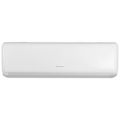


Single zone mini splits are ductless heating and cooling systems that pair one outdoor condensing unit with one indoor air handler, delivering conditioned air to a single room or open space without running ductwork. An inverter-driven compressor ramps output up and down to match the space's load rather than simply cycling on and off, which keeps temperature swings smaller than a standard on/off system produces. Cooling capacities on single zone systems commonly range from about 9,000 to 36,000 BTU/h, sized to the room or addition being conditioned.
They're a common fit for additions, garages, converted attics, and other spaces where extending existing ductwork isn't practical or would be too costly. Because the system only serves one zone, sizing and installation stay simpler than a multi-zone setup, which is part of why they show up so often on smaller remodel and addition jobs.
Subcategories
- Wall-Mounted Single Zone Systems: Wall-mounted indoor units are the most common single zone configuration, hanging high on an interior wall to keep floor and ceiling space clear. They work well in bedrooms, living rooms, and additions where a straightforward supply and return path is available. Their compact profile also makes them the easiest option to retrofit into an existing finished room.
- Ceiling Cassette Single Zone Systems: Ceiling cassette units mount flush into a drop or suspended ceiling, distributing air in multiple directions from a discreet grille instead of a wall-mounted unit. They're a common choice in commercial spaces or rooms where a wall-mounted unit would interfere with furniture layout or windows. Installation requires enough ceiling plenum depth to house the unit and its condensate line.
- Floor-Mounted Single Zone Systems: Floor-mounted indoor units sit low on the wall near the floor, which suits rooms with limited wall space above, sloped ceilings, or occupants who prefer air delivery closer to floor level. They're commonly specified in converted attics and rooms with low ceiling height where a wall-mounted unit wouldn't have adequate clearance. The lower mounting also simplifies service access for maintenance.
- Heat Pump Single Zone Systems: Heat pump single zone systems provide both heating and cooling from the same outdoor unit by reversing the refrigeration cycle, making them a common all-in-one solution for additions without existing furnace or boiler service. Contractors typically weigh a heat pump system's rated heating capacity against the local climate, since heating output drops as outdoor temperature falls. They're frequently paired with a backup heat source in colder regions.
- Cooling-Only Single Zone Systems: Cooling-only single zone systems handle air conditioning alone, without the reversing valve and added components a heat pump system requires. They're a straightforward fit for spaces that already have separate heating, such as a garage with electric baseboard heat, where only supplemental cooling is needed. Skipping the heating function typically keeps equipment cost lower than a comparable heat pump model.
Buying Guide
Start with an accurate load calculation for the room being conditioned rather than sizing by square footage alone. Ceiling height, insulation levels, window area, and sun exposure all affect the BTU/h a space actually needs, and an oversized single zone mini split will short-cycle while an undersized one won't keep up on the hottest or coldest days.
Decide between a cooling-only and a heat pump single zone mini split based on what heating already exists in the space. A garage or addition with no other heat source is usually better served by a heat pump model, while a room that already has a separate heat source may only need supplemental cooling.
Choose the indoor unit style to match the room layout. Wall-mounted units cover most standard rooms, ceiling cassettes suit spaces where a wall unit would be in the way, and floor-mounted units work well under low ceilings or where air delivery near floor level is preferred. Whichever style is chosen, confirm there's a clear path for the refrigerant line set and condensate drain between the indoor and outdoor units.
Check the outdoor unit's rated performance at low ambient temperatures if the system will be relied on for winter heating, since a heat pump's heating capacity and efficiency both decline as outdoor temperature drops. In colder climates, this often means sizing the outdoor unit with some margin or planning for backup heat.
Line set length and elevation change between the indoor and outdoor units matter too, since most manufacturers cap the maximum linear distance and vertical rise the system can handle while still performing to its rated specifications. Confirming those limits before the outdoor unit location is finalized avoids a costly relocation later in the job.
Frequently Asked Questions
What size single zone mini split do I need for a room?
Sizing depends on more than square footage alone. Ceiling height, insulation, window area, and sun exposure all factor into the load calculation, so it's best to size based on the room's actual heat gain and loss rather than a rule of thumb.
Can a single zone mini split heat a room in winter?
Yes, if it's a heat pump model rather than a cooling-only unit. Heat pump single zone systems reverse the refrigeration cycle to provide heat, though their heating output and efficiency drop as outdoor temperature falls.
What's the difference between a wall-mounted and ceiling cassette single zone system?
A wall-mounted unit hangs on an interior wall and is the more common, easier retrofit option. A ceiling cassette mounts flush into a drop ceiling and distributes air from a discreet grille, which suits rooms where a wall unit would interfere with furniture or windows.
Is a single zone mini split a good fit for a garage?
Yes, since a garage typically doesn't have existing ductwork and only needs to condition one space. A cooling-only unit works if the garage already has separate heat, while a heat pump model can handle both heating and cooling on its own.
How far can the refrigerant line set run between the indoor and outdoor unit?
Manufacturers set a maximum linear line set length and vertical elevation change for each system, so it's important to confirm those limits before finalizing where the outdoor unit will sit.
