



'/%3E%3C/svg%3E)
 --%3E %3Csvg version='1.1' id='Fill' xmlns='http://www.w3.org/2000/svg' xmlns:xlink='http://www.w3.org/1999/xlink' x='0px' y='0px' viewBox='0 0 100 100' enable-background='new 0 0 100 100' xml:space='preserve'%3E %3Cpath fill='%23F15C02' d='M79.44,0.95H20.56C9.78,0.95,0.95,9.78,0.95,20.56v58.87c0,10.79,8.82,19.61,19.61,19.61h58.87 c10.79,0,19.61-8.83,19.61-19.61V20.56C99.05,9.78,90.22,0.95,79.44,0.95z M65.38,58.24l9.38,29.58L49.69,69.78L24.5,87.82 l9.34-29.6L8.8,39.6l30.73-0.17c0,0,6.98-19.61,10-28.93c0.54,1.36,9.88,29.1,9.88,29.1H91.2L65.38,58.24z'/%3E %3C/svg%3E)
 --%3E %3Csvg version='1.1' id='Half' xmlns='http://www.w3.org/2000/svg' xmlns:xlink='http://www.w3.org/1999/xlink' x='0px' y='0px' viewBox='0 0 100 100' enable-background='new 0 0 100 100' xml:space='preserve'%3E %3Cg%3E %3Cpath fill='%23F15C02' d='M30.05,70.23l3.79-12.01L8.8,39.6l30.73-0.17c0,0,6.98-19.61,10-28.93c0.54,1.36,9.88,29.1,9.88,29.1h1.58 L93.71,7.18c-3.58-3.82-8.66-6.23-14.28-6.23H20.56C9.78,0.95,0.95,9.78,0.95,20.56v58.87c0,5.41,2.22,10.32,5.79,13.88 L30.05,70.23z'/%3E %3C/g%3E %3Cpath fill='%23FBC8B4' d='M93.71,7.18L60.98,39.6H91.2L65.38,58.24l9.38,29.58L49.69,69.78L24.5,87.82l5.55-17.59L6.75,93.32 c3.55,3.54,8.44,5.73,13.82,5.73h58.87c10.79,0,19.61-8.83,19.61-19.61V20.56C99.05,15.4,97.01,10.69,93.71,7.18z'/%3E %3C/svg%3E)


MANUALS (4)
'/%3E%3C/svg%3E)
Product Highlights


Description
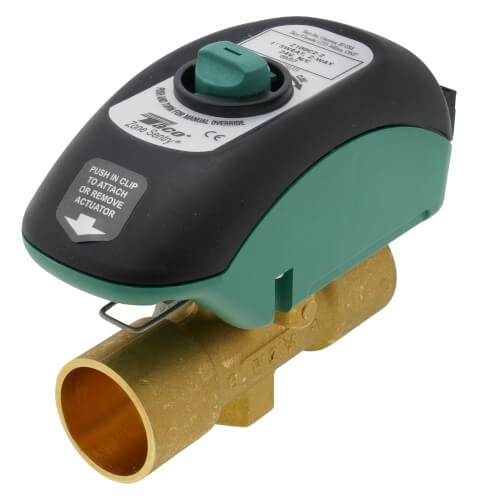
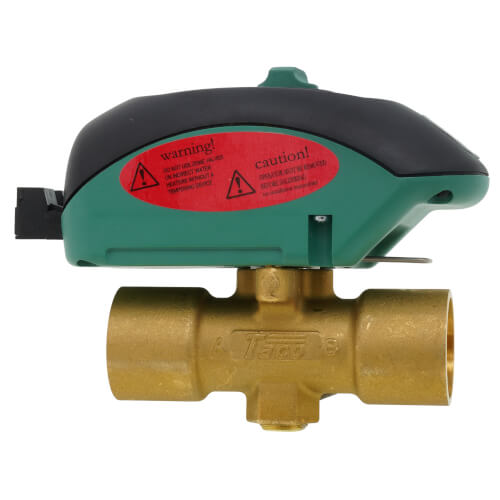
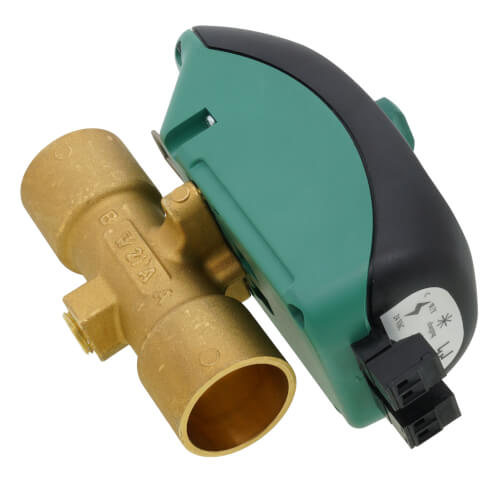
The Zone Sentry is the most technologically advanced zone valve ever made. It's also simple to install and operate. The valve can be installed in any direction, in any orientation. Taco then went a step further, allowing the operator to be mounted to the valve body in either direction (see Figure A of the manual in the "Manuals" tab), great for those tight baseboard jobs. Snap-in quick connects on the back of the valve make for a simple, secure and fast wiring hook-up. A green LED light shows full functionality of the valve's operation and thermostat status. Under a no power situation the manual override button located on the top of the valve allows the ball to be rotated up to 90° and is also marked with a slot to indicate the position of the valve.
Specs
| Application: | Zoning |
|---|---|
| Size: | 1" |
| Voltage: | 24 VAC |
| Connection Type: | Sweat |
| Hertz: | 60 |
| Flow Capacity (Cv): | 8.9 |
| Amperage: | 0.48 |
| Body Pattern: | 2-Way |
| Max Operating Pressure: | 300 psi |
| End Switch: | Yes |
| Position: | Normally Closed |
| Fluid Temperature Range: | 20°F to 220°F |

Questions?
Compare Similar Products

You May Also Need
1 Replacement Part

Need help finding a replacement part?
Product Reviews
Most Liked Positive Review
Easy to install and runs great.
Most Liked Negative Review
 --%3E %3Csvg version='1.1' id='With-RB' xmlns='http://www.w3.org/2000/svg' xmlns:xlink='http://www.w3.org/1999/xlink' x='0px' y='0px' viewBox='0 0 100 100' enable-background='new 0 0 100 100' xml:space='preserve'%3E %3Cpath fill='%23FBC8B4' d='M79.44,0.95H20.56C9.78,0.95,0.95,9.78,0.95,20.56v58.87c0,10.79,8.82,19.61,19.61,19.61h58.87 c10.79,0,19.61-8.83,19.61-19.61V20.56C99.05,9.78,90.22,0.95,79.44,0.95z M65.38,58.24l9.38,29.58L49.69,69.78L24.5,87.82 l9.34-29.6L8.8,39.6l30.73-0.17c0,0,6.98-19.61,10-28.93c0.54,1.36,9.88,29.1,9.88,29.1H91.2L65.38,58.24z'/%3E %3C/svg%3E)
got me halfway to a solution
not a full opening valve
yes
Perfect
Outstanding
Would recommend
Quality parts
Simple to install
Great quality
Perfect
Not what I expected.
Product Q&A
8 QuestionsQ: I am working on a design that will use 12 of these valves. I am using Taco HSS design software but this particular valve is not included in the preloads. Can you please tell me the Head loss and flow loss for this valve?
Asked by hotsauce 9 years ago
Add your answer
Verified Reply- SupplyHouse StaffThe 1/2" have a 4.9 cV.
Q: Can this valve be used in a potable water supply? Is it lead free?
Asked by Mike 11 years ago
Add your answer
Verified Reply- Supplyhouse Staffno, its not lead free
Q: Are your taco zone valves both 3/4 inch and 1 inch a full port valve?
Asked by Bill 13 years ago
Add your answer
They are NOT full port valve. The valve necks down the flow.
I used the 1" and I do not believe they are full port. I remember noticing that during installation. Working well though...
Yes they are.
No they are reduced port . Sent from my iPhone
I don't believe any of the ball type zone valves are full flow valves I think the Spec sheet will give you flow and friction loss data.
No, the port is quite a bit smaller than the pipe size. A 1" Zone Sentry ball valve is about 1/2" through the ball; a 3/4" is about 3/8". Taco's spec sheet shows the 3/4" is equivalent in restriction to 8.4 feet of pipe @ 4' per second, and the 1" to 47'. Tom Wills
The simple answer is, no they are not full port valves. However, the engineers will tell you the pressure drop, or flow rate loss across the valve is insignificant. I can't confirm or rebut the statistics, but I've had no problems in this regard.
I don't remember if they were 100% full but they had very big openings. Thanasis
Q: What's the VA of the 1" model? Thanks. Steve
Asked by Steve 14 years ago
Add your answer
The VA is 11.5.
I don't understand your question. If this is any help I trigger and operate these valves on 16/5 data wire up to 40 feet.
Hi, The ansure is aprox 11.5 VA See below How to convert VA to Watts and KVA to Kilowatts Basics Since watts is volts times amps, what is VA? VA (or volt-amps) is also volts times amps, the concept however has been extended to AC power. For DC current VA = Watts (DC current). In AC if the volts and amps are in phase (for example a resistive load) then the equation is also VA=Watts (resistive load) where V is the RMS voltage and A the RMS amperage. In AC the volts and amps are not always in phase (meaning that the peak of the voltage curve is does not happen at the peak of the current curve). So in AC, if the volts and amps are not precisely in phase you have to calculate the watts by multiplying the volts times the amps at each moment in time and take the average over time. The ratio between the VA (i.e. rms volts time rms amps) and Watts is called the power factor PF. VA·PF = Watts (any load, including inductive loads) In other words, volt-amps x power factor = watts. Similarly, KVA*PF = KW, Or kilovolt-amps times power factor equals kilowatts. Product Specifications: Maximum Operating Pressure: 300 PSI (2,100 kPa) Maximum Shutoff Pressure: 125 PSI (875 kPa) Fluid Temperature Range: 20° to 240°F, (-7° to 115°C) @ 135°F (57°C) ambient Service: Closed systems Optional open system configuration Up to 50% Glycol Ball Rotation Speed: Full Open to Full Close (90° turn), 5 seconds (after charge time) Full Close to Full Open (90° turn), 5 seconds (after charge time) Seat Leakage: Drop-Tight Close-Off Electrical Rating: 24 VAC, 60 HZ, 0.48 Amps Do not use more than 12 zone valves per 40VA transformer. Power Consumption, Charging: 11.4 Watts, 0.48 Amps Power Consumption, Power On: 1.44 Watts, 0.06 Amps Heat Anticipator Setting: 0.5 Amps End Switch Rating: 1 Amp @ 24 VA Rgds, D2
Do you mean as far as power draw goes? From what I remember it is something like 1/10 of regular valves. It is very low because it uses 10 seconds to charge a capacitor inside.
40va 24 volt
Q: What is the Life Expectancy of these valves?
Asked by nobelb 14 years ago
Add your answer
I installed these last year and have not had a problem. My installer indicated that he had a lot of success with these in the past.
I have had two installed for six months on hot water storage application. I havent seen any issues with the operation to date. I did have issues with the manual operation mode. Depsite following directions, when I intially operated the valve manually (per instructions) prior to wiring up, an internal plastic linkage failed. When I attempted to manually operate the other valve it was obvious that the second linkage would have broken. The root cause was that the ball valve was sticking when shipped, once I removed the operator and turned the valve stem once, the break away torque was a lot less for subsequent operations. Taco replaced the valve, but indicated that in their opinion, it was my fault.
the zone sentry valve actuator (green & black) is an improved model. The original (all black) actuators for ESP and EBV models had a high failure rate in the first few years. I have had no problem with the zone sentry model.
Check out the product review and Q&A for 3/4" Zone Sentry Zone Valve (Sweat) People have been using them for 4 years with no problems and the PEXSupply staff says life expectancy is 7-12 years.
very reliable valve, last from 8- 10 years+
The life expectancy seems to be bound by the ability of these valves to turn off after power is turned off. That means the capacitors storage. The previous generation lasted only 2 years. The new generation has 2x bigger capacitors so I expect it will last well more than 6 years. Even then you can just replace the head in 5 minutes. I am happy with them because they don't leak when they are off. Thanasis
We have seen no failures with the new design of the actuator, which is called the Zone Sentry and is what is pictured in the posting of your question. We have been getting these actuators to install on the older model valves when needed. Tom Wills Solar Consultants, Inc.
Q: What is the maximum flow rate of this valve?
Asked by 14 years ago
Add your answer
Verified Reply- PexSupply StaffAccording to the manufacturer, you would not want to exceed 8 GPM through the 1" valve. Velocity noise could result if you do.
Q: How do operate this valve as normally open?
Asked by 15 years ago
Add your answer
Verified Reply- PexSupply StaffIf you have this valve and want to operate it as normally open, you would need to use a ZB024Q4A1 valve head. Part V100T2A1ZB024Q4A1 is the 1" threaded normally open valve.
Order normally open controller
Q: What is the cycle time to open and close this valve?
Asked by Chuck 15 years ago
Add your answer
Verified Reply- PexSupply StaffThe cycle time for this valve is about 4 seconds.
20 seconds. In our setup they are not powered all of the time. It takes that long to carge the caps. in them.