



Filters
SORT
Product Availability –
Size –
Connection Type –
Position –
Body Pattern –
Review Score –
 --%3E %3Csvg version='1.1' id='Fill' xmlns='http://www.w3.org/2000/svg' xmlns:xlink='http://www.w3.org/1999/xlink' x='0px' y='0px' viewBox='0 0 100 100' enable-background='new 0 0 100 100' xml:space='preserve'%3E %3Cpath fill='%23F15C02' d='M79.44,0.95H20.56C9.78,0.95,0.95,9.78,0.95,20.56v58.87c0,10.79,8.82,19.61,19.61,19.61h58.87 c10.79,0,19.61-8.83,19.61-19.61V20.56C99.05,9.78,90.22,0.95,79.44,0.95z M65.38,58.24l9.38,29.58L49.69,69.78L24.5,87.82 l9.34-29.6L8.8,39.6l30.73-0.17c0,0,6.98-19.61,10-28.93c0.54,1.36,9.88,29.1,9.88,29.1H91.2L65.38,58.24z'/%3E %3C/svg%3E)
 --%3E %3Csvg version='1.1' id='With-RB' xmlns='http://www.w3.org/2000/svg' xmlns:xlink='http://www.w3.org/1999/xlink' x='0px' y='0px' viewBox='0 0 100 100' enable-background='new 0 0 100 100' xml:space='preserve'%3E %3Cpath fill='%23FBC8B4' d='M79.44,0.95H20.56C9.78,0.95,0.95,9.78,0.95,20.56v58.87c0,10.79,8.82,19.61,19.61,19.61h58.87 c10.79,0,19.61-8.83,19.61-19.61V20.56C99.05,9.78,90.22,0.95,79.44,0.95z M65.38,58.24l9.38,29.58L49.69,69.78L24.5,87.82 l9.34-29.6L8.8,39.6l30.73-0.17c0,0,6.98-19.61,10-28.93c0.54,1.36,9.88,29.1,9.88,29.1H91.2L65.38,58.24z'/%3E %3C/svg%3E)
Price Range –
Taco Zone Sentry Valves


 --%3E %3Csvg version='1.1' id='Half' xmlns='http://www.w3.org/2000/svg' xmlns:xlink='http://www.w3.org/1999/xlink' x='0px' y='0px' viewBox='0 0 100 100' enable-background='new 0 0 100 100' xml:space='preserve'%3E %3Cg%3E %3Cpath fill='%23F15C02' d='M30.05,70.23l3.79-12.01L8.8,39.6l30.73-0.17c0,0,6.98-19.61,10-28.93c0.54,1.36,9.88,29.1,9.88,29.1h1.58 L93.71,7.18c-3.58-3.82-8.66-6.23-14.28-6.23H20.56C9.78,0.95,0.95,9.78,0.95,20.56v58.87c0,5.41,2.22,10.32,5.79,13.88 L30.05,70.23z'/%3E %3C/g%3E %3Cpath fill='%23FBC8B4' d='M93.71,7.18L60.98,39.6H91.2L65.38,58.24l9.38,29.58L49.69,69.78L24.5,87.82l5.55-17.59L6.75,93.32 c3.55,3.54,8.44,5.73,13.82,5.73h58.87c10.79,0,19.61-8.83,19.61-19.61V20.56C99.05,15.4,97.01,10.69,93.71,7.18z'/%3E %3C/svg%3E)




 --%3E %3Csvg version='1.1' id='No-RB' xmlns='http://www.w3.org/2000/svg' xmlns:xlink='http://www.w3.org/1999/xlink' x='0px' y='0px' viewBox='0 0 100 100' enable-background='new 0 0 100 100' xml:space='preserve'%3E %3Cpath fill='%23CECECE' d='M79.44,0.95H20.56C9.78,0.95,0.95,9.78,0.95,20.56v58.87c0,10.79,8.82,19.61,19.61,19.61h58.87 c10.79,0,19.61-8.83,19.61-19.61V20.56C99.05,9.78,90.22,0.95,79.44,0.95z M65.38,58.24l9.38,29.58L49.69,69.78L24.5,87.82 l9.34-29.6L8.8,39.6l30.73-0.17c0,0,6.98-19.61,10-28.93c0.54,1.36,9.88,29.1,9.88,29.1H91.2L65.38,58.24z'/%3E %3C/svg%3E)


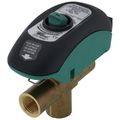
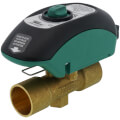
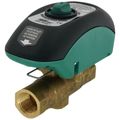
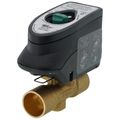
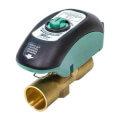


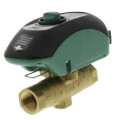
Taco Zone Sentry valves are electronically actuated zone valves used to control individual heating or cooling zones in closed hydronic systems. A gear-driven electronic actuator turns a ball-valve body, giving the valve a max operating pressure rating of 300 psi and a max shutoff pressure of 125 psi. Contractors use these valves on baseboard, fan coil, radiator, convector, air handler, heat pump, and radiant loops where reliable zone-by-zone shutoff matters as much as flow capacity.
Because the actuator draws less current than older synchronous-motor zone valves, a single 40VA transformer can run up to twelve Zone Sentry valves on one system, which simplifies wiring on multi-zone jobs. That efficiency, paired with a compact ball-valve body, makes the line a common replacement choice when a technician is troubleshooting a failed zone valve or designing a new zoned hydronic layout from scratch.
Subcategories
- Two-Way Normally Closed Valves: Two-way normally closed Zone Sentry valves stay shut until the zone calls for heat, then open to allow flow through the loop. Techs use this configuration on the majority of residential zoning jobs where each zone should default to off. The valve is available in 1/2 inch, 3/4 inch, and 1 inch connection sizes. It pairs directly with a standard zone thermostat and transformer setup.
- Two-Way Normally Open Valves: Normally open Zone Sentry valves stay open by default and close only when a zone should be shut off, which suits systems where one zone (like a boiler-protection loop) needs to keep flowing whenever the system runs. Contractors select this version for primary-secondary piping arrangements. Like the normally closed version, it is offered in 1/2 inch through 1 inch sizes. It uses the same ball-valve and actuator platform as the rest of the line.
- Three-Way Diverting Valves: Three-way diverting Zone Sentry valves route flow between two outlets instead of simply stopping and starting it, which is useful for systems that need to divert water between a zone loop and a bypass. Installers use these where a system needs continuous pump flow regardless of zone demand. The diverting body still uses the same gear-driven actuator as the two-way models. Sizing follows the same 1/2 inch to 1 inch range.
- Potable Water Zone Sentry Valves: The potable water version is rated for domestic water zoning rather than closed hydronic loops, so plumbers use it on systems like radiant floor loops that draw from the domestic supply. It is built on the same actuator platform but with materials suited to potable water contact. Contractors specify this version specifically when a job mixes domestic water with a zoned distribution layout. It is available in a 2-way configuration.
- Multi-Volt Zone Sentry Valves: Multi-volt Zone Sentry valves accept a range of input voltages instead of a single fixed voltage, which lets an installer use one valve model across systems wired at different control voltages. This reduces the number of distinct SKUs a contractor needs to stock for service calls. The multi-volt design still uses the same ball-valve body as the standard line. It is a common choice for service trucks that cover mixed equipment ages.
Buying Guide
Start with the flow configuration the job actually needs. Most residential zoning calls for a normally closed two-way valve, but primary loops, boiler-protection loops, and systems with a dedicated bypass often call for normally open or three-way diverting bodies instead. Getting this wrong means a zone that behaves backward from what the thermostat expects, so confirm the piping layout before ordering.
Next, match the connection size to the existing pipe run. Taco Zone Sentry valves are offered in 1/2 inch, 3/4 inch, and 1 inch sizes, and installing an undersized valve on a larger loop restricts flow across the whole zone. Oversizing wastes money without adding benefit, so measure the existing line rather than guessing from the boiler's rated output.
Check the transformer budget on the job before adding valves. Since the Zone Sentry design allows up to twelve valves per standard 40VA transformer, a small residential system usually has plenty of headroom, but a large multi-zone commercial retrofit can approach that limit fast. Count the total valves the transformer will need to power, including any existing valves already on the circuit, before adding more zones to an existing panel.
Decide whether the job needs a standard two-way body or a specialty variant. A domestic water zoning application calls for the potable water rated version, and a service truck stocking valves for buildings wired at different control voltages benefits from the multi-volt version instead of carrying several fixed-voltage models.
Finally, confirm sweat or threaded connections match how the rest of the system is piped, since mixing connection types mid-run adds unnecessary fittings and joints. A Taco Zone Sentry valve installed with the wrong connection style still works, but it adds labor and potential leak points that a correctly matched valve avoids.
Frequently Asked Questions
What is the difference between normally open and normally closed Zone Sentry valves?
A normally closed valve stays shut until its zone calls for heat, while a normally open valve stays open by default and closes only when that zone should be shut off. Most residential zoning uses normally closed valves, while primary loops or boiler-protection loops often need the normally open version.
How many Zone Sentry valves can run on one transformer?
Up to twelve Zone Sentry valves can be powered from a single standard 40VA transformer. On a large multi-zone job, count all valves on the circuit, including existing ones, before adding more to avoid overloading the transformer.
What sizes do Taco Zone Sentry valves come in?
The line is available in 1/2 inch, 3/4 inch, and 1 inch connection sizes across the two-way and three-way configurations. Match the size to the existing pipe run rather than the boiler's total output to avoid restricting flow.
When should a three-way diverting valve be used instead of a two-way valve?
A three-way diverting valve routes flow between two outlets instead of simply starting and stopping it, which suits systems that need continuous pump flow regardless of zone demand. A two-way valve is the right choice when a zone simply needs to turn on or off.
Is there a Zone Sentry valve rated for domestic water zoning?
Yes, the potable water Zone Sentry valve is built on the same actuator platform but uses materials suited for domestic water contact. It is the correct choice for radiant loops or other systems that draw directly from the potable water supply.
