




'/%3E%3C/svg%3E)
 --%3E %3Csvg version='1.1' id='Fill' xmlns='http://www.w3.org/2000/svg' xmlns:xlink='http://www.w3.org/1999/xlink' x='0px' y='0px' viewBox='0 0 100 100' enable-background='new 0 0 100 100' xml:space='preserve'%3E %3Cpath fill='%23F15C02' d='M79.44,0.95H20.56C9.78,0.95,0.95,9.78,0.95,20.56v58.87c0,10.79,8.82,19.61,19.61,19.61h58.87 c10.79,0,19.61-8.83,19.61-19.61V20.56C99.05,9.78,90.22,0.95,79.44,0.95z M65.38,58.24l9.38,29.58L49.69,69.78L24.5,87.82 l9.34-29.6L8.8,39.6l30.73-0.17c0,0,6.98-19.61,10-28.93c0.54,1.36,9.88,29.1,9.88,29.1H91.2L65.38,58.24z'/%3E %3C/svg%3E)


MANUALS (4)
'/%3E%3C/svg%3E)
Product Highlights


Description
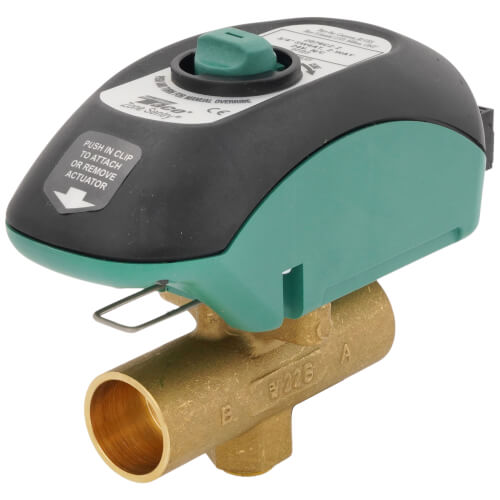
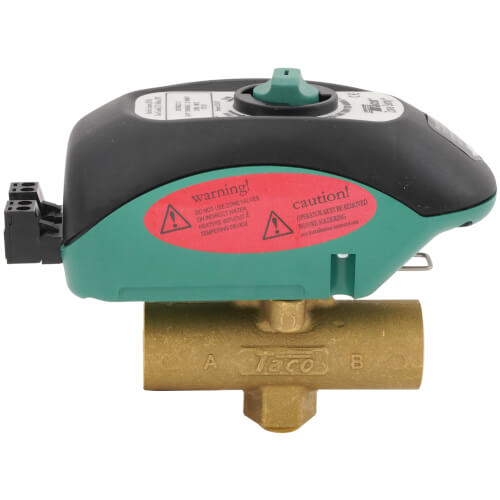
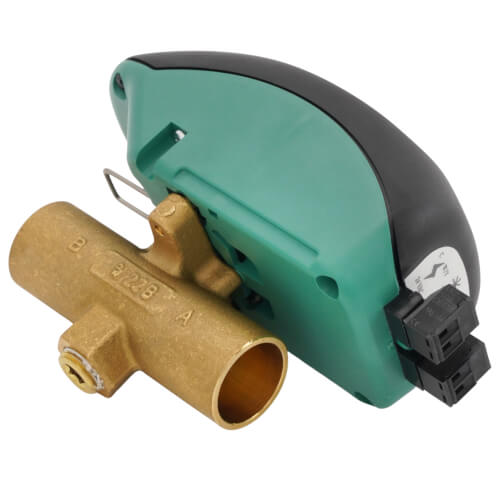
The Zone Sentry is the most technologically advanced zone valve ever made. It's also simple to install and operate. The valve can be installed in any direction, in any orientation. Taco then went a step further, allowing the operator to be mounted to the valve body in either direction (see Figure A of the manual in the "Manuals" tab), great for those tight baseboard jobs. Snap-in quick connects on the back of the valve make for a simple, secure and fast wiring hook-up. A green LED light shows full functionality of the valve's operation and thermostat status. Under a no power situation the manual override button located on the top of the valve allows the ball to be rotated up to 90° and is also marked with a slot to indicate the position of the valve.
Specs
| Application: | Zoning |
|---|---|
| Size: | 3/4" |
| Voltage: | 24 VAC |
| Connection Type: | Sweat |
| Hertz: | 60 |
| Amperage: | 0.48 |
| Flow Capacity (Cv): | 10.3 |
| Max Operating Pressure: | 300 psi |
| Body Pattern: | 2-Way |
| Fluid Temperature Range: | 20°F to 220°F |
| Position: | Normally Closed |
| End Switch: | Yes |

Questions?
Compare Similar Products

You May Also Need
1 Replacement Part

Need help finding a replacement part?
Product Reviews
Most Liked Positive Review
Great product
Most Liked Negative Review
 --%3E %3Csvg version='1.1' id='With-RB' xmlns='http://www.w3.org/2000/svg' xmlns:xlink='http://www.w3.org/1999/xlink' x='0px' y='0px' viewBox='0 0 100 100' enable-background='new 0 0 100 100' xml:space='preserve'%3E %3Cpath fill='%23FBC8B4' d='M79.44,0.95H20.56C9.78,0.95,0.95,9.78,0.95,20.56v58.87c0,10.79,8.82,19.61,19.61,19.61h58.87 c10.79,0,19.61-8.83,19.61-19.61V20.56C99.05,9.78,90.22,0.95,79.44,0.95z M65.38,58.24l9.38,29.58L49.69,69.78L24.5,87.82 l9.34-29.6L8.8,39.6l30.73-0.17c0,0,6.98-19.61,10-28.93c0.54,1.36,9.88,29.1,9.88,29.1H91.2L65.38,58.24z'/%3E %3C/svg%3E)
Cheap Plastic Manual Override
Worked perfectly
Installs Easily
Exact replacement fast delivery
Perfect customer service
I will continue to buy this product !
Working correctly
Work just fine
Used these to set up a new boiler
I will buy again and again !
First Time
Product Q&A
19 QuestionsQ: I currently have an older taco zone valve normally closed. EN024Q4A2. My control head is going bad. It is located downstream from my open loop Geo thermal. It opens to let the water discharge. I know I can by just your replacement head but am thinking of buying the whole valve assembly. Big price difference between the Geo Zone sentry and the others. Whats the major differences in the valve bodies? Are all the replacement heads the same[normally closed]Which one would you recommend?
Asked by JR 10 years ago
Add your answer
Verified Reply- SupplyHouse StaffThe components of the valve bodies are going to differ in materials and internal construction. The Geo-Sentry will be constructed to function in open or closed loop systems whereas a standard zone valve is only to be used in closed loop systems. Some changes to the valve materials will allow the Geo-Sentry to be used in system fluids with concentrations of methanol or ethanol up to 25%. If you have an open loop Geo-Thermal system then you should be using a Geo-Sentry zone valve.
Q: can I use this to control a potable water supply
Asked by sam 10 years ago
Add your answer
Verified Reply- SupplyHouse StaffThis valve is not approved for use in a potable water supply system. A potable alternative valve would be the V075C2D2ZA024Q4A1 valve: http://www.supplyhouse.com/Taco-V075C2D2ZA024Q4A1-3-4-Normally-Closed-Potable-Water-Zone-Sentry-Valve-Sweat
Q: Does a 3/4 inch copper pipe fit inside or outside of the 3/4 inch valve?
Asked by Ant 11 years ago
Add your answer
Inside...it is essential to protect the valve from excessive heat during the sweating process. Concentrate the heat away from the valve body and use a wet rag around the brass body part to dissipate excessive heat from harming the valve.
Q: Is the bottom port of this valve normally open, or normally closed?
Asked by snowman 11 years ago
Add your answer
Verified Reply- SupplyHouse StaffThis valve is in the normally closed position.
Q: I'm confused about the orientation described in the installation manual that says that the value can only be oriented +/- 85 degrees for chilled water applications. I want to orient the valve vertically so that the chilled water flows upward. Is this acceptable?
Asked by Ed 11 years ago
Add your answer
Verified Reply- SupplyHouse StaffYes this valve can be installed vertically.
Q: Would I be able to use these Sentry valves (threaded) in place of a Taco 571 zone valve. (i am redoing my system and am looking for a threaded zone valve) Thank you.
Asked by john 11 years ago
Add your answer
You can. ..system would have to be rewired because the 571 is a 3 wire and the newsentry valve uses 4 wires. Sent from my Verizon Wireless 4G LTE smartphone
I think the valve would work OK, but it is motor driven and make some noise when it operates. So if quiet operation is necessary, the thermal actuator in the Taco valve will be much quieter. Don S.
Q: Can this be installed outdoors for irrigation in a foggy area? Will moisture/condensation affect operation?
Asked by Omar 12 years ago
Add your answer
Yes. I'm sure moisture would affect the valve.
I have not used this valve in a condensing environment, and would not recommend it. It has an electronic circuit board inside which is likely prone to problems with condensate present.
I would not install outside. does have a circuit board Sent from Windows Mail
Q: My new baseboard hydronic heating system has 1/2" Supply and Return lines (increased through the 3/4" Slant Fin Baseboard then reduced). What size Taco Sentry Zone valve should I purchase 1/2" or 3/4"? I was thinking 3/4" to get more flow/pressure.
Asked by Rick 12 years ago
Add your answer
3/4 will have less pressure drop then the 1/2" will. Cost difference is minimal.
1/2" are fine. Your system will be limited by the 1/2" tube so that you don't have velocity noise. Up sizing just the valves won't gain ya much.
yes do the 3/4 because it is smaller than 3/4 thru the valve Sent from Windows Mail
Go with the ¾.
I am using a 3/4 valve which has a nearly straight through path, so the pressure drop introduced by the valve is minimal. Assuming the construction of the 1/2 valve is similar, it would perform as well as the 3/4 in your application. So you would not likely get more flow with the 3/4 valve. Don
Since the supply and return line is 1/2" there is no advantage to buying 3/4" valves. Besides the fluid must remain in the finned baseboard unit for effective heat transfer so a slow circulation may not be an issue.
Your statement " I was thinking 3/4" to get more flow/pressure." IMO the flow/volume and pressure is controlled already by the 1/2" supply and return lines. Changing the size of the Taco valve will have little impact. I would just match the existing line size (1/2") and avoid the additional sweat joints
If there is not to much price difference I would go with the 3/4" but I expect the pressure drop on the 1/2" would be very minimal give the low flow rate through each rad. Sent from my Android phone using TouchDown (www.nitrodesk.com)
Hi, It doesn't sound like your system designer knows what he is doing. 1/2 inch copper is probably inadequate for heat system distribution. Putting in 3/4 inch zone valve(s) will not make any real difference. Good luck!
The circulator pump dictates flow - All residential hydronic systems run on 12PSI. The only effect the 1/2" has is the amount of gpm that it can carry. What dictates btu/hr? Simply gpm x Delta-T x 500 = Btu/hr delivered. Typical residential hydronic systems are designed for a 20 Degree Delta-T, the numnber 500 represents the weight of 1 gallon of water x 60 minutes rounded up. Max flow rate through 1/2" copper is 3gpm 3 x 20 x 500 = 30,000 Btu/hr Does that zone require more then 30,000 btu/hr? The only effect using a 3/4" Zone Valve is the pressure drop across it is less. If the pump is a Taco 007 the difference btwen a 1/2" and 3/4" valve is irrelevant.
Q: Can I use this valve to replace a Taco valve model 5101G? Thanks.
Asked by Jerry 12 years ago
Add your answer
Verified Reply- SupplyHouse StaffThe 5101G can be used in open systems, while this zone sentry should not. V075C2G2ZA024Q4A1 would be the zone sentry equivalent.
Q: Is the threaded version of this valve a female NPT or male NPT ?
Asked by Ken 15 years ago
Add your answer
The valve is female NPT.
It is a female thread.
It is a female NPT " National Pipe Thread"
Female NPT
female
Sorry I was not on this email last eve, to answer the question the fitting is "female pipe thread". These valves are wonderful and a major improvement over the old "heat motor" style valves. They have become the "valve of choice" for all my hydronic and geothermal applications that require a motorized valve.
The valve housing, is "female NPT" it is designed to mate with "male" threaded pipe, or other fittings.
female NPT
Female NPT
It's female thread.