




Veris Temperature Controllers

 --%3E %3Csvg version='1.1' id='No-RB' xmlns='http://www.w3.org/2000/svg' xmlns:xlink='http://www.w3.org/1999/xlink' x='0px' y='0px' viewBox='0 0 100 100' enable-background='new 0 0 100 100' xml:space='preserve'%3E %3Cpath fill='%23CECECE' d='M79.44,0.95H20.56C9.78,0.95,0.95,9.78,0.95,20.56v58.87c0,10.79,8.82,19.61,19.61,19.61h58.87 c10.79,0,19.61-8.83,19.61-19.61V20.56C99.05,9.78,90.22,0.95,79.44,0.95z M65.38,58.24l9.38,29.58L49.69,69.78L24.5,87.82 l9.34-29.6L8.8,39.6l30.73-0.17c0,0,6.98-19.61,10-28.93c0.54,1.36,9.88,29.1,9.88,29.1H91.2L65.38,58.24z'/%3E %3C/svg%3E)


 --%3E %3Csvg version='1.1' id='Fill' xmlns='http://www.w3.org/2000/svg' xmlns:xlink='http://www.w3.org/1999/xlink' x='0px' y='0px' viewBox='0 0 100 100' enable-background='new 0 0 100 100' xml:space='preserve'%3E %3Cpath fill='%23F15C02' d='M79.44,0.95H20.56C9.78,0.95,0.95,9.78,0.95,20.56v58.87c0,10.79,8.82,19.61,19.61,19.61h58.87 c10.79,0,19.61-8.83,19.61-19.61V20.56C99.05,9.78,90.22,0.95,79.44,0.95z M65.38,58.24l9.38,29.58L49.69,69.78L24.5,87.82 l9.34-29.6L8.8,39.6l30.73-0.17c0,0,6.98-19.61,10-28.93c0.54,1.36,9.88,29.1,9.88,29.1H91.2L65.38,58.24z'/%3E %3C/svg%3E)
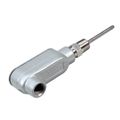
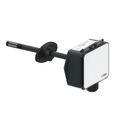

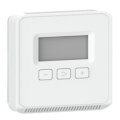
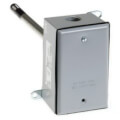
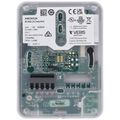
Veris Temperature Controllers are sensing devices used in commercial building automation systems to measure air and surface temperature for heating, ventilation, and air conditioning control loops. The lineup covers wall-mounted room sensors, duct-mount probes, and discharge air sensors, each built around a thermistor or platinum RTD element that feeds a building automation system or local controller. One confirmed model, the Veris TED00, uses a 10k Ohm Type 2 NTC thermistor housed in a wall-mount ABS enclosure rated for an operating range from negative 25 to 105 degrees Celsius. Contractors servicing commercial HVAC, hydronic, and building automation installations rely on these sensors to replace failed units or complete new control panel wiring. Because thermistor type and resistance value must match the controller's input configuration, selecting the correct model keeps a control loop reading accurately and prevents nuisance faults in zone temperature control.
Subcategories
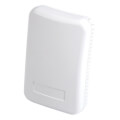
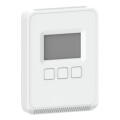
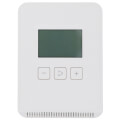
- Wall Temperature Sensors: Wall-mounted sensors like the Veris TED00 install into a standard duplex wall box and read room air temperature for space heating and cooling control loops. Building automation technicians use these in offices, schools, and retail spaces where a discreet low-profile housing matters. The TED00 uses a 10k Ohm Type 2 NTC thermistor with an operating range from negative 25 to 105 degrees Celsius. Flush and surface mounting options let the same sensor family fit new construction or retrofit walls.
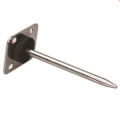
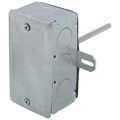
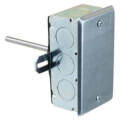
- Duct Temperature Sensors: Duct-mount sensors such as the Veris TFDHR00 insert directly into ductwork to monitor supply or return air temperature across an air handling unit. Mechanical contractors use these when a building automation system needs a temperature reading taken from the moving airstream rather than a wall location. The TFDHR00 ships with an 8 inch probe and mounting box and uses a 10k Ohm NTC Type 3 thermistor. Stainless steel probe construction holds up to continuous airflow and condensation inside the duct.
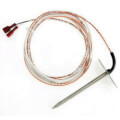
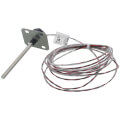
- Discharge Air Sensors: Discharge air sensors, including the Veris TJBDR03, mount at the discharge side of an air handler or rooftop unit to track the temperature of air leaving the equipment. Commissioning technicians use these readings to confirm a unit is heating or cooling to setpoint before handoff. The TJBDR03 pairs a 4 inch probe with a 10 foot cable and a 10k Ohm NTC Type 2 thermistor. A pre-wired cable speeds installation in tight mechanical rooms.
- Humidity and Temperature Combination Sensors: Combination sensors bundle a temperature element with a humidity sensor in a single wall-mounted housing, reducing the number of devices a technician has to wire into a control panel. Facility teams specify these where a building automation point list calls out both readings from the same zone, such as hospitals or labs with humidity requirements. Mounting matches the standalone TE series temperature sensors, using the same wall box footprint. One enclosure replaces two separate devices on the wall.
Buying Guide
Choosing the right sensor starts with identifying what the existing or specified building automation system expects as an input signal. Thermistor type, typically NTC Type 2 or Type 3, and resistance value such as 10k Ohm must match the controller's programmed input, or readings will be inaccurate even though the sensor is wired correctly. Confirm this value against the control sequence or the original equipment cut sheet before ordering a replacement.
Next, match the mounting style to the physical location. A wall sensor fits a duplex box in occupied space, a duct sensor needs probe length sized to the ductwork depth, and a discharge air sensor with a pre-wired cable suits tight mechanical room clearances where a hardwired junction box is impractical. Veris Temperature Controllers cover all three mounting styles within compatible thermistor families, which simplifies standardizing on one sensor line across a building.
Operating range matters on exterior-adjacent ducts or unconditioned mechanical spaces, where a sensor needs to perform across a wide temperature swing without drift. Confirm enclosure material, ABS plastic for wall units and stainless steel for duct probes, holds up to the installation environment, including exposure to cleaning chemicals or condensation.
Finally, verify wiring gauge and cable length against the run from sensor to controller to avoid signal loss on long runs, especially in sensors using remote probes with fixed cable lengths.
Frequently Asked Questions
What thermistor type do Veris Temperature Controllers use?
Veris Temperature Controllers use NTC thermistors in Type 2 or Type 3 configurations, most commonly rated at 10k Ohm resistance. Matching the thermistor type to the building automation system's input configuration keeps temperature readings accurate.
Can a duct sensor replace a wall sensor in the same control point?
Duct sensors and wall sensors read temperature from different locations and are not interchangeable within a control point. A duct sensor measures airstream temperature inside ductwork while a wall sensor measures room air, so the application determines which style a project requires.
What operating range do Veris Temperature Controllers handle?
Operating range depends on the specific model, with wall sensors like the Veris TED00 rated from negative 25 to 105 degrees Celsius. Checking the manufacturer cut sheet for a given model confirms the exact range before installation in an unconditioned space.
How long are the probes on duct and discharge air sensors?
Probe length varies by application, with common options including 4 inch and 8 inch probes depending on duct depth and mounting location. Discharge air sensors often pair a shorter probe with a pre-wired cable, such as a 10 foot length, for easier routing to a controller.
Do Veris Temperature Controllers work with any building automation system?
Compatibility depends on matching the sensor's thermistor type and resistance value to the input the building automation controller expects. Confirming these electrical specifications against the controller manufacturer's documentation prevents mismatched readings after installation.
