



'/%3E%3C/svg%3E)
 --%3E %3Csvg version='1.1' id='Fill' xmlns='http://www.w3.org/2000/svg' xmlns:xlink='http://www.w3.org/1999/xlink' x='0px' y='0px' viewBox='0 0 100 100' enable-background='new 0 0 100 100' xml:space='preserve'%3E %3Cpath fill='%23F15C02' d='M79.44,0.95H20.56C9.78,0.95,0.95,9.78,0.95,20.56v58.87c0,10.79,8.82,19.61,19.61,19.61h58.87 c10.79,0,19.61-8.83,19.61-19.61V20.56C99.05,9.78,90.22,0.95,79.44,0.95z M65.38,58.24l9.38,29.58L49.69,69.78L24.5,87.82 l9.34-29.6L8.8,39.6l30.73-0.17c0,0,6.98-19.61,10-28.93c0.54,1.36,9.88,29.1,9.88,29.1H91.2L65.38,58.24z'/%3E %3C/svg%3E)

MANUALS (4)
Product Highlights


Description
**Note: The HydroClaw Expansion Tank Support Bracket provides a safe and reliable option if you prefer to mount your expansion tank. This expansion tank bracket is easy to install and will hold any tank with a diameter of 11" nominal.
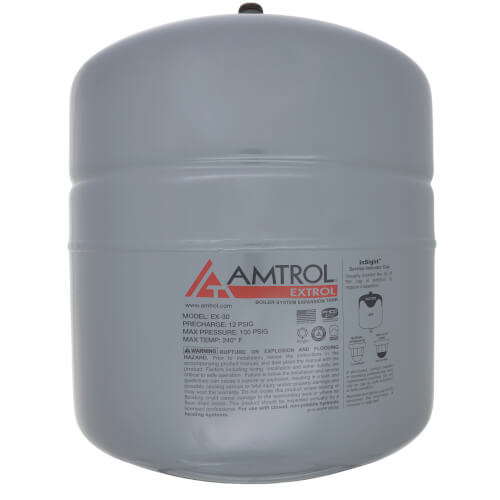
The Amtrol EX30 EXTROL Expansion Tank is designed to be installed in residential and commercial applications and it factory pre-charged to 12 PSIG. Though this expansion tank can be mounted horizontally this can cause a decrease in the products life.
Features:
- For use with closed hydronic heating and cooling systems
- Factory pre-charged to 12 psig
- Pre-charge should be adjusted to equal minimum operating pressure at tank location
- Accepts expanded water as system temperature rises to reduce pressure build-up.
- System connection sets the point of no pressure change
- Water-tight reservoir for expanded water
- Sealed air cushion - factory pre-charged and 100% tested
- Deep-drawn steel tank
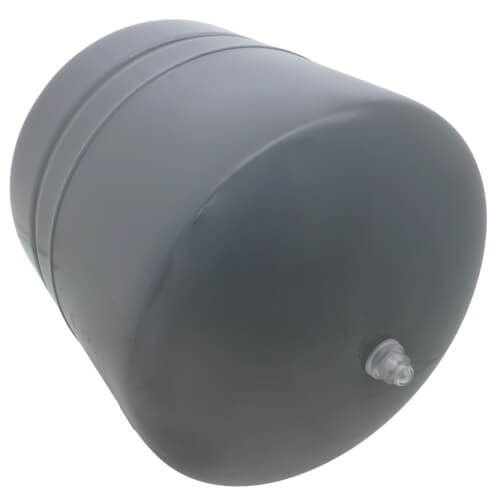
- Air stem for pre-charge adjustment
Specs
| Tank Volume: | 4.4 Gallons |
|---|---|
| Application: | Heating |
| Diameter (Inches): | 11" |
| Height (Inches): | 15.5" |
| Max Accepted Volume: | 2.5 Gallons |
| Warranty: | 5 Year |
| Max Pressure (PSI): | 100 |
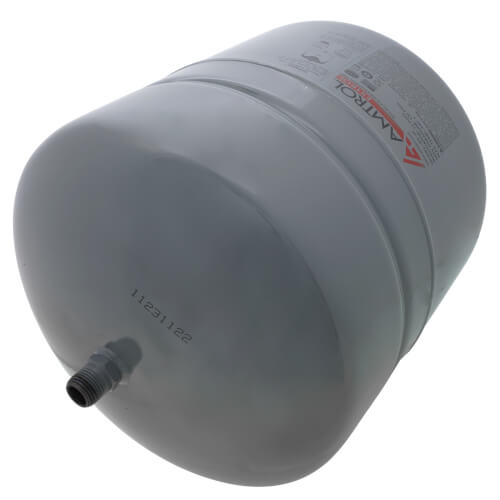
| Thread Type: | Male |
| Max Temp (F): | 240°F |
| Precharged PSI: | 12 psi |
| Thread Size: | 1/2" |


Questions?

Compare Similar Products
You May Also Need
Product Reviews
Most Liked Positive Review
 --%3E %3Csvg version='1.1' id='With-RB' xmlns='http://www.w3.org/2000/svg' xmlns:xlink='http://www.w3.org/1999/xlink' x='0px' y='0px' viewBox='0 0 100 100' enable-background='new 0 0 100 100' xml:space='preserve'%3E %3Cpath fill='%23FBC8B4' d='M79.44,0.95H20.56C9.78,0.95,0.95,9.78,0.95,20.56v58.87c0,10.79,8.82,19.61,19.61,19.61h58.87 c10.79,0,19.61-8.83,19.61-19.61V20.56C99.05,9.78,90.22,0.95,79.44,0.95z M65.38,58.24l9.38,29.58L49.69,69.78L24.5,87.82 l9.34-29.6L8.8,39.6l30.73-0.17c0,0,6.98-19.61,10-28.93c0.54,1.36,9.88,29.1,9.88,29.1H91.2L65.38,58.24z'/%3E %3C/svg%3E)
Quick and easy.
Most Liked Negative Review
good item
The industry standard.
I would buy this product again.
Absolutely
Great product
Expansion tank
Almost 5 Year Lifespan
Would buy this again
I will buy it again when this new expansion tank fails
I would buy again
Would buy this again
Product Q&A
37 QuestionsQ: I have a watts et-60. It seems to be discontinued. What do you have that would replace it?
Asked by Bill 8 years ago
Add your answer
Verified Reply- SupplyHouse StaffThe direct replacement for the Watts tank is SKU: 0066607
Q: The max accepted volume of the Amtrol 60 EXTROL is listed as 2.5 gallons vs. a total tank volume of 7.6. The Amtrol 30 EXTROL is also listed as having a max accepted volume of 2.5, but with a total tank volume of 4.4. Is this a typo?
Asked by Kevin 12 years ago
Add your answer
the tank has a diaphragm in it so a portion of the tank is separated and used for air pressure. on one end of the tank you will see a standard air inlet that you can add or release air from to adjust your back pressure.
No. See factory spec sheet at http://www.amtrol.com/media/documents/extrol/MC2680_01_14_EXTROL_Brochure.pdf. r/s
Q: what is diff #30 and RX-30? If I have both baseboard and radiant, do I need the RX-30 or can I just use the #30?
Asked by scott 12 years ago
Add your answer
RX 30 is specific to radiant heat. The internal bladder system is plastic ( polypropylene) and can withstand 200F temps. Corrosion is your concern, if you use the wrong parts in Rad heat system. #30 rubber bladder system, operating temp 240F, both max pressure around 100psi
Q: Hello, I have a Amtrol Extrol Model 30 Date code: 21224006 1) Is this compatible with our radiant floor system? 2) It is beginning to leak, it is 7yrs old installed with a Buderus system. Any suggestions? Thank you
Asked by Dan 12 years ago
Add your answer
I don't see why not, as long as it matches the old one. Sent from Yahoo Mail on Android
Unfortunately expansion tanks due tend to fail after only that long but it's not the system your using, your relief valve must have been popping also, I would just change it out with the same one and check the pressure in the boiler. Mike
Q: I apologize for lack of information about my system. the information on the name plate has worn off. when I bought my house many years ago the expansion tank already was on the system. I have a 30+ year old Weil-McClain boiler system and my house is 1100 sq. ft. and am not sure whether to use a #15 or a #30 expansion tank. the tank I have now is approximately 11 inch in height and approximately 11 inch in diameter and is a 12-lb pressure system with 100PSI and 240 degree max range. the tank is the same size as a 20 gallon propane tank and has worked fine for many years. will it make a difference which tank I buy? thank you, William
Asked by the dummy! 12 years ago
Add your answer
I'm using a No. 30. I have a peerless wbv-3 boiler so its a 3 section unit. I have about 1300sq ft house. No problems here.
recommend going to the Amtrol web-site and using their calculator for sizing of a thermal expansion tank. failing that, you may wish to contact their customer service, technical support, and they probably can run their calculator for you. it sounds like based on dimensions provided that your current expansion tank is equivalent to the S-30, but see caution below. 1985 data that I used to design my system indicated the S-15 Solar Extrol Tank “...is adequate for systems containing no more than five gallons of glycol-based fluid. Model 30 should be used on larger systems.” Caution – the 1985 data also indicates the maximum pressure of the S-15 or S-30 tank is 75 psi with a max temp of 240 deg F. r/s
I would use the #30 as long as you have the room ,it may cost a little more than the smaller one but it's worth it since it has more room for expansion and less chance of popping the relief valve, just make sure you get the one for boiler and not hot water heater Mike
William--You can always go larger without consequence. Too small can cause the pressure relief valve to open to discharge water from the boiler. #30 is the best choice. It is a few bucks more than a #15. There is a formula for sizing tanks. The volume of liquid, density of the liquid,(anti-freeze or water), fill temperature of the liquid and operating temperature of the liquid. Just go with the #30.
This web site has a calculator that will help you do the math. When you are taking responsibility for your system, read up on it :-) P.S. buy the larger one.
In order to keep the tank similar I would go with the #30. It sounds like the one you have on there now. Most residential systems came with that same size of expansion tank. I have the same one on my 30 year old system and have replaced it about 2 years agao, working fine. Good luck.
The size that you currently have and are describing is a #30. If you have copper fin tube baseboard a #15 is good up to 50, 000 btu's. If you have copper fin tube baseboard a #30 is good up to 150, 000 btu's. If you have copper fin tube baseboard a #60 is good up to 250, 000 btu's. If you have wall convectors or cast iron baseboard or radiators. ....the expansion tank sizes are different. Sent from my Samsung Galaxy Note® II
Here is a better explanation. Click on this link to Amtrols expansion tank brochure and look on the 2nd page under "Amtrol expansion tanks" the 3rd chart down. Select your boiler size and type of heating radiation to get the right size expansion tank. http://www.amtrol.com/media/documents/extrol/MC2680_04_12_EXTROL_Brochure.pdf Sent from my Samsung Galaxy Note® II
Q: what size expansion tank do i need for boiler wgo3 gold series
Asked by hank 13 years ago
Add your answer
Expansion tank size depends on total volume of water in the system. Most systems use the #30 size unless they are large volume systems like a house with cast iron steam radiators that has been converted from steam to forced hot water. Then you might use a #60 expansion tank. A WGO3 with regular forced hot water baseboard heat would typically use a #30 expansion tank. Sent from my Samsung Galaxy Note® II
It depends on what the boiler is used for (Hot water, radiators, radiant floor heat etc.) Read the following brochure from Amtrol on EXTROL expansion tanks. From your boiler's BTU/HR rating and what it's used for you can find out what tank to order. http://www.amtrol.com/media/documents/extrol/MC2680_04_12_EXTROL_Brochure.pdf
#30 extrol tank is fine
The quick method is - the tank is based on the total BTU output of boiler and the type of radiation ( finned baseboard or cast iron radiator or radiant panels etc..... ) Mike
Q: i just received my number #30 tank. i may need from 1" to 1-1/2" of clearance.the old tank was 8" diameter this one is 11"diameter. If I use a couple of short nipples and a couple of elbows to get clearance from the boiler wall,would it affect the function of the tank.
Asked by Lobo 13 years ago
Add your answer
Absolutely not Sent from Yahoo! Mail
It won't effect the function at all, just more potential for leaks having more fittings in between , I like to keep the least amount of connections In between. Mike
The short answer is no - it will not affect the function as long as boiler water can reach the tank. I've seen them put between ceiling joists.
Q: i have a weil- mclain the design of the boiler was certified in 1983.my expation tank is installed horizontal,no room to install vertical,boiler model #PHE-3 series-3, NG ,D.O.E. HTC.CAPACITY BTU/HR 55000, baseboard heating, 2 zones.max.w.p 55LB/HR.I used your size calculator the #15 tank diameter and capacity seems small, the #30 looks like my old one.Can i use the #30 and is the male nipple 1/2 inch thread a standart on all tanks?
Asked by Lobo 13 years ago
Add your answer
To clarify some of these answers - it was mentioned you have just cold in the tank, no water leak and no water out of valve when you test there. Tanks can go bad a couple of different ways: (1) you could have a bladder tear. In that case, the bladder doesn't hold pressure and you probably do get water out of the valve. (2) the tank body can fail and leak air (corrosion at a seam, pinholes from rust or mineral damage, etc) - in this case, you probably have no water coming out of the valve and you may or may not see water on exterior - depends where the leak is and how large - most likely it's not visible. Put a simple tire gauge on tank. If you're working on a closed system hydronic heat (typical boiler) and pressure is low or zero try to fill to 12-15 LBS with a compressor or push pump, etc. If it takes a charge check it every day, week, month and see if it is holding. If it holds, keep the tank. If it bleeds off, replace it. If the tank is on a domestic water heater with a check-valve to prevent back-flow, you should really get gauge on a garden hose nipple and check the water pressure there. Match the pressure in your tank to that pressure. Before you pump pressure into that tank you should open a hot water valve at a sink, shower, etc.,
The 15 would be enough for a 55000 btu boiler. You can use a 30 it will not cause any problems in operation. They are both a 1/2" ips threads. If it is installed horizontally I would recommend that you support the other end some how, When the tank gets water in it, can make it sag. Hope this helps Plumber63
I believe #30 tank is a good choice. It comes with 1/2" NPT connection Sent from my BlackBerry® PlayBook™ www.blackberry.com
Using a larger than called for expansion tank won't hurt things a bit - you can use a larger tank no problem. The threads are indeed ½" mpt and this is standard (at least on smaller residential sized tanks)
Q: tank about 10 years old. Relief valve opens when pressure reaches 30 psi. Expansion tank reads 15 psi and there is no hollow sound on the bottom. Top and bottom feel the same full of water. If so why is water not dripping from the shroeder valve when I take a measurement. Also tank is not getting hot, I assume it is because it is full of water and is not accepting the hot water. please comment back in particular when water is not coming out of the valve.
Asked by henry 13 years ago
Add your answer
The design of the expansion tank does not allow water to come out of the shrader valve because the water is confined in a rubber bladder. Sounds like your tank has lost it precharge. Need to remove pressure from input of expansion tank, then add pressurized air through the shrader valve to 15 pounds or whatever the operating pressure of your boiler is. If pressure will not hold, then the shrader valve or tank may have an air leak and the tank should be replaced.
I believe you need to replace the expansion tank - it should normally be empty and it obviously cannot take more water. I question why the pressure is building up to 30 PSI and the relief valve is opening. The relief valve should rarely, if ever open under normal conditions. You should check on the supply side to see if your inlet valve is working properly. I have a shut off valve on my supply and only open it when bleeding the radiators each fall. As for your shroeder valve - the pressure relief valve should operate first if needed. My shroeder valve has never operated except under test conditions and the pressure relief valve has only operated once when I overfilled the boiler. I would get a new tank and have the system checked.
In my tank's case, the water also did not come out of the valve. I knew the tank was not functioning because the pressure was going up to 30-40psi and the relief valve was working often. Also the sound was dull and the tank was cold even with the boiler on. The cost of this tank was only around $30 bucks and i just replaced and now the pressure is really nice at 12-15psi.
Tank is bad replace it
The expansion tank has a diaphragm between the water and shroeder valve so the water won't come out.
Q: Does it matter which direction is up or down. Does the air valve go on top or bottom , or does it matter? For a Extrol model 30 expansion tank.
Asked by bob 13 years ago
Add your answer
It does not matter how the tank is oriented Sent from my BlackBerry® PlayBook™ www.blackberry.com
Bob It doesn't matter I install mind with air valve onm bottom and it works find been installed for over 3yrs. no problem with it Andy
if one refers to the installation instructions for use with Solar EXTROL Expansion tanks, one finds the following: “TO INSTALL: SOLAR EXTROL may be installed into a tee or other suitable tapping anywhere on a solar heating system. It may be placed in a vertical or horizontal position. It may also be remotely located and piped to a convenient point on the system.” For piping and component location convenience and sound engineering practices, I installed my expansion tank vertically in the bottom of an AMTROL Air Purger Model #443 with an automatic air eliminator (Part #17130, Solar Components Corp., Manchester, NH) on top the purger, for 30 years, with no problems. See attached photo. I personally would not mount the expansion tank in the horizontal position nor with the air volume upwards for the simple reason one cannot vent all the air from the void against the internal bladder in these configurations. With the fluid connection up, the circulating fluid readily floods into the expansion tank against the bladder and air is readily removed by the purger / air eliminator (elimination of all air is necessary to allow the expansion tank to function correctly [maintaining net positive suction head on the circulating pump] and to minimize corrosion products from developing in the system. the above is supported by more detailed install instructions with: “An ideal SOLAR EXTROL installation is to screw it into the bottom of an American Air Purger located on the main. This combination offers both a mounting tapping and continuous automatic air removal from the system.” r/s
On YouTube you will see some tanks mounted with the opening 'down'. That is an improper installation. Any air in the system will congregate there and the tank will not do its job. The tank must be installed with the threaded opening up, so air does not gather there.
It does not matter the air valve is for the pre-charged air pressure
It Doesn't matter. but if you mount it up with the threaded end down you need to support the tank so it can't tip sideways. Water goes into it when it heats up and makes it heavy. You can even mount it sideways but needs supported. But it is best to mount with threaded end up.