



'/%3E%3C/svg%3E)
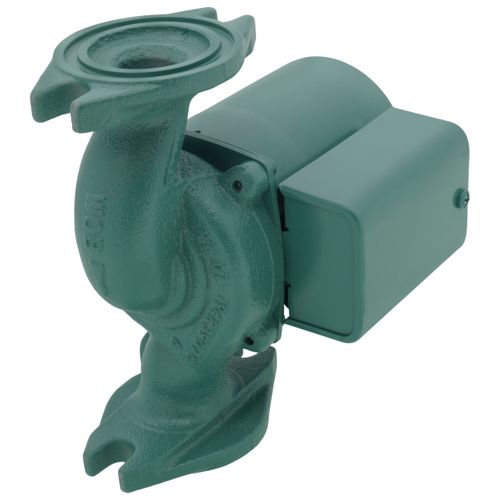
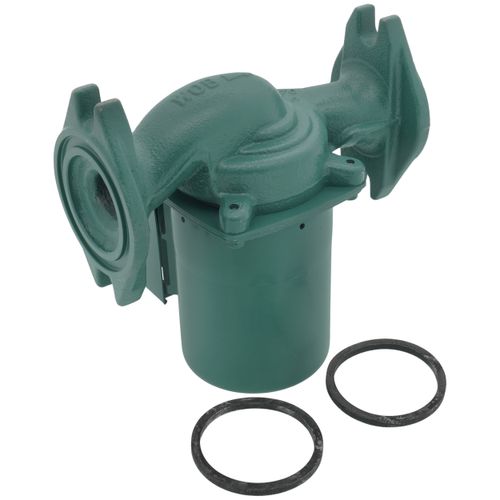
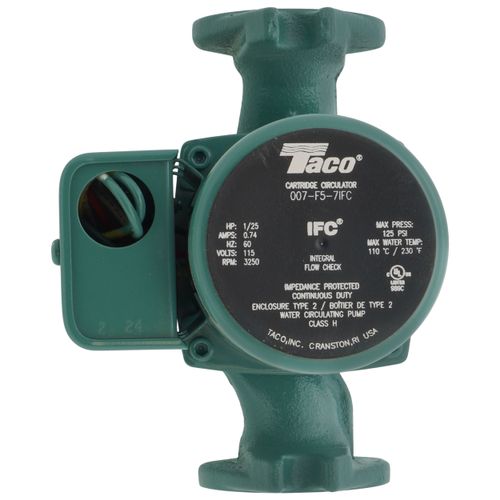
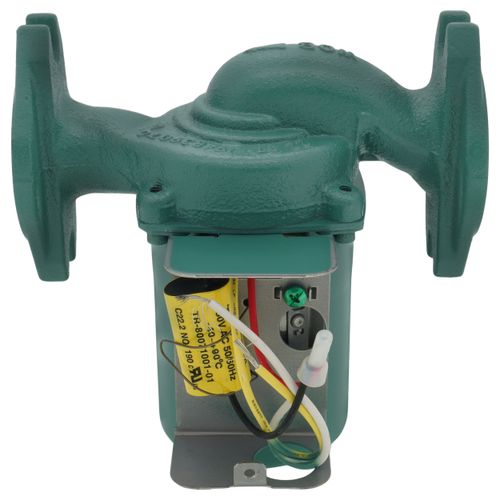
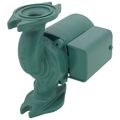
007 Cast Iron Circulator with Integral Flow Check, 1/25 HP
 --%3E %3Csvg version='1.1' id='Fill' xmlns='http://www.w3.org/2000/svg' xmlns:xlink='http://www.w3.org/1999/xlink' x='0px' y='0px' viewBox='0 0 100 100' enable-background='new 0 0 100 100' xml:space='preserve'%3E %3Cpath fill='%23F15C02' d='M79.44,0.95H20.56C9.78,0.95,0.95,9.78,0.95,20.56v58.87c0,10.79,8.82,19.61,19.61,19.61h58.87 c10.79,0,19.61-8.83,19.61-19.61V20.56C99.05,9.78,90.22,0.95,79.44,0.95z M65.38,58.24l9.38,29.58L49.69,69.78L24.5,87.82 l9.34-29.6L8.8,39.6l30.73-0.17c0,0,6.98-19.61,10-28.93c0.54,1.36,9.88,29.1,9.88,29.1H91.2L65.38,58.24z'/%3E %3C/svg%3E)


MANUALS (4)
'/%3E%3C/svg%3E)
Product Highlights


Description
Taco's 007-F5-7IFC Model is a cartridge style, maintenance free, wet-rotor, in-line, single stage circulator pump. Its rugged cast iron construction makes the circulating pump a versatile and reliable unit in your HVAC system. Since the cartridge contains all of the interacting parts, circulator and IFC maintenance is made easy and you don't have to replace the entire unit. Its quiet, effective operation, unmatched reliability, unique design and functionality makes the Taco 007-F5-7IFC cartridge circulator pump among the most popular hydronic circulator pumps available in the market.
The Taco 007-F5-7IFC is engineered to simplify piping, reduce installation costs and optimize system performance when zoning with Taco 00 circulators. Its main function is to protect against reverse and gravity flow. A low pressure drop caused by the spring-loaded IFC increases flow performance vs. traditional in-line flow checks. Applications include: hydronic heating/cooling, hydro-air fan coils, radiant heating, and indirect water heaters.
Replacement Parts List:
Casing O-Ring: 008-005RP
Flange Gasket Set: 007-007RP
Capacitor or PC Board: 007-002RP
Cartridge Assembly Complete: 0010-025RP
valve Assembly Trans/Relay: 006-047RP
Features:
- Integral Flow Check (IFC)--Eliminates In-Line Flow Check, Reduces Installed Cost, Easy to Service, and Improved Performance vs. In-Line Flow Checks
- Unique Replaceable Cartridge Design-Field Serviceable
- Unmatched Reliability-Maintenance Free
- Quiet, Efficient Operation
- Direct Drive-Low Power Consumption
- Standard High Capacity Output-Compact Design
- Self Lubricating, No Mechanical Seal
- Cast iron Construction with Flanged Connections
Specs
| Application: | Zoning |
|---|---|
| Material: | Cast Iron |
| Amperage: | 0.71 |
| Voltage: | 115V |
| Max Pressure (PSI): | 125 |
| Type: | Pump |
| Horse Power: | 1/25 |
| Connection Size: | 1-1/2" 1" 1-1/4" 3/4" |
| Flow Range (GPM): | 0-17 |
| Max Flow (GPM): | 17 |
| Head Range (ft.): | 0-8.5 |
| Max Head (Ft): | 8.5 |
| Hertz: | 60 |
| Phase: | 1 |
| RPM: | 3250 |
| Temperature Range (F): | 40°F to 230°F |
| Connection Type: | Flanged x Flanged |
| Warranty: | 3 Year |

Questions?
Compare Similar Products
You May Also Need
6 Replacement Parts

Need help finding a replacement part?
Product Reviews
Most Liked Positive Review
Seized Iron Circulator Pump and No Heat In House
Most Liked Negative Review
 --%3E %3Csvg version='1.1' id='With-RB' xmlns='http://www.w3.org/2000/svg' xmlns:xlink='http://www.w3.org/1999/xlink' x='0px' y='0px' viewBox='0 0 100 100' enable-background='new 0 0 100 100' xml:space='preserve'%3E %3Cpath fill='%23FBC8B4' d='M79.44,0.95H20.56C9.78,0.95,0.95,9.78,0.95,20.56v58.87c0,10.79,8.82,19.61,19.61,19.61h58.87 c10.79,0,19.61-8.83,19.61-19.61V20.56C99.05,9.78,90.22,0.95,79.44,0.95z M65.38,58.24l9.38,29.58L49.69,69.78L24.5,87.82 l9.34-29.6L8.8,39.6l30.73-0.17c0,0,6.98-19.61,10-28.93c0.54,1.36,9.88,29.1,9.88,29.1H91.2L65.38,58.24z'/%3E %3C/svg%3E)
Pump had some issues at first
When I needed I will buy this circulation pomp again.
fast delivery, good price
Fast and always reliable
easy to install but must prime
As always, great price and fast shipping
Quick delivery and right product
Very happy
would buy circulator again
excelent product
Best pump on the market!
Product Q&A
35 QuestionsQ: Does it come with rubber gaskets? thanks
Asked by Kraig 13 years ago
Add your answer
Yes it comes with 2 rubber o-rings. It does not come with flanges or bolts.
Mine did- not a bad idea to have a spare set invade problems arise during installation. Bo
I can’t remember exactly, but I don’t remember ordering them separately.
yes
Yes it has gaskets no bolts Sent from my Sprint phone.
Yes, in the box
Q: will this pump (by itself) handle an 8 loop system with 1/2 300 ft. loops ( in slab floor heat )
Asked by robert 13 years ago
Add your answer
Verified Reply- PexSupply StaffIt ultimately depends on the required flow rates and the head pressure that needs to be overcome. You can calculate these figures by using the formulas in Taco's Circulator Selection Guide at the link below. A 0015 circulator may be a safer choice for this application. http://s3.pexsupply.com/manuals/1289252668477/41390_PROD_FILE.pdf
This might work, but the flow rates will increase the temp drop somewhat. You didn't specify much beyond the 8 - 300' loops. The maximum BTU delivery using water with a 40 degree temp drop over the loops would be 30,000 - 40,000 BTU. You may want to go slightly larger. With multiple, or even all loops open you may wish to deliver more heat than that. I'm using a 1/25th HP on each of three loops to three air handlers. The air handler heat exchangers have larger cross sectional area and much less length so I can do over 60,000 BTU to each simultaneously (3/4" supply lines and lots of short pipes in parallel compared to a single 300' 1/2" line). How large is your boiler and what is the estimated demand? Most well insulated homes around 3,000 sq ft can get by with about 70,000 - 80,000 BTU peak.
Let me see- Using 1/2" PEX in eight 300' loops. I would figure that you are using a header with eight outlets and, of course another with eight inlets. This header would probably be an 1-1/4 pipe size with a pump requirement of somewhere around 1/2 HP to push that much fluid. In my system I used a dedicated circulator for each loop with a control panel accepting the thermostat wiring controlling each pump circuit. You don't HAVE to use separate circulatory it just makes it oh so much easier when there is a problem. Also with just one pump all loops would operate at the same time, so you wouldn't be able to regulate zones independently unless you used zone valves which are miniature motorized valves which work with aforementioned controller. Nothing but trouble- use multiple circulators and be happy. John Carsten
Off the top of my head, no way! I have a pump covering each loop, using 3/4” PEX. I had one for one loop covering about 900 sqft and it just didn’t seem like it was working well at all. My 2nd loop is about 400 sqft and it seems to handle that well enough though. I replaced the larger loop with a 009 1/8 HP one which is probably a bit much but handles the job well. If I had to do it over I would have chosen a pump that I could dial in. It has been a few years and I can’t remember the math I used to figure out things. Give your local HVAC guy a call and ask them what they would do. Hope that helps!
Probably not efficiently - depending all on climate/ heat load requirements. Bo
no
Q: Hi I have a three story home the boiler will be on the first floor. each floor will have its own circulator controlled by a taco control box. my question is this pump is only rated for 8.5 feet head. will this pump be strong enough to service the second and third floor?. if not what pump would. Thanks
Asked by bill 13 years ago
Add your answer
Verified Reply- PexSupply StaffThis circulator is rated up to 8.5 feet of head, but this is only at near-zero flow rates. Also keep in mind that head pressure is not the same thing as vertical rise in a closed-loop system. This pump would probably be able to handle one floor in a typical house, but the answer ultimately depends on the flow requirements and head pressure in the zones.
You are not overcoming static head in a closed loop - there is an equal weight of water pushing down at the same time the pump is pushing up - you are overcoming friction head. At low flow rates and with normal sized piping, it is probably fine. I have a two story with one taco pump in the basement (so same height differential) and there is adequate flow on each floor. With a dedicated pump for each floor you'll be putting even more energy into each floor's loop. Rich Revering, PE Project Manager Bolton & Menk, Inc. email: ****@***.***<mailto:****@***.***>
The best course of action is to call Taco they are fantastic
I use this pump in my basement with a single story home and I have had no problems. However, I'm not sure how it would perform 2 stories higher than the pump itself. I'm sure it would greatly depend on the diameter of the line to be used and the linear footage of line to be supplied. I would probably look at the specs on the 009 taco pump. I use this pump to supply 3/4" tube 100ft from my boiler to my water heater and manifolds in the house. This pump moves qiute a bit more water and pressure enough that you can hear it going through the lines. Hope this helps.
I do not think this is the pump for your application. You may want to take a look at the curves of the 0011 and 0013 pumps. What is your flow requirements and lift for each zone? David Kay Golden Acre Farms
I live in a 3 level cottage. The boiler and circulators are in the basement . There are 5 zones, 2 on the top floor. I have no problems in any zone.
Don't cut this corner. Go with a Taco 011.
In general, sealed, deaerated circuits need less pressure head than the actual vertical elevation of the system. The system is fed on the inlet side by the pressure head of the column of water there; i.e. the inlet pump pressure is equivalent to the height of the closed circuit column. The only pumping resistance is the friction of the turbulent water flow. If you took the pump out of the closed circuit and attempted to pump a column of water on the outlet without that same column on the inlet side, it would be limited by the stated pressure head for that output. It'll work, but flow may be limited by the lengthier circuit with more fittings. Make certain that you have completely deaerated the system before trying to use it!
I run several of these pumps in a radiant application. My boiler is in the basement and I run 200 feet of 1/2 " pex and these pumps handle it easily.
HI, the short answer is Yes the pump is more then enough, unless you have more then 300 feet in loop per zone ..YOU SHOULD MEASURE YOUR PIPE RUN FOR EACH FLOOR , that is from the supply and returns to the circ pump, if less then 300 feet its ok...Also if 3/4 pipe is used this further reduces head loss ..
Q: Taco 007-F5-7IFC has 3/4" connection. On 1" line can I use this pump with 1" flange or should I look for a pump with 1" connection?
Asked by VM 14 years ago
Add your answer
Hi , yes you can use this pump , .The flanges are designed to be interchangable for 3/4 -1 -11/4 inch connections just get a flange for the size pipe you need to connect to. they come in threaded or soldered type , make sure you use a gasket between flange and head..Dont Overtighten but make sure the bolts are more then snug . Good Luck ..
You can use this pump with a 1" flange. "Taco 007-F5-7IFC has 3/4" connection. On 1" line can I use this pump with 1" flange or should I look for a pump with 1" connection?" <http://www.pexsupply.com/Taco-007-F5-7IFC-007-Cast-Iron-Circulator-with-Int egral-Flow-Check-1-25-HP-3647000-p>
Yes 1" flange is fine. Brian's iPhone
I have a 1" fittings coming from my boiiler. I also have 1" flange with 3/4 reducer to my Pex Pipe. Running approximate 120' Pex to and from boiiler. Hope this answers your question. I was away and just got back. Ran out and checked what I had.
007 can be used for up to 1 1/4" line, copper or pipe size
Yes, you can certainly use this pump. It is available with three flange sizes. The choice should be based on the flow rate and head generated. What flow rate do you need to achieve? How long of a pipe run with how many fittings that restrict flow? How many vertical feet of rise in the system? These are very low powered low pressure pumps designed to recirculate in low resistance loops without much vertical rise. They were made for recircing things like hot water for air handlers, radiant floor heating or baseboard heating. Hope that helps.
depends on what you are trying to do. the TACO 007 is a fairly small circulating pump, with, as you have stated, a 3/4" flange. if you can find a 1" flange, you can tie into a 1" line, but your velocity through the 1" line will be slower. the pump itself will put out a given flow against a given head ( this is your pump curve ), there will be less friction loss through a 1" line than a 3/4" line, which means that by using a 1" line you may have less head loss and can pump more gallons per minute. if all you want to do is circulate water through your 1" pipe, you should be able to do this. look at the different flanges availible for this pump, and you should have have several availible. hope this helps. jim
Q: If the 007-IFC is installed with the flow direction vertically downward (3/4" copper), is it possible for air to accumulate downstream of the pump ? If so, how would this be vented?
Asked by John S. 14 years ago
Add your answer
Verified Reply- PexSupply StaffAn air eliminator can generally prevent air from accumulating in the system, but if this does occur you may need to bleed the system to remove the air.
Mine are all installed downward on the return side. Never had an air problem but then again I have an air scoop. Every system should have an air scoop and pressure bleeder
I have never experienced that. That is not to say it can't happen, but with good system design it would not be an issue.
John, It is always possible for air to accumulate. The subject is very broad, but I use Caleffi products and I use their website to train myself and my employees. Here is an issue of their trade mag for air and dirt elimination. http://www.caleffi.us/caleffi/en_US/Site/Technical_library/Idraulica_magazine/args/detail/~Details~Magazines~magazine_detail_0000057/type/magazine/index.sdo
It is possible to get air in the system, but that does not mean it has to do with the direction of the flow. An air-scoop that has a vent preinstalled in it is the best way to purge air from the system. Follow the manufacturers instructions on placement.
I found you can always get air pockets in a loop no matter which way the pump flows. What I do to get air out of a closed loop is install a ball valve on both sides of the pump followed by a boiler drain (a tee with a drain in the middle. The drains are installed after the ball valves. In other words you have the pump flange, ball valve and drain. With the pump off, and ball valves closed hook up a washing machine to one of the boiler drains. Hook up a garden hose to the washing machine hose. Hook up a hose to the second drain and put the end of the hose into a 5 gallon bucket. Turn on the garden hose and open the drain line going to the bucket. When you see no more air pockets coming out of the drain line the loop is free of air. Close the drains and remove the hoses. You can now open the shut off valves and turn on the pump. The system should be air free.
John S.< on low flow applications, you probably can accumulate air downstream of the pump, but there are several ways around this. 1) if this on a closed circuit ( heating for instance) , i always recirculate water though the system and into a bucket, and then pump out of hte bucket with a sump pump into a hose bib mounted in the system. the added high flow rate, for say, 5 hours, makes sure you have all the air out of the system.( it also allows you to add glycol to the system) , i also install a Taco 'air scoop' with an automatic air vent at a high point in the system, and this usually removes any small bubbles that may come in with any 'make up water' you may add to get pressure int eh system.( i run my heating system at 15-20 psi when hot) if you do this, make sure you run the flow through all the individual control circuits one at a time first, then open them all and run them. when the flow from the system drain into the bucket is clean and clear of bubbles, you are set to go. 2) if this pump has an integral plastic backflow preventer on the downstream side (white thingy,can be grabbed with a needle nose pliers), this can easily be removed. this will allow air to move back through the pump when it is turned off, and allows it to accumulate at a high point. if you have a closed circuit heating system, you probably want to remove this anyway, once you get the air out of the system ( see above) you may not need it. hope this helps, Jim Koffer
I pump downward from my wood boiler. Inside the house, where my zone pumps are set up, I have a vertical pipe that goes higher than any of my other pex, copper won't matter. On top of the vertical, I have an automatic air bleeder. When I first turned on the system it hissed and sputtered letting the air out but I've never heard it since. I don't recall the brand or technical name but a google search for automatic air bleeder would get you part way there.
add a flange valve for circulator and a bleeder tee with valve .
Q: how hot can the outside pump get during normal operation....boiler temp is set at 170 degrees thank you
Asked by mark 15 years ago
Add your answer
I have 3 of these functioning normally in a radiant floor heating system x 1 year. I have never put a temp gauge on them but they get quite hot - intolerable to touch. The pump is lubricated by the fluid running through it so the temp of the fluid would be the minimum temp I would suspect.
The pump motar housing can get very hot. The pumps are rated for water temperatures over 200 degrees. Your boiler will typically operate between 140 and 180 degrees depending on the type of system you have and if you an outside air temperature sensor. If you have an outside air sensor, then you boiler wayer temp will be lower as it gets warmer outside. This save you money as you use less fuel. Sent from my Verizon Wireless BlackBerry
These get too hot to touch, but, they are supposedly built to take it. I have had no issues with the 3 I have installed.
Q: It seems a though the flow check is not operating properly on one of my zones, as that zone remains warm even with its thermostat turned off. The ciculator for that zone is definitely not running, yet hot water flows through the zone when one of the other circulators is running. Any suggestions would be greatly appreciated.
Asked by eug 15 years ago
Add your answer
Verified Reply- PexSupply StaffIt does appear that the flow check isn't working properly. You could always install one in the line, but the flow check in the circulator can also be replaced. It is part number 0010-025RP.
I am not sure of your issue, but is the circulator on the discharge of another circulator? Are they in parallel or in series? To see if the check valve is working, one way is to listen when the circulator turns off. You should hear a noise of the check valve closing. Hope this helps somewhat.
The check flow is probably working properly. Look at the other manifold and see what order the zones are in. I have my H/W heater on the end and when it calls for hot water it inadvertantly forces hot water up the other zones in the correct direction. Easy fix. Close the shut off valve for the other zones.
Q: This circulator is on a zone for master bath radiant heat and is the only zone calling for heat 90% of the time because rest of home is wood stove, my question is when cold under 15 degrees even though it runs constant will not heat above 60 degrees, have one line of 1/2" pex 50 ft run to bath and total of 300 ft on zone which was more than plans called for with rez check (this is new construction). Do you think it would help to supply lines under bath with 2 feed and return lines instead of 1? Seems like there is not enough water flow? Any thoughts?
Asked by Bob 15 years ago
Add your answer
Verified Reply- PexSupply StaffBreaking the area into two loops might allow this circulator to work. If you stick with a single loop, you may want to try a larger circulator.
Q: Two questions, please. (1) Does the Taco 007-IFC pump allow water to "flow-through" the system when the pump isn't running? There will be a small amount of fresh cold water entering the system to keep the water in the in-floor tubes from stagnating during off season. (2)Is a cast iron circulator pump suitable for an "open direct" hydronic heating system using potable heated water, or do I need bronze or stainless steel instead? Thanks for your help!
Asked by kt 15 years ago
Add your answer
Verified Reply- PexSupply StaffThe purpose of the integral flow check is to prevent flow through, so you may not want to use this circulator. Additionally, cast iron pumps rust in open systems because of the new water that is continually introduced. You would need to use a bronze or stainless steel circulator.
1 ) With the check valve there is no backflow when the system is not running. 2 ) I have used the cast iron for the past 7 years on mine with no problem.
Q: can this pump be used on the return side of the boiler without installing the inline flow check ?
Asked by 15 years ago
Add your answer
Verified Reply- PexSupply StaffThere is no need to install an in-line flow check with IFC circulators. The internal flow check removes the need for this extra part and it accomplishes the same job.
Yes, assuming the pump meets your flow rates, but with no additional space being used, getting the integrated flow check is a no-brainer. I have one for each of my zones on the supply side and one on the return. They are controlled with a Taco Zone Controller.