




Filters
SORT
Product Availability –
Category –
Product Type –
Application –
Programmability –
Stages –
Mount –
User Interface –
Options –
Review Score –
 --%3E %3Csvg version='1.1' id='Fill' xmlns='http://www.w3.org/2000/svg' xmlns:xlink='http://www.w3.org/1999/xlink' x='0px' y='0px' viewBox='0 0 100 100' enable-background='new 0 0 100 100' xml:space='preserve'%3E %3Cpath fill='%23F15C02' d='M79.44,0.95H20.56C9.78,0.95,0.95,9.78,0.95,20.56v58.87c0,10.79,8.82,19.61,19.61,19.61h58.87 c10.79,0,19.61-8.83,19.61-19.61V20.56C99.05,9.78,90.22,0.95,79.44,0.95z M65.38,58.24l9.38,29.58L49.69,69.78L24.5,87.82 l9.34-29.6L8.8,39.6l30.73-0.17c0,0,6.98-19.61,10-28.93c0.54,1.36,9.88,29.1,9.88,29.1H91.2L65.38,58.24z'/%3E %3C/svg%3E)
 --%3E %3Csvg version='1.1' id='With-RB' xmlns='http://www.w3.org/2000/svg' xmlns:xlink='http://www.w3.org/1999/xlink' x='0px' y='0px' viewBox='0 0 100 100' enable-background='new 0 0 100 100' xml:space='preserve'%3E %3Cpath fill='%23FBC8B4' d='M79.44,0.95H20.56C9.78,0.95,0.95,9.78,0.95,20.56v58.87c0,10.79,8.82,19.61,19.61,19.61h58.87 c10.79,0,19.61-8.83,19.61-19.61V20.56C99.05,9.78,90.22,0.95,79.44,0.95z M65.38,58.24l9.38,29.58L49.69,69.78L24.5,87.82 l9.34-29.6L8.8,39.6l30.73-0.17c0,0,6.98-19.61,10-28.93c0.54,1.36,9.88,29.1,9.88,29.1H91.2L65.38,58.24z'/%3E %3C/svg%3E)
Price Range –
Braeburn Thermostats




 --%3E %3Csvg version='1.1' id='Half' xmlns='http://www.w3.org/2000/svg' xmlns:xlink='http://www.w3.org/1999/xlink' x='0px' y='0px' viewBox='0 0 100 100' enable-background='new 0 0 100 100' xml:space='preserve'%3E %3Cg%3E %3Cpath fill='%23F15C02' d='M30.05,70.23l3.79-12.01L8.8,39.6l30.73-0.17c0,0,6.98-19.61,10-28.93c0.54,1.36,9.88,29.1,9.88,29.1h1.58 L93.71,7.18c-3.58-3.82-8.66-6.23-14.28-6.23H20.56C9.78,0.95,0.95,9.78,0.95,20.56v58.87c0,5.41,2.22,10.32,5.79,13.88 L30.05,70.23z'/%3E %3C/g%3E %3Cpath fill='%23FBC8B4' d='M93.71,7.18L60.98,39.6H91.2L65.38,58.24l9.38,29.58L49.69,69.78L24.5,87.82l5.55-17.59L6.75,93.32 c3.55,3.54,8.44,5.73,13.82,5.73h58.87c10.79,0,19.61-8.83,19.61-19.61V20.56C99.05,15.4,97.01,10.69,93.71,7.18z'/%3E %3C/svg%3E)


 --%3E %3Csvg version='1.1' id='No-RB' xmlns='http://www.w3.org/2000/svg' xmlns:xlink='http://www.w3.org/1999/xlink' x='0px' y='0px' viewBox='0 0 100 100' enable-background='new 0 0 100 100' xml:space='preserve'%3E %3Cpath fill='%23CECECE' d='M79.44,0.95H20.56C9.78,0.95,0.95,9.78,0.95,20.56v58.87c0,10.79,8.82,19.61,19.61,19.61h58.87 c10.79,0,19.61-8.83,19.61-19.61V20.56C99.05,9.78,90.22,0.95,79.44,0.95z M65.38,58.24l9.38,29.58L49.69,69.78L24.5,87.82 l9.34-29.6L8.8,39.6l30.73-0.17c0,0,6.98-19.61,10-28.93c0.54,1.36,9.88,29.1,9.88,29.1H91.2L65.38,58.24z'/%3E %3C/svg%3E)


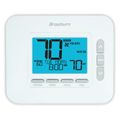


Braeburn thermostats are the temperature controls Braeburn manufactures for residential and light commercial heating and cooling systems, ranging from simple non-programmable models to full programmable thermostats. Contractors turn to this category when installing a new HVAC system, replacing an outdated or malfunctioning thermostat, or upgrading a customer to programmable scheduling. Compatibility depends on the type of heating and cooling equipment installed, since a thermostat designed for a conventional forced-air system won't necessarily work correctly with heat pumps, multi-stage equipment, or millivolt systems. Braeburn's lineup spans multiple product tiers, so contractors match the thermostat's staging and system-type support to the equipment it will control rather than choosing based on features alone. Wiring configuration is another point worth confirming before installation, since older systems may use fewer wires than a newer programmable thermostat expects. Selecting the correct Braeburn model for the connected equipment keeps temperature control accurate and avoids a callback for a thermostat that can't fully control the system it's paired with.
Subcategories
- Non-Programmable Thermostats: Non-programmable thermostats offer straightforward manual temperature control without scheduling features, a fit for rental properties, simple systems, or customers who prefer a basic control. Contractors specify them when programmable features aren't needed or wanted. The subcategory covers models compatible with common single-stage heating and cooling systems. A non-programmable thermostat is often the fastest, most cost-effective replacement for a failed basic unit.
- Programmable Thermostats: Programmable thermostats let a homeowner or building operator set different temperature schedules throughout the day and week, supporting energy savings without manual adjustment. Contractors install them for customers looking to automate temperature setbacks or manage multi-stage or heat pump systems. The subcategory includes models supporting a range of staging and system types across Braeburn's programmable lineup. Matching the thermostat's system-type compatibility to the installed equipment is the key step before installation.
- Thermostat Accessories: Thermostat accessories include the wall plates, sensors, and mounting hardware that support a Braeburn thermostat installation. Contractors use them to cover an existing wall opening larger than the new thermostat, add a remote sensor for more accurate temperature readings, or complete a clean installation. The subcategory groups accessories designed to work with specific Braeburn thermostat models. Having the right accessory on hand during installation avoids an extra trip for a mounting or coverage issue discovered on site.
Buying Guide
Start by confirming the heating and cooling system's staging and type, since a thermostat rated for single-stage conventional systems won't properly control multi-stage equipment or a heat pump without matching the correct model. Count the existing wires at the current thermostat location before selecting a replacement, since some programmable models require additional wires, such as a common wire, that older systems may not have run. Braeburn thermostats span several tiers from basic non-programmable models to full programmable units, so matching features to what the customer actually wants, rather than defaulting to the most feature-rich model, avoids paying for scheduling capability that won't get used. For heat pump systems specifically, confirm the thermostat supports the correct number of heating and cooling stages along with auxiliary or emergency heat control, since a mismatch here can leave a system running inefficiently or not heating adequately in cold weather. Wall plate size is worth checking against the space left by the old thermostat, since a smaller new unit can leave an unsightly gap without the right accessory. Contractors installing across a range of system types benefit from stocking a few different Braeburn models rather than one universal choice, since system compatibility, not thermostat features, is usually what determines whether an installation goes smoothly.
Frequently Asked Questions
How do I know if a Braeburn thermostat is compatible with my heating and cooling system?
Compatibility depends on the number of heating and cooling stages the system uses and whether it's a conventional forced-air, heat pump, or other system type. Checking the thermostat's system-type support against the installed equipment before purchase avoids a mismatch.
Do I need a common wire for a programmable Braeburn thermostat?
Many programmable thermostats need a common wire to maintain constant power, while older non-programmable models often don't. Checking the existing wiring at the thermostat location before selecting a model helps avoid an installation surprise.
Can a Braeburn thermostat control a heat pump system?
Certain Braeburn models are designed to support heat pump systems, including auxiliary and emergency heat staging, but not every model in the lineup does. Confirming heat pump compatibility on the specific model before purchase is necessary.
What's the benefit of a programmable thermostat over a non-programmable one?
A programmable thermostat allows scheduled temperature setbacks throughout the day and week, which can reduce energy use when a space is unoccupied. A non-programmable thermostat requires manual adjustment for the same effect.
Will a new thermostat cover the wall marks left by an old one?
It depends on the size of the new thermostat's wall plate relative to the old unit's footprint. A wall plate accessory sized to cover a larger opening solves this without repainting or patching the wall.
