




Filters
SORT
Product Availability –
Brand –
Fuel Type –
BTU (Max) –
Energy Factor –
Vent Type –
Installation Type –
Flow Rate At 40F Temp Rise (GPM) –
Flow Rate At 50F Temp Rise (GPM) –
Flow Rate At 60F Temp Rise (GPM) –
Flow Rate At 70F Temp Rise (GPM) –
Review Score –
 --%3E %3Csvg version='1.1' id='Fill' xmlns='http://www.w3.org/2000/svg' xmlns:xlink='http://www.w3.org/1999/xlink' x='0px' y='0px' viewBox='0 0 100 100' enable-background='new 0 0 100 100' xml:space='preserve'%3E %3Cpath fill='%23F15C02' d='M79.44,0.95H20.56C9.78,0.95,0.95,9.78,0.95,20.56v58.87c0,10.79,8.82,19.61,19.61,19.61h58.87 c10.79,0,19.61-8.83,19.61-19.61V20.56C99.05,9.78,90.22,0.95,79.44,0.95z M65.38,58.24l9.38,29.58L49.69,69.78L24.5,87.82 l9.34-29.6L8.8,39.6l30.73-0.17c0,0,6.98-19.61,10-28.93c0.54,1.36,9.88,29.1,9.88,29.1H91.2L65.38,58.24z'/%3E %3C/svg%3E)
 --%3E %3Csvg version='1.1' id='With-RB' xmlns='http://www.w3.org/2000/svg' xmlns:xlink='http://www.w3.org/1999/xlink' x='0px' y='0px' viewBox='0 0 100 100' enable-background='new 0 0 100 100' xml:space='preserve'%3E %3Cpath fill='%23FBC8B4' d='M79.44,0.95H20.56C9.78,0.95,0.95,9.78,0.95,20.56v58.87c0,10.79,8.82,19.61,19.61,19.61h58.87 c10.79,0,19.61-8.83,19.61-19.61V20.56C99.05,9.78,90.22,0.95,79.44,0.95z M65.38,58.24l9.38,29.58L49.69,69.78L24.5,87.82 l9.34-29.6L8.8,39.6l30.73-0.17c0,0,6.98-19.61,10-28.93c0.54,1.36,9.88,29.1,9.88,29.1H91.2L65.38,58.24z'/%3E %3C/svg%3E)
Price Range –
Tankless Natural Gas Water Heaters

 --%3E %3Csvg version='1.1' id='No-RB' xmlns='http://www.w3.org/2000/svg' xmlns:xlink='http://www.w3.org/1999/xlink' x='0px' y='0px' viewBox='0 0 100 100' enable-background='new 0 0 100 100' xml:space='preserve'%3E %3Cpath fill='%23CECECE' d='M79.44,0.95H20.56C9.78,0.95,0.95,9.78,0.95,20.56v58.87c0,10.79,8.82,19.61,19.61,19.61h58.87 c10.79,0,19.61-8.83,19.61-19.61V20.56C99.05,9.78,90.22,0.95,79.44,0.95z M65.38,58.24l9.38,29.58L49.69,69.78L24.5,87.82 l9.34-29.6L8.8,39.6l30.73-0.17c0,0,6.98-19.61,10-28.93c0.54,1.36,9.88,29.1,9.88,29.1H91.2L65.38,58.24z'/%3E %3C/svg%3E)
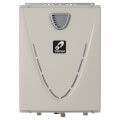






Tankless Natural Gas Water Heaters heat water on demand instead of storing it in a tank, firing a gas burner only when a hot water fixture opens. Output is measured in gallons per minute (GPM), and high-capacity condensing models, such as the Rinnai RU199iN, can deliver up to 11 GPM at a 0.95 Uniform Energy Factor (UEF) rating with input up to 199,000 BTU. Efficiency depends heavily on whether a unit condenses exhaust gas heat before venting: Navien's NPE-2 series posts up to 0.96 UEF by pulling additional heat from flue gas, while non-condensing models like Rinnai's REi-SP series post around 0.82 UEF and require different venting materials since they exhaust hotter flue gas. Non-condensing units in that series still cover a wide flow range, from 6.6 GPM up to 9.8 GPM depending on model. Because these units take up less space than a storage tank and only heat water when called for, contractors specify them for retrofits with tight mechanical closets and for households that want continuous hot water without standby heat loss.
Subcategories
- Condensing Tankless Water Heaters: Condensing tankless water heaters use a secondary heat exchanger to pull additional heat from flue gas before it vents outside, which pushes efficiency ratings higher than non-condensing designs. Contractors specify condensing models for whole-home installs where efficiency and lower operating temperatures allow PVC or CPVC venting instead of stainless steel. Navien's NPE-2 series reaches up to 0.96 UEF, putting it near the top of the residential efficiency range. Because condensing units produce acidic condensate, installers also need a condensate neutralizer or drain line as part of the setup.
- Non-Condensing Tankless Water Heaters: Non-condensing tankless water heaters vent hotter exhaust gas without recovering extra heat from it, which keeps the unit and installation simpler but lowers overall efficiency compared to condensing models. Rinnai's REi-SP series posts a 0.82 UEF rating, with flow rates that vary by model. Technicians reach for these units on straightforward retrofits where stainless steel Category III or IV venting is already in place or easy to run. Non-condensing designs also tend to have a lower upfront part count, which can simplify service down the line.
- High-Capacity Whole-Home Units: High-capacity units serve households running multiple showers, laundry, and dishwashing at the same time without a drop in hot water temperature. The Rinnai RU199iN delivers up to 11 GPM with input up to 199,000 BTU, covering larger homes that would overwhelm a smaller unit. Installers size these units around peak simultaneous demand rather than average daily use, since undersizing shows up only during high-demand periods. Because of the higher BTU input, these units also need larger gas lines and venting sized to the manufacturer's specifications.
- Standard-Efficiency Non-Condensing Models: Standard-efficiency non-condensing models cover smaller households or point-of-service applications where peak flow demand stays modest. The Rinnai RE160i delivers 6.6 GPM at a 0.81 UEF rating, making it suited to a single bathroom or a small home with limited simultaneous fixture use. Contractors often select this tier for replacements of an existing tank-style water heater where venting and gas line sizing are already modest. Smaller BTU input also means a shorter recovery gap during high-demand moments like back-to-back showers.
Buying Guide
Start sizing a tankless natural gas water heater around peak simultaneous demand, not average use, since a unit that runs two showers and a dishwasher at once needs meaningfully higher GPM than a single-bathroom home. GPM tells capacity, but UEF tells efficiency, so weigh both figures together rather than picking the highest flow rate available. Condensing models, such as Navien's NPE-2 series at up to 0.96 UEF, cost more upfront but allow PVC or CPVC venting and recover more heat from exhaust gas, which lowers gas bills over the life of the unit. Non-condensing models, like Rinnai's REi-SP series at 0.82 UEF, install with Category III or IV stainless steel venting and suit retrofits where that venting already exists or budget favors a simpler install. Gas line sizing matters just as much as venting: higher-BTU units, such as the 199,000 BTU RU199iN, need a larger gas supply line than a smaller household unit, so confirming existing line capacity before ordering avoids a mid-installation surprise. Tankless Natural Gas Water Heaters also need a dedicated combustion air source or direct venting kit depending on where the mechanical closet sits in the home. Finally, check local code for condensate drainage and neutralization requirements on condensing models, since acidic condensate cannot go straight into most drain lines without treatment. Matching flow rate, efficiency tier, venting type, and gas line capacity together prevents a callback for an undersized system.
Frequently Asked Questions
What's the difference between condensing and non-condensing tankless water heaters?
Condensing tankless water heaters recover extra heat from exhaust gas before venting, which pushes efficiency ratings up to around 0.96 UEF on models like Navien's NPE-2 series. Non-condensing units vent hotter exhaust without that extra heat recovery step, landing closer to 0.82 UEF on Rinnai's REi-SP series. Condensing models allow PVC or CPVC venting, while non-condensing units need stainless steel Category III or IV venting.
How many GPM does a household actually need?
GPM needs depend on how many fixtures run hot water at the same time, not just the number of bathrooms in the home. A household running multiple showers and a dishwasher simultaneously calls for a higher-capacity unit, such as the Rinnai RU199iN at up to 11 GPM, while a smaller household can size down to a model like the Rinnai RE160i at 6.6 GPM. Sizing around peak simultaneous demand rather than average daily use prevents cold water at the tap during busy mornings.
Do tankless natural gas water heaters need special venting?
Venting requirements depend on whether the unit is condensing or non-condensing. Condensing models exhaust cooler flue gas and typically use PVC or CPVC venting, while non-condensing models like Rinnai's REi-SP series exhaust hotter gas and require stainless steel Category III or IV venting. Confirming venting type before installation avoids a mismatch between the unit and materials already run to the mechanical closet.
What does UEF mean and why does it matter?
UEF stands for Uniform Energy Factor, a rating that measures how efficiently a water heater converts fuel into usable hot water. Higher UEF numbers mean less wasted energy, and figures range from around 0.82 on non-condensing models to as high as 0.96 on condensing models like Navien's NPE-2 series. Comparing UEF alongside GPM gives a fuller picture of a unit's real-world performance than flow rate alone.
Can a tankless natural gas water heater replace an existing tank-style unit?
Replacing a tank-style water heater with a tankless natural gas water heater usually requires a gas line sizing check, since higher-BTU tankless units draw more gas volume than most tank models. Venting also changes, since tankless units vent differently than atmospheric tank water heaters. Working through gas line capacity, venting path, and flow rate together during planning avoids a mid-installation surprise.
