




Filters
SORT
Product Availability –
Brand –
Shutoff Head (ft.) –
Voltage –
Flow At 5 FT Head –
Review Score –
 --%3E %3Csvg version='1.1' id='Fill' xmlns='http://www.w3.org/2000/svg' xmlns:xlink='http://www.w3.org/1999/xlink' x='0px' y='0px' viewBox='0 0 100 100' enable-background='new 0 0 100 100' xml:space='preserve'%3E %3Cpath fill='%23F15C02' d='M79.44,0.95H20.56C9.78,0.95,0.95,9.78,0.95,20.56v58.87c0,10.79,8.82,19.61,19.61,19.61h58.87 c10.79,0,19.61-8.83,19.61-19.61V20.56C99.05,9.78,90.22,0.95,79.44,0.95z M65.38,58.24l9.38,29.58L49.69,69.78L24.5,87.82 l9.34-29.6L8.8,39.6l30.73-0.17c0,0,6.98-19.61,10-28.93c0.54,1.36,9.88,29.1,9.88,29.1H91.2L65.38,58.24z'/%3E %3C/svg%3E)
 --%3E %3Csvg version='1.1' id='With-RB' xmlns='http://www.w3.org/2000/svg' xmlns:xlink='http://www.w3.org/1999/xlink' x='0px' y='0px' viewBox='0 0 100 100' enable-background='new 0 0 100 100' xml:space='preserve'%3E %3Cpath fill='%23FBC8B4' d='M79.44,0.95H20.56C9.78,0.95,0.95,9.78,0.95,20.56v58.87c0,10.79,8.82,19.61,19.61,19.61h58.87 c10.79,0,19.61-8.83,19.61-19.61V20.56C99.05,9.78,90.22,0.95,79.44,0.95z M65.38,58.24l9.38,29.58L49.69,69.78L24.5,87.82 l9.34-29.6L8.8,39.6l30.73-0.17c0,0,6.98-19.61,10-28.93c0.54,1.36,9.88,29.1,9.88,29.1H91.2L65.38,58.24z'/%3E %3C/svg%3E)
Price Range –
Backup Sump Pumps




 --%3E %3Csvg version='1.1' id='Half' xmlns='http://www.w3.org/2000/svg' xmlns:xlink='http://www.w3.org/1999/xlink' x='0px' y='0px' viewBox='0 0 100 100' enable-background='new 0 0 100 100' xml:space='preserve'%3E %3Cg%3E %3Cpath fill='%23F15C02' d='M30.05,70.23l3.79-12.01L8.8,39.6l30.73-0.17c0,0,6.98-19.61,10-28.93c0.54,1.36,9.88,29.1,9.88,29.1h1.58 L93.71,7.18c-3.58-3.82-8.66-6.23-14.28-6.23H20.56C9.78,0.95,0.95,9.78,0.95,20.56v58.87c0,5.41,2.22,10.32,5.79,13.88 L30.05,70.23z'/%3E %3C/g%3E %3Cpath fill='%23FBC8B4' d='M93.71,7.18L60.98,39.6H91.2L65.38,58.24l9.38,29.58L49.69,69.78L24.5,87.82l5.55-17.59L6.75,93.32 c3.55,3.54,8.44,5.73,13.82,5.73h58.87c10.79,0,19.61-8.83,19.61-19.61V20.56C99.05,15.4,97.01,10.69,93.71,7.18z'/%3E %3C/svg%3E)


 --%3E %3Csvg version='1.1' id='No-RB' xmlns='http://www.w3.org/2000/svg' xmlns:xlink='http://www.w3.org/1999/xlink' x='0px' y='0px' viewBox='0 0 100 100' enable-background='new 0 0 100 100' xml:space='preserve'%3E %3Cpath fill='%23CECECE' d='M79.44,0.95H20.56C9.78,0.95,0.95,9.78,0.95,20.56v58.87c0,10.79,8.82,19.61,19.61,19.61h58.87 c10.79,0,19.61-8.83,19.61-19.61V20.56C99.05,9.78,90.22,0.95,79.44,0.95z M65.38,58.24l9.38,29.58L49.69,69.78L24.5,87.82 l9.34-29.6L8.8,39.6l30.73-0.17c0,0,6.98-19.61,10-28.93c0.54,1.36,9.88,29.1,9.88,29.1H91.2L65.38,58.24z'/%3E %3C/svg%3E)





Backup sump pumps are secondary pumping systems installed alongside a primary sump pump to keep a basement or crawlspace dry when the primary pump fails or loses power. Power outages during heavy storms are one of the most common triggers for basement flooding, since that's exactly when a primary pump is most likely to be needed and least likely to have grid power available. Battery-powered and water-powered are the two main backup types, each drawing on a different resource to run: stored battery charge or municipal water pressure. Homeowners and property managers most often add a backup system after a first flooding event, but specifying one at initial installation avoids that costly lesson.
Subcategories
- Battery Backup Sump Pumps: Battery backup pumps run on a dedicated deep-cycle battery that charges continuously and kicks in automatically when the primary pump loses power or fails. Runtime depends on battery capacity and pump load, so battery size needs to match the expected outage duration for the property. Battery backup systems work in any home with sump pump plumbing already in place, regardless of municipal water pressure.
- Water-Powered Backup Sump Pumps: Water-powered backup pumps use municipal water pressure through a venturi to remove water without needing electricity or a battery at all, which makes them useful in homes that want a backup with no battery to maintain. Effectiveness depends on adequate, consistent municipal water pressure at the property. Some municipalities restrict or meter this type of system, so checking local code before installation matters.
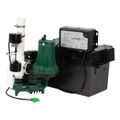
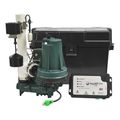
- Combination Primary/Backup Pump Systems: Combination systems pair a primary pump with an integrated backup pump and controller in a single unit, simplifying installation compared to adding a separate backup system to an existing pit. Alarm and monitoring features are more commonly built into combination units than into standalone backups. New construction and full sump system replacements are common applications for this configuration.
Buying Guide
Choosing a backup sump pump starts with identifying what's most likely to cause the primary pump to fail on a given property. If power outages are the main risk, a battery backup with enough runtime to cover a typical outage is the priority, and battery capacity should be sized against both the pump's draw and how long outages tend to last in the area. If low municipal water pressure or a lack of a reliable water supply is a bigger concern, a water-powered backup is the wrong choice, since it depends entirely on consistent water pressure to operate. Backup sump pumps need to match the discharge capacity of the primary pump, or at minimum handle the expected inflow rate during a heavy storm, since an undersized backup can still let water rise even while running. Battery backup systems need periodic battery testing and replacement, typically every few years, so factoring maintenance into the recommendation avoids a backup that's dead when it's actually needed. Alarm and notification features, whether a local audible alarm or a connected alert, add real value since a backup pump running silently in a basement doesn't help if nobody knows the primary pump failed. For new installations, a combination primary/backup unit simplifies the pit and wiring, while retrofitting a backup onto an existing pump usually means confirming pit size and available power before ordering parts.
Frequently Asked Questions
What's the difference between a battery backup and a water-powered backup sump pump?
A battery backup runs on a dedicated battery that charges continuously and takes over automatically if the primary pump loses power. A water-powered backup uses municipal water pressure through a venturi instead of electricity or a battery. The right choice depends on whether power loss or water pressure is the bigger risk at a given property.
How long does a battery backup sump pump run during an outage?
Runtime depends on battery capacity and how much water the pump has to move, so there's no single answer across every installation. Larger deep-cycle batteries extend runtime but add cost and space requirements in the pit area. Sizing the battery against the area's typical outage length is the most reliable way to avoid a mid-outage failure.
Does a water-powered backup pump work during a power outage?
Yes, since a water-powered backup doesn't need electricity to operate, only consistent municipal water pressure. A water-powered backup remains a reliable option specifically during power outages, as long as the water utility keeps supplying pressure. Homes on well water with an electric well pump aren't good candidates for this type, since the well pump itself needs power to maintain pressure.
Do backup sump pumps need regular maintenance?
Battery backups need periodic battery testing and replacement, typically every few years, since a dead battery defeats the purpose of having a backup at all. Water-powered backups need less routine maintenance but benefit from an occasional test run to confirm the venturi and check valve are working. Both types should be tested before storm season or after any known power interruption.
Can a backup pump handle the same amount of water as the primary pump?
Capacity varies by model, and some backups move less water than the primary pump they're paired with. Matching backup capacity to the primary pump's discharge rate, or at least to the expected storm inflow, avoids a situation where the backup runs but still can't keep the pit from overflowing. Checking the manufacturer's flow rate specification against the primary pump's rating is the most direct way to confirm compatibility.
