





'/%3E%3C/svg%3E)
 --%3E %3Csvg version='1.1' id='Fill' xmlns='http://www.w3.org/2000/svg' xmlns:xlink='http://www.w3.org/1999/xlink' x='0px' y='0px' viewBox='0 0 100 100' enable-background='new 0 0 100 100' xml:space='preserve'%3E %3Cpath fill='%23F15C02' d='M79.44,0.95H20.56C9.78,0.95,0.95,9.78,0.95,20.56v58.87c0,10.79,8.82,19.61,19.61,19.61h58.87 c10.79,0,19.61-8.83,19.61-19.61V20.56C99.05,9.78,90.22,0.95,79.44,0.95z M65.38,58.24l9.38,29.58L49.69,69.78L24.5,87.82 l9.34-29.6L8.8,39.6l30.73-0.17c0,0,6.98-19.61,10-28.93c0.54,1.36,9.88,29.1,9.88,29.1H91.2L65.38,58.24z'/%3E %3C/svg%3E)
 --%3E %3Csvg version='1.1' id='Half' xmlns='http://www.w3.org/2000/svg' xmlns:xlink='http://www.w3.org/1999/xlink' x='0px' y='0px' viewBox='0 0 100 100' enable-background='new 0 0 100 100' xml:space='preserve'%3E %3Cg%3E %3Cpath fill='%23F15C02' d='M30.05,70.23l3.79-12.01L8.8,39.6l30.73-0.17c0,0,6.98-19.61,10-28.93c0.54,1.36,9.88,29.1,9.88,29.1h1.58 L93.71,7.18c-3.58-3.82-8.66-6.23-14.28-6.23H20.56C9.78,0.95,0.95,9.78,0.95,20.56v58.87c0,5.41,2.22,10.32,5.79,13.88 L30.05,70.23z'/%3E %3C/g%3E %3Cpath fill='%23FBC8B4' d='M93.71,7.18L60.98,39.6H91.2L65.38,58.24l9.38,29.58L49.69,69.78L24.5,87.82l5.55-17.59L6.75,93.32 c3.55,3.54,8.44,5.73,13.82,5.73h58.87c10.79,0,19.61-8.83,19.61-19.61V20.56C99.05,15.4,97.01,10.69,93.71,7.18z'/%3E %3C/svg%3E)


MANUALS (3)
'/%3E%3C/svg%3E)
Product Highlights


Description
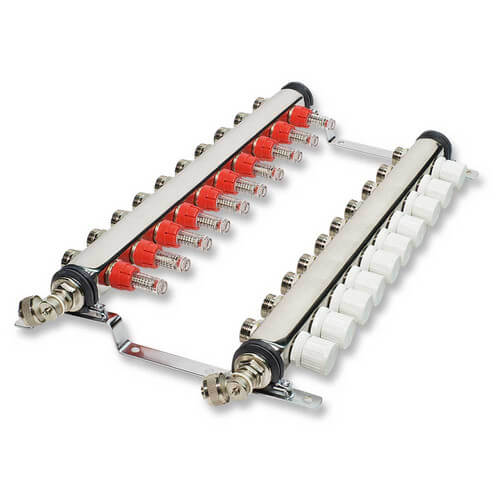
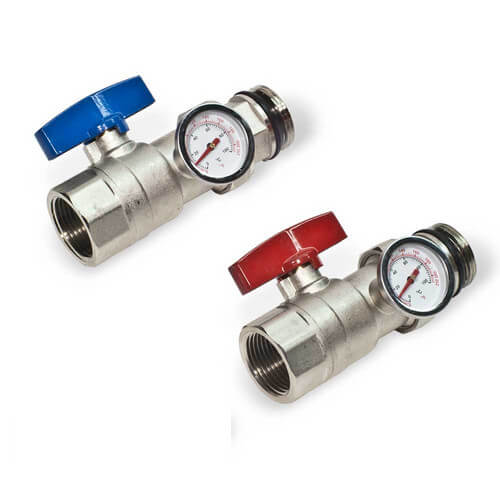
Includes supply/return shut-off valves with temperature wells.
Requires 20 Loop Fitting Assemblies (please see below).
Features:
- Flexible, modular and singular design system
- Easy-to-assemble construction
- Precise flow control and balancing
- Fitting for both PEX and Multilayer Pipe
- Control for the dominant heating systems like hydronic floor heating, fan coil heating or baseboard heating.
- No Sealant or Teflon required
This manifold requires (20) Loop Fitting Assemblies:
PEX Loop Fitting Assemblies Options
- 1/2" PEX to EK20 Loop Fitting Assembly
This fitting will connect 1/2" PEX to a loop of the Manifold - 3/8" PEX to EK20 Loop Fitting Assembly
This fitting will connect 3/8" PEX to a loop of the Manifold - 5/8" PEX to EK20 Loop Fitting Assembly
This fitting will connect 5/8" PEX to a loop of the Manifold
PEX-AL-PEX Loop Fitting Assemblies Options
- MA-50PAP: 1/2" PEX-AL-PEX to EK20 Loop Fitting Assembly
This fitting will connect 1/2" PEX-AL-PEX to a loop of the Manifold - 3/8" PEX-AL-PEX to EK20 Loop Fitting Assembly
This fitting will connect 3/8" PEX-AL-PEX to a loop of the Manifold - MA-58PAP: 5/8" PEX-AL-PEX to EK20 Loop Fitting Assembly
This fitting will connect 5/8" PEX-AL-PEX to a loop of the Manifold
Optional Installation Accessories:
Loop End Cap - These allow you to cap off a loop of the manifold if it will not be used.
Actuators
- Thermal Actuator for Bluefin Manifolds
If you want to use your manifold to heat multiple zones, you can purchase return side actuators that work along side thermostats. The actuators act as zone valves to allow you to use one manifold to control the temperature in different rooms independently.
The VA 80 adapter ring is also required when using an actuator with a Bluefin manifold, which you can find here.
Supply/Return Adapter Options
- MA-1014C: Supply/Return Adapter to 1" & 1-1/4" Copper
- MA-10MPT: Supply/Return Adapter to 1" Male NPT
- MA-10FPT: Supply/Return Adapter to 1" Female NPT
- MA-75MPT: Supply/Return Adapter to 3/4" Male NPT
Pressure Test Kit
Specs
| Number of Outlets: | 10 |
|---|---|
| PEX Size: | 1/2" 3/8" 5/8" |
| Main Inlet Size: | 1" FPT |
| Loop Thread: | EK20 |
| Temperature Range (F): | 0°F - 185°F |
| Max Temp (F): | 194°F |
| Material: | Stainless Steel |
| Application: | Heating |
| Fitting System Compatibility: | PEX Compression PEX-AL-PEX Compression |
| Tubing Compatibility: | PEX-AL-PEX PEX |
| Standards Met: | CSA B137.5 NSF ASTM F877 |

Questions?
Compare Similar Products
You May Also Need
9 Replacement Parts
Need help finding a replacement part?
Product Reviews
Most Liked Positive Review
Professional Looking Job!
Most Liked Negative Review
 --%3E %3Csvg version='1.1' id='With-RB' xmlns='http://www.w3.org/2000/svg' xmlns:xlink='http://www.w3.org/1999/xlink' x='0px' y='0px' viewBox='0 0 100 100' enable-background='new 0 0 100 100' xml:space='preserve'%3E %3Cpath fill='%23FBC8B4' d='M79.44,0.95H20.56C9.78,0.95,0.95,9.78,0.95,20.56v58.87c0,10.79,8.82,19.61,19.61,19.61h58.87 c10.79,0,19.61-8.83,19.61-19.61V20.56C99.05,9.78,90.22,0.95,79.44,0.95z M65.38,58.24l9.38,29.58L49.69,69.78L24.5,87.82 l9.34-29.6L8.8,39.6l30.73-0.17c0,0,6.98-19.61,10-28.93c0.54,1.36,9.88,29.1,9.88,29.1H91.2L65.38,58.24z'/%3E %3C/svg%3E)
Disappointed, but I would buy this again with caution
Manifold
Disappointed, but I would buy this again with caution
Great quality!
Good looking quality product that was priced affordable
Very nicely made
Impressive
Good looking product
Love service
Yes
Very nice
Product Q&A
8 QuestionsQ: Can i mount the manifold vertically and the flow meters still work?
Asked by Jocko 10 years ago
Add your answer
Verified Reply- Supplyhouse StaffNo it should be mounted horizontally W flow meters upright.
Q: I will have 10 loops in 6 different heating zones. Will this manifold supply my needs(6 pumps) or should I use smaller, seperate manifolds?
Asked by Greg 11 years ago
Add your answer
Verified Reply- SupplyHouse StaffThis will supply your needs. It is a 10 loop manifold and can be zoned up to 10 zones.
Q: Will this work with 1/2 inch Uponor O2 barrier tubing?
Asked by Dave 11 years ago
Add your answer
Verified Reply- SupplyHouse StaffYes, the RHM10 manifold may be used with 1/2" Uponor oxygen barrier tubing. You would need the MA-50P loop fitting assemblies to make the connection.
Q: I am going out to SlantFin baseboards with a 3/4 inlet and outlet. I see the manifold has 3/4 port, but I cant find the right 3/4 to 3/4 pex fitting. Which one should I be using?
Asked by Doin it myself 11 years ago
Add your answer
Verified Reply- SupplyHouse StaffRifeng does not offer 3/4" fittings for their manifolds. The largest connection options is 5/8".
Q: What is the width of the RHM10 manifolds (with temp well installed)?
Asked by Patty Mayonaisse 14 years ago
Add your answer
Verified Reply- PexSupply StaffThe RHM10 is 23.5" long and the ball valves add another 4" to that if you use them.
Q: Hi I need to know what is the outlet size
Asked by Al 14 years ago
Add your answer
Verified Reply- PexSupply StaffRifeng stainless steel manifolds have EK20 threaded outlets. We offer EK20 compression fittings for three different PEX sizes: 3/8" (part MA-38P), 1/2" (part MA-50P), 5/8" (part MA-58P). PEX-AL PEX fittings in those sizes are also available.
The outlet size is 1" female pipe thread …….its the same size on a 2 port all the way to a 10 port.
I believe the 10-ports for the loops are threaded for EK20 fittings (a European trade size, I believe) but the I.D. of the port is fairly large and list for use with up to 5/8" tube. The inlet and outlet mains are much larger - 1"+ ID, I think ... each 10-port manifold (supply and return)has an EK size fitting at the end, which is then fitted to a small brass body with temperature gauge/ball valve shut-off which then terminates in a 1" female NPT thread. The other end of the 10-port manifold also has an EK thread fitting spedcialized for filling and draining the system But maybe that is just how I purchased mine - with the temp gauges and valves included. These certainly do make it nice for filling / draining and watching water temp in and out of the manifold. Chris
Q: Hello, I will be installing 3 of these units for hydronic floor heating, each loop will be about 200 to 250 linear feet 2000-2500 total feet. One on each floor, basement, main floor and second floor, creating 3 zones. What size circulator pump is recommended with these manifolds, I would use 3 seperate pumps, one for each manifold. I was considering the Taco 0015-MSF2-IFC, would this pump be enough, or would a larger pump be required?
Asked by Dipal 14 years ago
Add your answer
Verified Reply- PexSupply StaffCirculator pump sizing depends on the flow rate and head pressure of the area that is controlled by the circulator pump. See the link below for specific sizing information. http://s3.pexsupply.com/manuals/1289252668477/41390_PROD_FILE.pdf
depending on gmp flow rate you are trying to achieve usually around 3gpm your head loss would be between 4 and 5 ft plus you feeder lines if 3/4 in is 3.73 per 100 ft. so as long as your pump can pump the gpm at your head loss you should be fine. I usually use Grundfos pumps UPS15-58FC three speed pumps for this application and have had great results. Hope that helps. Troys Mechanical Inc. Troy L. Donat
Q: What if the difference between stainless steel and brass manifolds? Which is better to use?
Asked by Sergey 15 years ago
Add your answer
Verified Reply- PexSupply StaffThe material is the only difference. Many people prefer the Rifeng manifolds because of the stainless steel metal, the price, and the inclusion of shut-off valves and flow meters.
Typically Stainless steel is harder material, and can be more problematic to seal the threaded joints, but it is more tolerant of aggressive water chemistry. Brass is softer, and thus easier to seal threads on, but can be a problem where water has sulfur, or other problems. I use the Stainless Rifeng manifolds, as they are priced right, and if you use teflon tape, and pipe thread sealant both on the threaded connections, they are no problem. The o-ring connections on the loop connections is no problem, but be careful when sliding them up into the manifold, as it needs to be straight, and put a little water on them to lubricate the o-ring, or it can tear the o-ring and you will have to replace it. Hope that helps. Best, Ben SchneiderSchneider Plumbing
In my humble opinion, both are excellent choices, however, depending on the other components in your system, stainless steel may be the better option since it is not affected by electrolysis problems that sometimes occur with the electrical currents that sometimes are created within a system. Stainless is a "harder" material than brass. Thus, if cost is not a factor of concern, I would prefer Stainless Steel over brass but it may be more of personal preference than it might be of any thing of substance. G Lewis
I believe the main difference is chemical resistance, i.e. stainless steel (SS) products are more resistant to corrosion than similar products made of brass. SS while very strong is not as ductile and is therefore more likely to shear or crack under high mechanical stress. Brass is not as strong by weight and so is generally reinforced with thicker walls (heavier.) That being said, different manufacturers may use different grades (series) of SS to make a product for the same purpose. The 316 series and 630 series are more resistant to corrosion than the 400 series and so different grades might be used for the different parts in a single valve (stem, ball, etc.). So manuafacturer and reputation may be a concern. For the 10-loop manifold pictured below from Rifeng, (1/2" I am guessing) I will say that it has worked well in the very limited time I have been using it (2 weeks) and installation was very straightforward. I should note that the flow gages might work well if mounted right side up (and perhaps sideways?) but not well upside down (PEX runs going up).. I have both brass (Mr. PEX) and SS manifolds (Rifeng) in my setup - originally I had a Mr. PEX 2-port 3/4" brass manifold sending water to Rifeng 10-port 1/2" and 7-port 1/2" SS as "remote" manifolds in the 2 zones of my house. However, having one large manifold fed through one port of another manifold (even if it was a 3/4") caused flow to be too restricted, especially by the internal parts of the flow gauges (along with the valve on the return side) so I removed the 3/4" brass manifold from that setup. The Rifeng 1/2" manifolds did not come packed very well by Rifeng and each manifold set had one of two thermometers broken (PEX Supply was very good they suggested I return one manifold set with both broken thermometers and then sent a replacement.) They are decent manifolds - very light for their size (because of the SS) but parts seem but some of the parts seem a bit cheap or "chincy" as they say, for example the broken thermometers and half of one handle on a ball valve just broke off in my hand trying to spin it. The other end of the manifold does have a nice drain valve which spins freely 360' open or closed which was nice and it could be removed to mount on a gauge for pressure testing. The end by the ball valve is 1 1/4" MPT while other fittings are a different thread with O-rings.. These fittings did provide good tight seals. Comparatively, the Mr. PEX 2-port 3/4" brass manifold seemed like it had more quality (maybe that is just my feeling being that it was made in Italy as opposed to China) but the thermometer and handle thing did not help. The Mr. Pex manifold being brass is pretty heavy,the threads all seem very high quality as did the valves and thermometers. It came with one end of each manifold piece (supply and return) capped on one end with a special T for a drain and either a screw-bleed vent or an auto-air vent. The auto-air vent I acutally think is a bit cheap. The last thing I did not like was that the special T-fitting on the end must have been glued down (Loc-Tite?) after being wrenched on really well because that thing was NOT coming off, which makes mounting in different configuarations a bit more of a thought process. But this also led me to believe that the whole unit was really built well because a lesser unit might have been damaged by the stress of trying to disconnect the T from the manifold. Overall the Rifeng manifold is great, especially for its size, light weight and number of ports, but consider how hard you will be playing with it. If you tend to play rough, or the unit might be subjected to some bumps in your basement, then you may want to think about the Mr. PEX units, just know they are not as easily configuredas the Rifengs.