



'/%3E%3C/svg%3E)
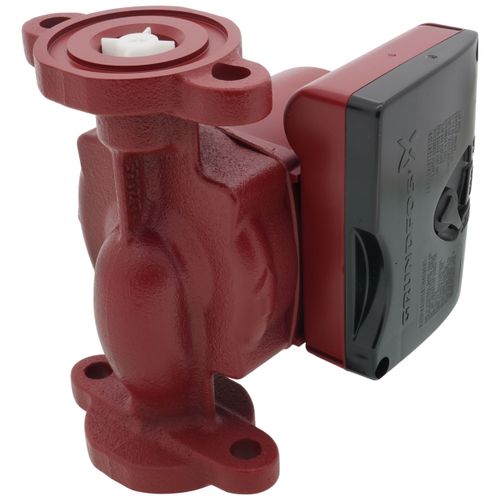
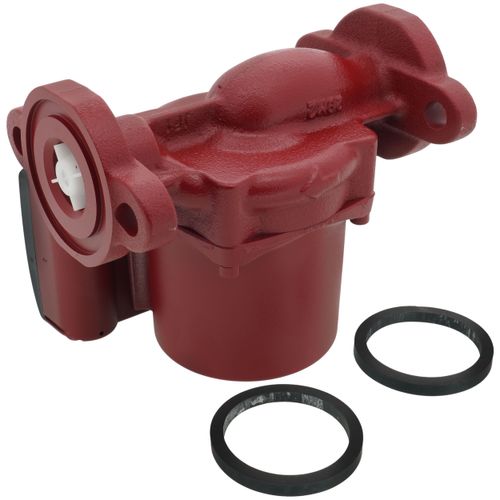
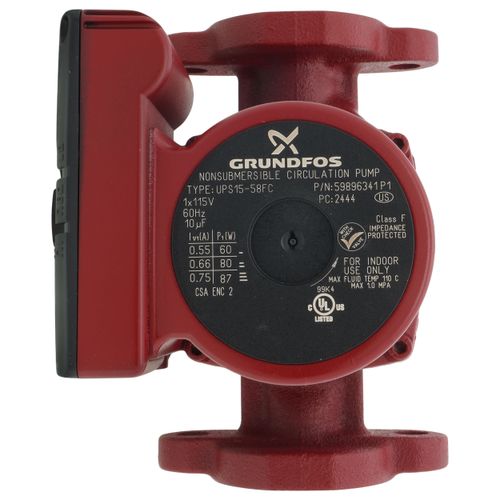
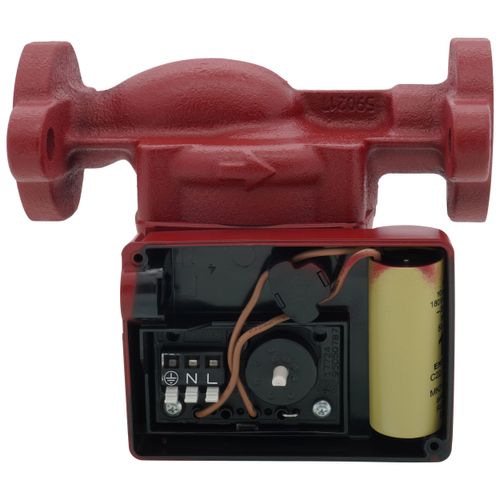
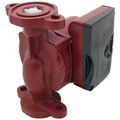
UPS15-58FC, 3-Speed Circulator Pump, 1/25 HP, 115 volt
 --%3E %3Csvg version='1.1' id='Fill' xmlns='http://www.w3.org/2000/svg' xmlns:xlink='http://www.w3.org/1999/xlink' x='0px' y='0px' viewBox='0 0 100 100' enable-background='new 0 0 100 100' xml:space='preserve'%3E %3Cpath fill='%23F15C02' d='M79.44,0.95H20.56C9.78,0.95,0.95,9.78,0.95,20.56v58.87c0,10.79,8.82,19.61,19.61,19.61h58.87 c10.79,0,19.61-8.83,19.61-19.61V20.56C99.05,9.78,90.22,0.95,79.44,0.95z M65.38,58.24l9.38,29.58L49.69,69.78L24.5,87.82 l9.34-29.6L8.8,39.6l30.73-0.17c0,0,6.98-19.61,10-28.93c0.54,1.36,9.88,29.1,9.88,29.1H91.2L65.38,58.24z'/%3E %3C/svg%3E)


MANUALS (3)
'/%3E%3C/svg%3E)
Product Highlights


Description
- Compact, space-saving design for easy installation in tight spaces
- Maintenance-free, canned rotor design
- Corrosion resistant impeller
- Designed for low-noise operation in residential environments
- Three-speed motor allows you to optimize performance and reduce energy consumption
Specs
| Amperage: | 0.75 |
|---|---|
| Frequency: | 60 Hz 60 Hz 60 Hz |
| Application: | Zoning |
| Material: | Cast Iron |
| Poles: | 2 |
| Voltage: | 115V |
| Max Pressure (PSI): | 145 |
| Type: | 3-Speed Pump |
| Features: | Integral Check Valve |
| Horse Power: | 1/25 |
| Max Flow (GPM): | 17 |
| Flow Range (GPM): | 0-17 |
| Max Head (Ft): | 19.5 |
| Head Range (ft.): | 0-19.5 |
| Hertz: | 60 |
| Phase: | 1 |
| RPM: | 2450 |
| Temperature Range (F): | 36°F - 230°F |
| Connection Size: | 1-1/4" 1" 3/4" 1-1/2" |
| Connection Type: | Flanged x Flanged |

Questions?
Compare Similar Products
You May Also Need
3 Replacement Parts

Need help finding a replacement part?
Product Reviews
Most Liked Positive Review
Easy Out & Easy In with Exact Replacement Parts
Most Liked Negative Review
 --%3E %3Csvg version='1.1' id='With-RB' xmlns='http://www.w3.org/2000/svg' xmlns:xlink='http://www.w3.org/1999/xlink' x='0px' y='0px' viewBox='0 0 100 100' enable-background='new 0 0 100 100' xml:space='preserve'%3E %3Cpath fill='%23FBC8B4' d='M79.44,0.95H20.56C9.78,0.95,0.95,9.78,0.95,20.56v58.87c0,10.79,8.82,19.61,19.61,19.61h58.87 c10.79,0,19.61-8.83,19.61-19.61V20.56C99.05,9.78,90.22,0.95,79.44,0.95z M65.38,58.24l9.38,29.58L49.69,69.78L24.5,87.82 l9.34-29.6L8.8,39.6l30.73-0.17c0,0,6.98-19.61,10-28.93c0.54,1.36,9.88,29.1,9.88,29.1H91.2L65.38,58.24z'/%3E %3C/svg%3E)
Time will tell
yes
yes
I will continue to buy from Supplyhouse.com
Great pump
good
Great delivery time
Great product
A solid little work horse
Great Pumps
I would buy again
Product Q&A
64 QuestionsQ: I have 1 zone with 4 loops of 225ft 1/2 inch pex. I want to heat this space to 50F. Will this pump work in this setup or is there a better pump for me.
Asked by chuck 14 years ago
Add your answer
Verified Reply- PexSupply StaffThis circulator would probably work, but the only way to know for sure would be to calculate the GPM and head pressure of your system.
This pump will move the water just fine for these loops, and will heat well under normal construction parameters. If it doesn't heat you have other issues. Too much heat loss in the structure or in the floor, too wide of spacing for the tubing, too low initial water temp, etc. But the water velocity and volume pumped with this pump in these lengths of loops should not be an issue. The change in temp between the supply and the return will not be very large. I use the pump in more loops than the 4 you state and never use more than the first speed.
You want a flow rate of about .625 GPM in each circuit to ensure turbulent flow. Maximum recommended flow rate for 1/2 PEX is 3.0 GPM. Therefore, you need a pump with that will do at least 2.5 GPM but not exceed 12 GPM at the circuit Head (pressure drop on your circuit). UPS15-58 will give you about 3.2 GPM and at speed 1 and 4.6 GPM at speed 3. There some other pumps shown on the graph but I like the flexibility of the 3 speed pump This pump is the right pump for your circuit. Running the pump at Speed 3 will increase the heat transfer to your room. However, whether this is adequate to maintain 50 F depends on many variables. If the room is insulated and you have the circuits installed in the majority of the floor you should have no problem. If the heat is not adequate you have several options: Improve the insulation Run the pump at the higher speed Increase water heater temperature Add aluminum plate or silicone caulk to improve heat transfer to the floor. Add more circuits ( this same pump would handle 8 circuits )
This pump can easily do this on MED speed and maybe LO speed depending on manifolding, if the pump also has to push the water thru the heat source then the whole system needs to be evaluated to determine application of this pump. Mike
This circulator should do the job. Eric
I heat 4 zones. 1 Zone has 6 loops of 210ft/1/2 inch pex per loop and another has 4 loops on the average of 190ft per loop another zone that runs into a heat exchanger and finally another zone with 4 loops on the average of 220ft per loop and all I use are these circulators. They are very dependable and do not cost much to run. I have been heating with these circulators since 2007 and they are still going strong.
That one will work
The absolute maximum loop length for 1/2" tubing is 300'. Shorter loop lengths work better because they provide less temperature drop in the loop. Hot-spots and Cold-Spots become very noticeable with longer loop lengths. This Pump will handle this application with proper spacing.
This should work fine. Nathan Nagaruk NJ Construction, LLC
Flow of 1 gal/min of 120 degree H2O without anti-freeze is a pressure loss of .0344 Feet/Head per foot.--.0344 X 225'= 7.75'/hd + the loss from the boiler to the manifold. Figure 8.5'/hd total(a guesstimate). 4 loops at 1 gal/min= 4 gal/min total. Use speed Med (#2). This speed is a bit higher on the '/hd so you will get a bit more gal/min flow. NOTE--The loops must be as close to the same length or you will have an unbalanced flow with more water flowing thru the shortest length loop. You can also use an ALPHA pump on auto adapt and just control the flow with a Taco sentry zone valve connected to a thermostat. Leave the ALPHA pump plugged into an outlet all the time.
Q: What fittings are use to connect to 3/4" copper to avoid Dielectric corrosion?
Asked by Joe 14 years ago
Add your answer
Its called a dielectric union. They should be in 3/4".
You're asking about a dielectric union, but this cast iron circulator is only suitable for closed loop systems where dielectric unions aren't used. They're used in open systems to insulate dissimilar metals preventing the direct connection from forming a low voltage wet cell battery where the electrical current developed increases the rate of metal erosion into the water. They aren't used in closed systems because no matter what rate it happens at the water in the closed system becomes saturated with metal from the system and then because the water can't carry any more dissolved metal, no more metal is lost. Likewise, when the oxygen has been spent creating metal oxides, no more metal is oxidized. Both the circulator motor and the piping are ordinarily bonded to the house safety ground shorting out a dielectric union anyway. Dielectric unions could be useful to isolate a tankless coil in a boiler in the open hot water system though.
Q: I purchased this product and currently have it inline at the same height with a water source exposed to the open atmosphere. After electrically hooking up the pump it does not seem to be pumping the water through the pump on any of the three speeds. I now noticed from one of the spec sheets that there is an inlet pressure requirement. Could this be why I am having troubles? Is it necessary to elevate the water supply to increase pressure? Or is it a problem with the pump itself?
Asked by Griffin 14 years ago
Add your answer
The Pump is most likely air bound. Loosen the pump seals until water comes out or bleed the air out however possible.
I don't think so. Check the following: 1. Check pump receives electricity. 2. Is pump piped properly? Check flow arrow in pump head. 3. Check there is no air in inlet line, purge it. Try again. 4. Be sure pump works, take off motor. Take away four screws with Allen key, separate motor and head. Once separated, having motor with impeller on free rotation, start pump, impeller should rotate fast. 5. If impeller doesn't work, motor is faulty, exchange it. If it works, it should be 2 or 3, or discharge is too high.
You will need some head (pressure) to get the water into the pump at least to get it "primed", otherwise your trying to pump air. These pumps aren't made to work with vacuum, but it may operate once it is primed. If its too far above your tank it will just cavitate. It should be placed below the water level. Pumps have a npsh spec (http://en.wikipedia.org/wiki/NPSH) which dictates how much head they need above them. On a side note this is a cast iron pump, your atmospheric system will need oxygen control or the pump will rust out.
It has an integrated Check valve. Prime the pump and it should work or pull the check valve off of the top of the pump.
Your going to need 10 psi of pressure. The water is basically flat now and cannot build head pressure because it drains the incoming water. Pex sells an auto fill valve that will keep your system pressurized. Walter
not sure what the opening presure is of the check valve, maybe you could try removing the inlet check valve and try it
Generally speaking this pumps requires a positive pressure at the inlet, they are not self-priming, the easiest way to accomplish this is to make sure the level of the water is a couple of feet above the level of the pump, this will produce 1psi at the inlet do to the weight of the water. You should always flush water through the system prior to turning on the pump, this is a wet lubricated pump and will ruined if run dry more than a few seconds. Mike
the term "Pump" is a little misleading with any circulator pump... These circulators will only circulate water that is already under pressure inside the pipes. Example one, a closed loop heating system. If you are trying to use this circulator to lift or pump water above the impeller then in 98% of all installations it will just sit there and spin. You would have to stack a group of these pumps together or purchase a much larger pump to overcome the head pressure. Personalized Plumbing & Heating
You'll want some pressure on the inlet side. But that's not your biggest problem: You said that the water source is open to the atmosphere, but this product is a cast iron pump. That's not a good combination. Use a bronze or stainless steel pump for that.
There is probably air in the line. This pump cannot pump any air John Rush Evolo Home Center Evolo Energy Solutions www.evolohomecenter.com www.evoloenergysolutions.com Sent from my U.S. Cellular® Android phone
Q: Hi, I have a open system on a domestic hot water tank. 5 loops of 200' 1/2 pex ,one zone. What pump,relay and thermostat I have to use?
Asked by Clau 15 years ago
Add your answer
Verified Reply- PexSupply StaffWe would recommend a Taco SR501-2 switching relay, a Tekmar 509 thermostat, and a bronze or stainless steel circulator. The size of the circulator must be based on the flow rate and head pressure of the loops.
I use one of these pumps on my basement slab which is 6 loops of ½" @ 200' each. I use a simple 120v wall thermostat to control the pump. That set-up is designed for my basement though I use the pump set on the slowest speed and have the water temp mixed down to 95deg. Set-ups vary though, I use the same pump upstairs on the highest speed with water mixed to 145deg with 12v t-stats and Honeywell zone valves which have a 120v switch built in to turn the pump on. I would not make it an open system unless you have to, there is no reason to make it open unless you have a vessel in the system that can't handle 15psi. Your water heater can take much more and so can the pump and piping. Just get a little expansion tank, save yourself from the corrosion.
Clau, Some things to think about. The size of the pump is determined by A) the amount of hot water you'll need to push through the pipes, and B) the amount of resistance in the pipes to that flow of water. Since you don't mention what the heat requirement is (BTUs), I can only guess. Is this one room in a cold climate? Maybe 10,000 BTUs max? You are using the domestic hot water heater in an open system, so is the water temp 120 F? There is some fun math that converts heat requirements to gallons/min of water at a certain temperature. How the pipes are installed in your floor also impacts the math. A low water temperature can be a problem heating a big room in a cold climate. Your system piping sounds simple (1 manifold?), so the flow resistance (feet of head) is probably low (<5 feet perhaps?). Just guessing, but a 1/25 orhorsepower pump will probably work just fine. Just guessing. All pumps come with graphs showing how much flow they generate for a given resistance. Many bro choose from. The MOST IMPORTANT thing is that you choose a brass or stainless steel pump. Dissolved air in water contains oxygen, which corrodes iron pumps (and piping!). The Taco one zone pump relay is easy to use. Many thermostats to choose from. I like the Uponor models, which are designed for radiant heat.Never put a thermostat on an exterior wall.
Hello, I have a similar system and I use the Grundfos 15-58 pumps and standard programmable thermostats connected via the Taco SR 503 switching relay to control the pumps. The thermostats click on and the switching relay allows 120 v power to flow to the pumps which pushes hot water through the system. This has great worked to heat three zones in my house for three years. Sean
A Grundfos UPS15-58FC or Taco 007 w/IFC will work fine. You will need a single zone (Pony) relay. For Radiant, go with a very basic t-stat. One zone, heat only. Be sure to have a thermostatic mixing valve installed with radiant heat. Personalized Plumbing & Heating "Solutions for every budget"
You have relatively low flow with ½” pipe. PEX has a C factor of 150 for which the Glover pocket ref lists a friction head of 10.5 ft./100 ft. at 2 gpm. So for a single line for 200 ft. your friction head is 10.5 x 2 = 21 ft. With five runs x 2 gpm, you would have 5 x 2 gpm = 10 gpm total with 21 ft. of friction head. Looking at pump curves, you will find a TACO 009 pumps 6 gpm at 21 ft., and 8 gpm at 12.5 ft. so it will pump somewhere between 6 to 8 gpm., probably closer to 8 gpm. A TACO 011 pump will produce 12 gpm at 21 ft. of head and 10 gpm at 23 ft., so it will pump a little more than 2 gpm per loop. Your choice. You should use a stainless or brass pump, not ferrous. The TACO Single Zone Switching Relay will work for you. Hope you can read the wiring diagram because you’re going to have to wire per the diagram. The manufacturer’s wiring labels are misleading, in my opinion. A basic heat only, or 1 heat, 1 cooling thermostat is all you need. Install it at chest level (~48”). Best wishes, SOLAR TECH, LLC Allan Wulff ***.****
1st) Is this for in-floor radiant heat? For this discussion I will assume it is. 2nd) If you’re going to use an open system where is it vented? All I have seen are closed system w/an expansion tank when using a domestic hot water heater. Solar systems do incorporate a drain down system (open loop system) but even those often have the heat exchanger coil and water heater closed. If you drain down a domestic hot water heater (remove fluid from the inside) you run the risk of causing damage to it and or your dwelling by overheating what ever fluid is left inside it, the pressure relief valve may also open further emptying the tank causing an even more dangerous condition, I would not go this way. 3rd) If you have ’” PEX tubing each that is fine, however those five loops equate into 5 zones, not one. So you will need a 5 zone manifold to properly distribute and adjust the flow to each area you’re heating. 4th) In order to calculate the pump size you will need to know the total head pressure and the rate of flow. That m be calculated by the number of feet of tubing, how many fittings and their sizes (1/2”-3/4”-1”), the pressure drop through the water heater as well as any other item the fluid flows in and out of. Then you will need to know the total amount of flow in Gallons Per Minute (GPM) to heat the floor on the coldest day of the year. You should be able to find this info from either the Taco or Grundfos web sites. In any case the Taco 007 008 009 etc. single speed and the Grundfos 3 speed UPS 15 58 are standards in the industry for moving this kind of flow. The nice part of the three speed is that if your calculations are off, the pump speed can be changed with the flick of a switch to make up for the miscalculation. There are many variables to a system, you need to do a little more homework so when your system is up and running, it works and you don’t find yourself going back and redoing it over and over again. 5th) There are different ways to control the pump, a very simple way is to get a 120 volt thermostat and connect it to the pump. When the room calls for heat the thermostat turns it on (which starts the fluid circulating) the individual zone temperatures are controlled by the flow meter setting on the zone manifold. Then there is the 24vac power supply method with relays etc., or the use of a differential temperature controller with sensors. There are several ways to control the heat, this is something you will have to decide on. Budget, system configuration and knowledge may be important factors in determining this. Good Luck Fred
Pump works great. I have 2 zones 500. Ft each. Workable great. Sent from my Verizon Wireless 4GLTE smartphone
Assuming that these 5 loops are in parallel, and the water temp is 120 deg. F., your system will have about 0.6 ft. of head @ 1 GPM. Also, you need to know the heat load of what you are heating. Are these loops embeded in concrete, or under a wood subfloor? A concrete slab (if insulated) will generally require less BTU/h than a wood sub floor. Since I don't have that information we'll size the pump for a wood subfloor (which if for concrete the pump will have shorter cycles). Figuring 0.6 ft. head @ 1 gpm, a Grundfos UP 15-10 B7 would give you about 5 gpm. Relay: Taco SR501-2 Thermostat: Honeywell TH2110D1009 I have a open system on a domestic hot water tank. 5 loops of 200' 1/2 pex ,one zone. What pump,relay and thermostat I have to use?
No heat exchanger in the tank? Set house pressure to 55 psi. Open system (no heat exchanger) bronze or stainless pump mandatory. Set tank output temp not more than 125 degrees. Use W/R 1F86-344 type thermostat. Control pump with W/R 90-130 fan control center type. Can't run 110V through 18 ga thermostat wire (24V only). 5 Loops must be identical in size, length and resistance or balancing valves necessary. Max flow thu 1/2" PEX is 2gal/min. calculate for less (1gal/min). Diff. Manufactures make 1/2"PEX in diff. dia. see their pressure loss tables. Off-Hand, Pr. Loss 200' 1/2" PEX @ 1gal/min @ 120 deg. H2O = 6.88'/hd---2gal/min = 23.88'/hd. You need pump that will pump 7'/hd @ 1gal/min, + all other pressure losses. Grundfos UP15-42SF or SU. --- 3 ways to increase heat output--increase # loops--increase flow--increase Water temp. Can use ALPHA 15-55SF pump + Taco Sentry zone valve + 24V--20VA transformer.
Q: Since this has a flow valve it is not necessary to install an inline flow valve. My question what if an inline flow valve was installed with this circulator would it cause any damage?
Asked by 15 years ago
Add your answer
Verified Reply- PexSupply StaffIt wouldn't cause any damage, but it would create a further reduction in flow.
It would not be necessary to install a seperate flow valve if the pump has one. However I don't see any real problem with having a seperate flow valve. If there is already a flow valve in the system then simply remove the flow valve from the pump before installing the pump.
An inline flow valve can be installed only downstream from any pump, NOT upstream. It will not cause any damage to the pump. But there should be no reason to install any valves anywhere.
Q: If this pump is mounted in a horizontal position, will it perform correctly?
Asked by 15 years ago
Add your answer
Verified Reply- PexSupply StaffThis pump will operate as long as its canister is not pointing straight up in the air, but it's never a good idea to allow water to run over electric.
they will not work that way,it's not recommended to install that way.
YES, it will perform correctly. I use this pump, a lot. With the axis through the pump flanges it can be mounted vertically (vertical axis) in any position. Horizontally ( horizontal axis) the pump motor must be level(not be below or above the horizontal axis). However, in systems with 45 psi or above, system static pressure , the motor can be mounted above the horizontal axis. Never below, 45 psi precludes most hydronic systems. The motor, if in the wrong configuration, can be rotated on the volute by removing the 4 screws which hold the motor to the volute and rotating the motor to the position you want and re-tightening.
Q: I have this pump running on a 1/2 inch 250 foot underfloor pex leg. The rest of the home is is circulated by a boiler pump in my 2000 sq/ft home with cast iron radiators in the rest of the house. The Grundros pump just is on the pex leg but the return goes back to the main boiler system. My problem is that after about 24 hours my 12 lbs system is up to the the system relief valve pressure of 30 lbs. There is an expansion tank on the system, I don't know what it is set at as I never had to pay any attention to it. What can I do to stop the pressure build up?
Asked by Doug in Buffalo 15 years ago
Add your answer
Verified Reply- PexSupply StaffExpansion tanks are normally pre-set to 12 psi. It's possible that the expansion tank is not functioning properly due to a broken diaphragm.
Be sure your pressure regulating valve is functioning correctly and set to 12-15 psi. Amtrol Filtrol Exp tank static pressure is regulated by the air charge in the Exp tank (factory set to 12 psi). If O.K.--then-- Your expansion tank is water logged. assuming air cushion type, you lost your air cushion. On bottom of tank is a plastic blue or red cap. Inside is a schrader valve(same as tire air valve) . You can unscrew the tiny valve, go to auto parts store and buy a new schrader valve and tightening tool and replace the valve (easy). Make sure it is tight. If water comes out of the schrader valve when you take out valve , you need a new EXP tank. I've discussed setting the pressure under the heading Expansion Tanks, this forum. Basically this, no water in tank when inflating tank--- The static system pressure (pump not pumping)height from the Exp. tank to the highest heat emitter + 5psi. --2 story house, typically, 12-15 psi. Your Exp. tank too small if PEX is new addition?
Q: I have a UPS 15-42F that needs replaced is the correct model to replace or a UP 15-42/VS?
Asked by 15 years ago
Add your answer
Verified Reply- PexSupply StaffThe current part number for UPS15-42F circulators is 59896180.
Q: I was looking for this pump on Grundfos' website and couldn't find it. Is this pump still being produced?
Asked by 15 years ago
Add your answer
UPS 15-58FC YES!!! SKU: 59896341
Q: What exactly does the check valve do. When this pump is used as a zone pump, does the check valve prevent forward flow thru the pump when when others are running?
Asked by 15 years ago
Add your answer
Verified Reply- PexSupply StaffThe purpose of the check valve is to prevent heat from flowing into areas that are not calling for heat. Check valves are a necessity in systems zoned by circulator. This pump includes an integral check valve, eliminating the need for one in the line.