




Filters
SORT
Product Availability –
Category –
Brand –
Number Of Plates –
Review Score –
 --%3E %3Csvg version='1.1' id='Fill' xmlns='http://www.w3.org/2000/svg' xmlns:xlink='http://www.w3.org/1999/xlink' x='0px' y='0px' viewBox='0 0 100 100' enable-background='new 0 0 100 100' xml:space='preserve'%3E %3Cpath fill='%23F15C02' d='M79.44,0.95H20.56C9.78,0.95,0.95,9.78,0.95,20.56v58.87c0,10.79,8.82,19.61,19.61,19.61h58.87 c10.79,0,19.61-8.83,19.61-19.61V20.56C99.05,9.78,90.22,0.95,79.44,0.95z M65.38,58.24l9.38,29.58L49.69,69.78L24.5,87.82 l9.34-29.6L8.8,39.6l30.73-0.17c0,0,6.98-19.61,10-28.93c0.54,1.36,9.88,29.1,9.88,29.1H91.2L65.38,58.24z'/%3E %3C/svg%3E)
 --%3E %3Csvg version='1.1' id='With-RB' xmlns='http://www.w3.org/2000/svg' xmlns:xlink='http://www.w3.org/1999/xlink' x='0px' y='0px' viewBox='0 0 100 100' enable-background='new 0 0 100 100' xml:space='preserve'%3E %3Cpath fill='%23FBC8B4' d='M79.44,0.95H20.56C9.78,0.95,0.95,9.78,0.95,20.56v58.87c0,10.79,8.82,19.61,19.61,19.61h58.87 c10.79,0,19.61-8.83,19.61-19.61V20.56C99.05,9.78,90.22,0.95,79.44,0.95z M65.38,58.24l9.38,29.58L49.69,69.78L24.5,87.82 l9.34-29.6L8.8,39.6l30.73-0.17c0,0,6.98-19.61,10-28.93c0.54,1.36,9.88,29.1,9.88,29.1H91.2L65.38,58.24z'/%3E %3C/svg%3E)
Price Range –
Heat Exchangers


 --%3E %3Csvg version='1.1' id='Half' xmlns='http://www.w3.org/2000/svg' xmlns:xlink='http://www.w3.org/1999/xlink' x='0px' y='0px' viewBox='0 0 100 100' enable-background='new 0 0 100 100' xml:space='preserve'%3E %3Cg%3E %3Cpath fill='%23F15C02' d='M30.05,70.23l3.79-12.01L8.8,39.6l30.73-0.17c0,0,6.98-19.61,10-28.93c0.54,1.36,9.88,29.1,9.88,29.1h1.58 L93.71,7.18c-3.58-3.82-8.66-6.23-14.28-6.23H20.56C9.78,0.95,0.95,9.78,0.95,20.56v58.87c0,5.41,2.22,10.32,5.79,13.88 L30.05,70.23z'/%3E %3C/g%3E %3Cpath fill='%23FBC8B4' d='M93.71,7.18L60.98,39.6H91.2L65.38,58.24l9.38,29.58L49.69,69.78L24.5,87.82l5.55-17.59L6.75,93.32 c3.55,3.54,8.44,5.73,13.82,5.73h58.87c10.79,0,19.61-8.83,19.61-19.61V20.56C99.05,15.4,97.01,10.69,93.71,7.18z'/%3E %3C/svg%3E)

 --%3E %3Csvg version='1.1' id='No-RB' xmlns='http://www.w3.org/2000/svg' xmlns:xlink='http://www.w3.org/1999/xlink' x='0px' y='0px' viewBox='0 0 100 100' enable-background='new 0 0 100 100' xml:space='preserve'%3E %3Cpath fill='%23CECECE' d='M79.44,0.95H20.56C9.78,0.95,0.95,9.78,0.95,20.56v58.87c0,10.79,8.82,19.61,19.61,19.61h58.87 c10.79,0,19.61-8.83,19.61-19.61V20.56C99.05,9.78,90.22,0.95,79.44,0.95z M65.38,58.24l9.38,29.58L49.69,69.78L24.5,87.82 l9.34-29.6L8.8,39.6l30.73-0.17c0,0,6.98-19.61,10-28.93c0.54,1.36,9.88,29.1,9.88,29.1H91.2L65.38,58.24z'/%3E %3C/svg%3E)
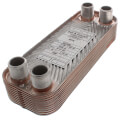
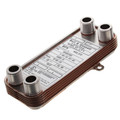
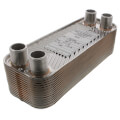
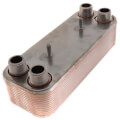
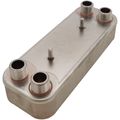

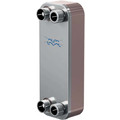

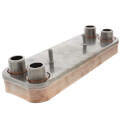
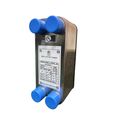
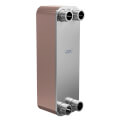
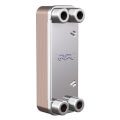
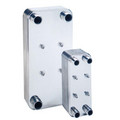
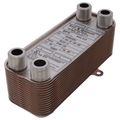
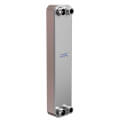
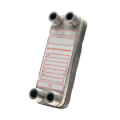
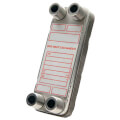
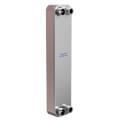
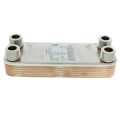
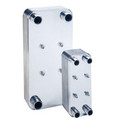

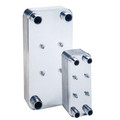

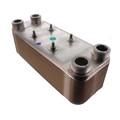

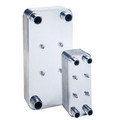




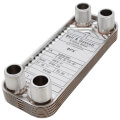
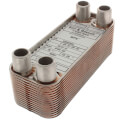
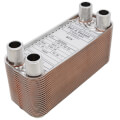
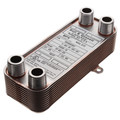
Heat Exchangers are devices that transfer heat from one fluid to another, and the brazed plate designs in this category pack that job into a compact footprint. Alfa Laval describes its CB brazed plate models as gasket free, with brazing material that seals and holds the plates together at the contact points. Bell & Gossett BPX units use stainless steel plates that are vacuum brazed into one integral piece, and the Low Pressure BPX is described as ideal for applications that require 150 PSIG or less. Kelvion describes its GBS-Series as suited to applications at a maximum of 580 psi. Listed applications include HVAC heating and cooling, hydronic heating panels and domestic water. Capacity, pressure rating, plate count and connection size differ from model to model, so matching the exchanger to the load keeps the job running right and the callbacks off the schedule.
Subcategories
- Domestic Water Brazed Plate Heat Exchangers: Domestic water brazed plate units transfer heat in a compact, gasket free design. The Alfa Laval CB16 with 11 plates is listed at 100,000 BTU/Hr for domestic water, with a 7.7 GPM flow rate. Alfa Laval lists HVAC heating and cooling among the applications for the CB line. Contractors use this style where a small footprint matters.
- Low Pressure BPX Heat Exchangers: Low Pressure BPX units from Bell & Gossett are described as ideal for applications that require 150 PSIG or less. The 60,000 BTU/Hr model lists 10 plates, and the stainless steel plates are vacuum brazed together into one integral piece. Bell & Gossett describes the line as a compact unit. Contractors use this style on lower pressure systems where a compact exchanger fits the job.
- Hydronic BPX Heat Exchangers with Mounting Tabs: Hydronic BPX units from Bell & Gossett include integral mounting tabs and connection locations. The tabs allow installation to a hydronic heating panel without a separate mounting bracket. The 60,000 BTU/Hr model lists 10 plates. Hydronic installers use this style to cut a bracket from the parts list.
- GBS-Series Brazed Plate Heat Exchangers: Kelvion describes its GBS-Series as the solid all-rounders among its brazed plate heat exchangers. The 14 plate model with 3/4 inch threads is listed at 8 GPM. Kelvion describes the series as suited to applications at a maximum of 392 degrees F and 580 psi. Contractors use this style on jobs of all sizes within those ratings.
Buying Guide
Start with the load and the fluids. Capacity is listed in BTU/Hr, so size the unit to the job first: the Alfa Laval CB16 11 plate model is listed at 100,000 BTU/Hr for domestic water, while the Bell & Gossett BPX 10 plate models are listed at 60,000 BTU/Hr. Flow rate matters just as much, and the listed examples show 7.7 GPM on the CB16 and 8 GPM on the 14 plate Kelvion unit.
Next, check pressure. Bell & Gossett positions the Low Pressure BPX for applications that require 150 PSIG or less, and Kelvion describes the GBS-Series for applications at a maximum of 580 psi. Match the unit's rating to the system before anything else gets ordered.
When shopping Heat Exchangers, confirm the connection and mounting style. The CB16 and the 14 plate Kelvion model list 3/4 inch threads, and the CB16 is male threaded. The Bell & Gossett hydronic BPX adds integral mounting tabs so it can attach to a hydronic heating panel without a separate bracket. Then compare plate count and depth, since the listed units run from 1-7/10 inch deep on the Kelvion to 2-1/5 inch on the hydronic BPX.
Finally, confirm the application. Alfa Laval lists HVAC heating and cooling, oil cooling and industrial heating and cooling for its CB line. Verify full specifications on the individual product page before purchase.
Frequently Asked Questions
How does a brazed plate heat exchanger hold together?
Brazed plate heat exchangers like the Alfa Laval CB series use brazing material that seals and holds the plates together at the contact points, so the design is gasket free. Bell & Gossett BPX units take a similar approach, with stainless steel plates vacuum brazed into one integral piece.
What pressure can a low pressure BPX heat exchanger handle?
Bell & Gossett describes the Low Pressure BPX heat exchanger as ideal for applications that require 150 PSIG or less. Pressure ratings differ across heat exchanger families, so check the exact model. Kelvion describes its GBS-Series for applications at a maximum of 580 psi.
Can a heat exchanger mount directly to a hydronic heating panel?
Some can. The Bell & Gossett Hydronic BPX heat exchanger has integral mounting tabs and connection locations that allow installation to a hydronic heating panel without a separate mounting bracket. The 60,000 BTU/Hr model lists 10 plates.
What connection size do brazed plate heat exchangers use?
Connection size varies by model. The Alfa Laval CB16 11 plate heat exchanger lists 3/4 inch male threads, and the Kelvion 14 plate unit is listed with a 3/4 inch thread. Check the connection type on each product page before ordering fittings.
What applications does Alfa Laval list for its CB brazed plate heat exchangers?
Alfa Laval lists HVAC heating and cooling, oil cooling and industrial heating and cooling for its CB brazed plate heat exchangers. The CB16 11 plate model is listed for domestic water at 100,000 BTU/Hr with a 7.7 GPM flow rate. Match capacity and flow rate to the job before choosing a heat exchanger.
