




Filters
SORT
Product Availability –
Brand –
Length (Inches) –
Review Score –
 --%3E %3Csvg version='1.1' id='Fill' xmlns='http://www.w3.org/2000/svg' xmlns:xlink='http://www.w3.org/1999/xlink' x='0px' y='0px' viewBox='0 0 100 100' enable-background='new 0 0 100 100' xml:space='preserve'%3E %3Cpath fill='%23F15C02' d='M79.44,0.95H20.56C9.78,0.95,0.95,9.78,0.95,20.56v58.87c0,10.79,8.82,19.61,19.61,19.61h58.87 c10.79,0,19.61-8.83,19.61-19.61V20.56C99.05,9.78,90.22,0.95,79.44,0.95z M65.38,58.24l9.38,29.58L49.69,69.78L24.5,87.82 l9.34-29.6L8.8,39.6l30.73-0.17c0,0,6.98-19.61,10-28.93c0.54,1.36,9.88,29.1,9.88,29.1H91.2L65.38,58.24z'/%3E %3C/svg%3E)
 --%3E %3Csvg version='1.1' id='With-RB' xmlns='http://www.w3.org/2000/svg' xmlns:xlink='http://www.w3.org/1999/xlink' x='0px' y='0px' viewBox='0 0 100 100' enable-background='new 0 0 100 100' xml:space='preserve'%3E %3Cpath fill='%23FBC8B4' d='M79.44,0.95H20.56C9.78,0.95,0.95,9.78,0.95,20.56v58.87c0,10.79,8.82,19.61,19.61,19.61h58.87 c10.79,0,19.61-8.83,19.61-19.61V20.56C99.05,9.78,90.22,0.95,79.44,0.95z M65.38,58.24l9.38,29.58L49.69,69.78L24.5,87.82 l9.34-29.6L8.8,39.6l30.73-0.17c0,0,6.98-19.61,10-28.93c0.54,1.36,9.88,29.1,9.88,29.1H91.2L65.38,58.24z'/%3E %3C/svg%3E)
Refrigeration Hoses


 --%3E %3Csvg version='1.1' id='No-RB' xmlns='http://www.w3.org/2000/svg' xmlns:xlink='http://www.w3.org/1999/xlink' x='0px' y='0px' viewBox='0 0 100 100' enable-background='new 0 0 100 100' xml:space='preserve'%3E %3Cpath fill='%23CECECE' d='M79.44,0.95H20.56C9.78,0.95,0.95,9.78,0.95,20.56v58.87c0,10.79,8.82,19.61,19.61,19.61h58.87 c10.79,0,19.61-8.83,19.61-19.61V20.56C99.05,9.78,90.22,0.95,79.44,0.95z M65.38,58.24l9.38,29.58L49.69,69.78L24.5,87.82 l9.34-29.6L8.8,39.6l30.73-0.17c0,0,6.98-19.61,10-28.93c0.54,1.36,9.88,29.1,9.88,29.1H91.2L65.38,58.24z'/%3E %3C/svg%3E)

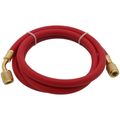
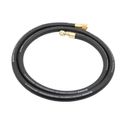
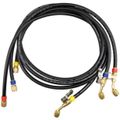
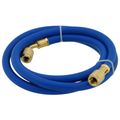
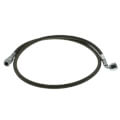
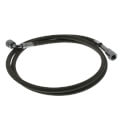
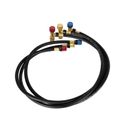
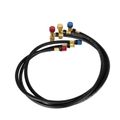
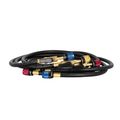
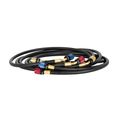

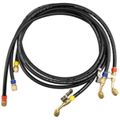
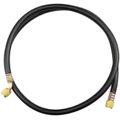
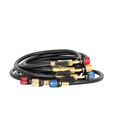
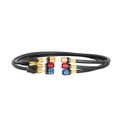
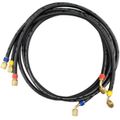
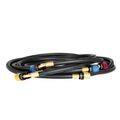
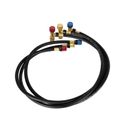
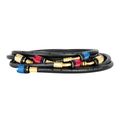
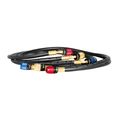
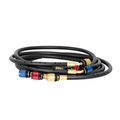
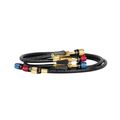
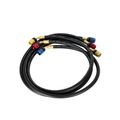
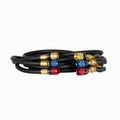


Refrigeration hoses are the flexible connections that link gauge manifolds to compressors, condensers, and service ports during charging, evacuation, and recovery work. Built with a rubber or synthetic core wrapped in a braided reinforcement layer, these hoses carry refrigerant under pressure while resisting the oils and additives found in modern refrigerant blends. Most versions terminate in quarter inch or five sixteenths inch flare fittings that thread directly onto manifold gauge sets and service valves.
Technicians typically keep a matched set on hand, color coded by convention: blue for the low side, red for the high side, and yellow for the utility or vacuum line. A hose rated for the refrigerants a shop services most often, paired with fittings that seal without leaking, keeps charging and recovery work moving without repeated reconnections mid job.
Subcategories
- Standard Charging Hoses: Standard charging hoses connect a manifold gauge set to a system's service ports for routine charging, evacuation, and recovery tasks. Technicians choose these based on length and the flare fitting size that matches their gauge set and the equipment being serviced. A basic hose set covers most day to day refrigeration and air conditioning calls.
- Hoses with Ball Valves: Hoses with built in ball valves let a technician shut off refrigerant flow at the hose itself rather than at the manifold, which reduces refrigerant loss when disconnecting from a live system. Techs working on larger commercial refrigeration systems often prefer this style since it limits the amount of refrigerant vented to atmosphere during hose changes.
- Low-Loss Fitting Hoses: Low loss fitting hoses use a check valve style connector that seals automatically when disconnected, minimizing refrigerant release during hose swaps or manifold changes. These fittings work well for technicians who frequently move between systems with different refrigerant types, since less residual refrigerant carries over between jobs.
- Hose Sets and Color-Coded Kits: Hose sets bundle matching high side, low side, and utility hoses together, often with color coded jackets that follow the blue, red, and yellow convention used across most manifold gauge brands. Buying hoses as a set keeps colors and lengths consistent across a service truck, which speeds up setup on the job.
Buying Guide
Selecting refrigeration hoses starts with matching the flare fitting size to a gauge manifold, since a mismatched connection leads to leaks or requires an adapter that adds another failure point to the setup. Quarter inch flare fittings remain the most common size for residential and light commercial equipment, while some commercial refrigeration applications call for five sixteenths inch connections.
Hose length affects both convenience and refrigerant capacity. Shorter hoses hold less refrigerant and reduce the volume purged during evacuation, which matters on jobs where minimizing refrigerant loss is a priority. Longer hoses give more reach on rooftop units or systems with awkward access, though they add slightly more internal volume to account for during charging.
Ball valve and low loss fitting styles cut down on refrigerant venting during connection and disconnection, an increasingly common requirement as refrigerant handling practices tighten across the trade. Technicians who swap hoses between different refrigerant types benefit most from these designs, since they limit cross contamination and reduce the refrigerant lost with each hose change.
Refrigeration Hoses also vary in their pressure rating and refrigerant compatibility, so checking a hose's rated working pressure against the system being serviced avoids a failure under load. A shop that standardizes on one hose length and fitting style across its trucks cuts down on missing pieces and mismatched connections during a service call.
Frequently Asked Questions
What size flare fitting do most refrigeration hoses use?
Most refrigeration hoses use a quarter inch flare fitting for residential and light commercial equipment, though some commercial refrigeration systems require a five sixteenths inch connection. Checking the manifold gauge set and the service port size before ordering avoids a fitting mismatch.
Why are refrigeration hoses color coded?
Refrigeration hoses follow a blue, red, and yellow color convention across most manufacturers, with blue marking the low side, red marking the high side, and yellow marking the utility or vacuum line. The consistent coding helps technicians connect the correct hose quickly, especially when working under time pressure.
What is the benefit of a hose with a built in ball valve?
A ball valve built into the hose lets a technician shut off refrigerant flow right at the connection point, which limits how much refrigerant escapes when disconnecting from a live system. The design suits technicians who service larger commercial refrigeration equipment where minimizing refrigerant loss matters.
How does a low loss fitting hose differ from a standard hose?
A low loss fitting hose uses a check valve style connector that seals itself when disconnected, reducing the refrigerant that escapes during a hose swap. A standard hose relies on the technician closing valves manually before disconnecting, which can vent more refrigerant if a step gets skipped.
Does hose length affect refrigerant charging accuracy?
Longer hoses hold more refrigerant internally, so techs performing a precise charge by weight often account for the extra volume in a long hose before finishing the job. Shorter hoses hold less refrigerant and simplify accurate charging on tight installations.
