




Filters
SORT
Product Availability –
Size –
Connection Type –
Max Flow (GPM) –
Review Score –
 --%3E %3Csvg version='1.1' id='Fill' xmlns='http://www.w3.org/2000/svg' xmlns:xlink='http://www.w3.org/1999/xlink' x='0px' y='0px' viewBox='0 0 100 100' enable-background='new 0 0 100 100' xml:space='preserve'%3E %3Cpath fill='%23F15C02' d='M79.44,0.95H20.56C9.78,0.95,0.95,9.78,0.95,20.56v58.87c0,10.79,8.82,19.61,19.61,19.61h58.87 c10.79,0,19.61-8.83,19.61-19.61V20.56C99.05,9.78,90.22,0.95,79.44,0.95z M65.38,58.24l9.38,29.58L49.69,69.78L24.5,87.82 l9.34-29.6L8.8,39.6l30.73-0.17c0,0,6.98-19.61,10-28.93c0.54,1.36,9.88,29.1,9.88,29.1H91.2L65.38,58.24z'/%3E %3C/svg%3E)
 --%3E %3Csvg version='1.1' id='With-RB' xmlns='http://www.w3.org/2000/svg' xmlns:xlink='http://www.w3.org/1999/xlink' x='0px' y='0px' viewBox='0 0 100 100' enable-background='new 0 0 100 100' xml:space='preserve'%3E %3Cpath fill='%23FBC8B4' d='M79.44,0.95H20.56C9.78,0.95,0.95,9.78,0.95,20.56v58.87c0,10.79,8.82,19.61,19.61,19.61h58.87 c10.79,0,19.61-8.83,19.61-19.61V20.56C99.05,9.78,90.22,0.95,79.44,0.95z M65.38,58.24l9.38,29.58L49.69,69.78L24.5,87.82 l9.34-29.6L8.8,39.6l30.73-0.17c0,0,6.98-19.61,10-28.93c0.54,1.36,9.88,29.1,9.88,29.1H91.2L65.38,58.24z'/%3E %3C/svg%3E)
Price Range –
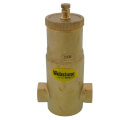
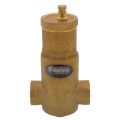
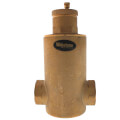
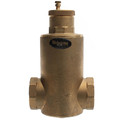
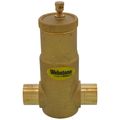
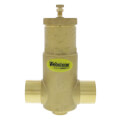
Webstone Air Separators


 --%3E %3Csvg version='1.1' id='No-RB' xmlns='http://www.w3.org/2000/svg' xmlns:xlink='http://www.w3.org/1999/xlink' x='0px' y='0px' viewBox='0 0 100 100' enable-background='new 0 0 100 100' xml:space='preserve'%3E %3Cpath fill='%23CECECE' d='M79.44,0.95H20.56C9.78,0.95,0.95,9.78,0.95,20.56v58.87c0,10.79,8.82,19.61,19.61,19.61h58.87 c10.79,0,19.61-8.83,19.61-19.61V20.56C99.05,9.78,90.22,0.95,79.44,0.95z M65.38,58.24l9.38,29.58L49.69,69.78L24.5,87.82 l9.34-29.6L8.8,39.6l30.73-0.17c0,0,6.98-19.61,10-28.93c0.54,1.36,9.88,29.1,9.88,29.1H91.2L65.38,58.24z'/%3E %3C/svg%3E)


 --%3E %3Csvg version='1.1' id='Half' xmlns='http://www.w3.org/2000/svg' xmlns:xlink='http://www.w3.org/1999/xlink' x='0px' y='0px' viewBox='0 0 100 100' enable-background='new 0 0 100 100' xml:space='preserve'%3E %3Cg%3E %3Cpath fill='%23F15C02' d='M30.05,70.23l3.79-12.01L8.8,39.6l30.73-0.17c0,0,6.98-19.61,10-28.93c0.54,1.36,9.88,29.1,9.88,29.1h1.58 L93.71,7.18c-3.58-3.82-8.66-6.23-14.28-6.23H20.56C9.78,0.95,0.95,9.78,0.95,20.56v58.87c0,5.41,2.22,10.32,5.79,13.88 L30.05,70.23z'/%3E %3C/g%3E %3Cpath fill='%23FBC8B4' d='M93.71,7.18L60.98,39.6H91.2L65.38,58.24l9.38,29.58L49.69,69.78L24.5,87.82l5.55-17.59L6.75,93.32 c3.55,3.54,8.44,5.73,13.82,5.73h58.87c10.79,0,19.61-8.83,19.61-19.61V20.56C99.05,15.4,97.01,10.69,93.71,7.18z'/%3E %3C/svg%3E)

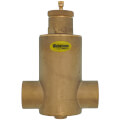


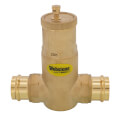
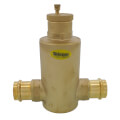
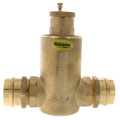
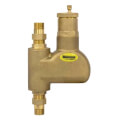
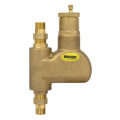
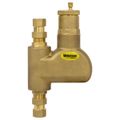
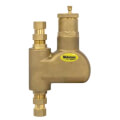

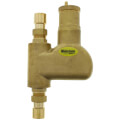
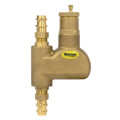
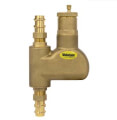
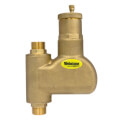


Webstone air separators are hydronic heating components that remove microbubbles and larger air pockets from a closed-loop boiler or radiant system before they can cause noise, corrosion, or reduced heat transfer at the emitters. Air trapped in a system collects at high points and pump volutes, where it causes cavitation noise and can eventually lead to pinhole leaks from oxygen corrosion. A properly sized air separator is installed at the point in the system where water temperature is highest and velocity is lowest, since dissolved air releases more readily under those conditions. Webstone air separators are commonly paired with an automatic air vent mounted on top, so the separated air is expelled from the system rather than just relocated. Technicians specify separator size based on system flow rate rather than pipe diameter alone, since an undersized unit won't have enough dwell time to pull air out of the water stream. Correct placement during a boiler retrofit or new install prevents callbacks for banging pipes and slow-to-heat zones.
Subcategories
- Inline Air Separators: Inline air separators are mounted directly in the main supply or return line and release air as water passes through at reduced velocity. They're typically installed close to the boiler outlet where water temperature is highest and air is most likely to come out of solution.
- Air Separators with Strainer: Some Webstone air separator models combine air removal with a magnetic or mesh strainer basket, catching debris in the same fitting used to remove air. Combining the two functions in one fitting reduces the number of separate components needed in a mechanical room and simplifies future strainer cleaning.
- Central System Air Separators: Central, or tangential, air separators use the incoming flow's spin to force air toward a central collection chamber before it exits through a vent. Larger commercial and multi-zone residential systems often use this style since it handles higher flow rates than a compact inline unit.
- Replacement Air Vents & Components: Automatic air vents, service caps, and internal strainer cartridges are sold separately for maintaining an existing Webstone air separator without replacing the whole body. A vent that sticks open or closed is a common source of a slow weeping leak at the top of the separator.
Buying Guide
Sizing a Webstone air separator starts with the system's design flow rate in gallons per minute, not the pipe size it will be installed on, since a separator that's too small won't give water enough time at low velocity to release trapped air. Boiler manufacturers typically specify a minimum clearance for air separator placement close to the supply outlet, where water is hottest and air solubility is lowest, so following that guidance during installation matters more than matching pipe diameter alone. Systems with in-floor radiant zones or multiple zone valves benefit from a central, tangential-style separator that can handle variable flow without losing separation efficiency as zones cycle on and off. For retrofits on older systems with no dedicated air separator, adding one during a boiler replacement is a common opportunity to solve chronic air-noise complaints that a customer may have lived with for years. Choosing a separator with an integrated strainer saves a fitting and a labor step where debris control is also a concern, such as systems with older cast iron radiators or boilers. Replacement parts, including caps, vents, and strainer cartridges, are worth stocking separately since a sticking air vent is one of the more common service calls on an otherwise healthy hydronic system.
Frequently Asked Questions
Where should a Webstone air separator be installed in a hydronic system?
Air separators work best close to the boiler supply outlet, where water is hottest and lowest in velocity, since air releases from water more easily under those conditions.
What size air separator is needed for a given system?
Sizing is based on the system's design flow rate in gallons per minute rather than the pipe diameter, so checking the boiler or pump specifications before ordering avoids an undersized separator.
Can an air separator remove debris as well as air?
Some models include a built-in strainer basket or magnetic element that catches debris in the same fitting, which is useful on older systems with cast iron radiation or accumulated sediment.
What causes a Webstone air separator to leak from the top?
A stuck or worn automatic air vent is the most common cause of weeping at the top of the assembly, and the vent is typically a separate replaceable part from the separator body.
Is an air separator needed on a system that already has an expansion tank?
An expansion tank manages pressure and volume changes but doesn't remove dissolved air from the water, so a dedicated air separator still addresses noise and corrosion issues an expansion tank alone won't solve.
