




BURNDY


 --%3E %3Csvg version='1.1' id='No-RB' xmlns='http://www.w3.org/2000/svg' xmlns:xlink='http://www.w3.org/1999/xlink' x='0px' y='0px' viewBox='0 0 100 100' enable-background='new 0 0 100 100' xml:space='preserve'%3E %3Cpath fill='%23CECECE' d='M79.44,0.95H20.56C9.78,0.95,0.95,9.78,0.95,20.56v58.87c0,10.79,8.82,19.61,19.61,19.61h58.87 c10.79,0,19.61-8.83,19.61-19.61V20.56C99.05,9.78,90.22,0.95,79.44,0.95z M65.38,58.24l9.38,29.58L49.69,69.78L24.5,87.82 l9.34-29.6L8.8,39.6l30.73-0.17c0,0,6.98-19.61,10-28.93c0.54,1.36,9.88,29.1,9.88,29.1H91.2L65.38,58.24z'/%3E %3C/svg%3E)


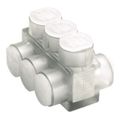




BURNDY traces back to July 19, 1924, when Bern Dibner founded Burndy Engineering Company in Brooklyn, New York. The company relocated its headquarters to New Hampshire in 1983 and has been part of Hubbell Incorporated's electrical systems business since 2009. BURNDY marked its 100th year in 2024.
Electrical contractors, utilities, and industrial maintenance crews have relied on BURNDY connectors for decades of grid and infrastructure work. The company's product development stayed centered on connection technology. It progressed from early compression connectors to the grounding, bonding, and cable management hardware it manufactures today. That gives it a long track record in a category where failure at a connection point carries outsized consequences.
Product Lines
SupplyHouse carries BURNDY connectors and related hardware across several core categories. Electrical and electronic connectors cover general-purpose wire termination and splicing. They are used throughout residential, commercial, and industrial wiring. Grounding and bonding products address code-required grounding paths for electrical systems and structures. Power and utility connectors are built for higher-capacity applications found in utility and industrial power distribution. BURNDY also supplies the hardware, such as bolts, nuts, and washers, along with the tools and dies used to install its connectors correctly in the field.
Why Contractors Specify BURNDY
Electrical contractors specify BURNDY connectors because grounding and bonding work has no tolerance for a loose or corroded connection. BURNDY has built its reputation over a century specifically around connection integrity. Choosing tooling and dies from the same manufacturer as the connector removes a common failure point. A connector crimped with the wrong die or tool can look correct while performing well below its rated capacity. BURNDY has a long-standing presence in utility and industrial markets. Contractors on larger commercial or utility jobs are specifying a connector line with an established history in those applications.
How to Choose BURNDY Products
Selecting the correct BURNDY connector starts with matching wire gauge and material. Copper and aluminum conductors require different connector bodies and, in many cases, different crimp dies. Grounding and bonding hardware should be chosen based on the specific code requirement it needs to satisfy and the conductor size specified for that ground path. For power and utility applications, connector selection depends on the voltage class and current-carrying requirement of the circuit. That information should come from the job's electrical specifications rather than a general guess. Contractors installing BURNDY connectors in volume should also confirm they are using the tool and die combination BURNDY specifies for that connector. Mismatched tooling is one of the more common causes of field failures.
Frequently Asked Questions
When was BURNDY founded?
BURNDY was founded on July 19, 1924, as Burndy Engineering Company in Brooklyn, New York, by Bern Dibner.
Is BURNDY still an independent company?
No. BURNDY has been part of Hubbell Incorporated's electrical systems business since 2009.
Where is BURNDY headquartered today?
BURNDY is headquartered in New Hampshire. Its headquarters moved there from Brooklyn, New York, in 1983.
What types of products does BURNDY manufacture?
BURNDY manufactures electrical and electronic connectors. It also makes grounding and bonding equipment and power and utility connectors. Its tools and dies are used to install them.
Why does tooling matter when installing BURNDY connectors?
Mismatched tooling can produce a crimp that looks correct but does not meet the connector's rated performance. Using the tool and die combination BURNDY specifies for a given connector helps avoid that problem.
