




Filters
SORT
Product Availability –
Brand –
Size –
Connection Type –
Features –
Handle Style –
Review Score –
 --%3E %3Csvg version='1.1' id='Fill' xmlns='http://www.w3.org/2000/svg' xmlns:xlink='http://www.w3.org/1999/xlink' x='0px' y='0px' viewBox='0 0 100 100' enable-background='new 0 0 100 100' xml:space='preserve'%3E %3Cpath fill='%23F15C02' d='M79.44,0.95H20.56C9.78,0.95,0.95,9.78,0.95,20.56v58.87c0,10.79,8.82,19.61,19.61,19.61h58.87 c10.79,0,19.61-8.83,19.61-19.61V20.56C99.05,9.78,90.22,0.95,79.44,0.95z M65.38,58.24l9.38,29.58L49.69,69.78L24.5,87.82 l9.34-29.6L8.8,39.6l30.73-0.17c0,0,6.98-19.61,10-28.93c0.54,1.36,9.88,29.1,9.88,29.1H91.2L65.38,58.24z'/%3E %3C/svg%3E)
 --%3E %3Csvg version='1.1' id='With-RB' xmlns='http://www.w3.org/2000/svg' xmlns:xlink='http://www.w3.org/1999/xlink' x='0px' y='0px' viewBox='0 0 100 100' enable-background='new 0 0 100 100' xml:space='preserve'%3E %3Cpath fill='%23FBC8B4' d='M79.44,0.95H20.56C9.78,0.95,0.95,9.78,0.95,20.56v58.87c0,10.79,8.82,19.61,19.61,19.61h58.87 c10.79,0,19.61-8.83,19.61-19.61V20.56C99.05,9.78,90.22,0.95,79.44,0.95z M65.38,58.24l9.38,29.58L49.69,69.78L24.5,87.82 l9.34-29.6L8.8,39.6l30.73-0.17c0,0,6.98-19.61,10-28.93c0.54,1.36,9.88,29.1,9.88,29.1H91.2L65.38,58.24z'/%3E %3C/svg%3E)
Price Range –
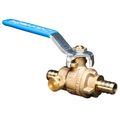
PEX Crimp Ball Valves w/ Drain

 --%3E %3Csvg version='1.1' id='No-RB' xmlns='http://www.w3.org/2000/svg' xmlns:xlink='http://www.w3.org/1999/xlink' x='0px' y='0px' viewBox='0 0 100 100' enable-background='new 0 0 100 100' xml:space='preserve'%3E %3Cpath fill='%23CECECE' d='M79.44,0.95H20.56C9.78,0.95,0.95,9.78,0.95,20.56v58.87c0,10.79,8.82,19.61,19.61,19.61h58.87 c10.79,0,19.61-8.83,19.61-19.61V20.56C99.05,9.78,90.22,0.95,79.44,0.95z M65.38,58.24l9.38,29.58L49.69,69.78L24.5,87.82 l9.34-29.6L8.8,39.6l30.73-0.17c0,0,6.98-19.61,10-28.93c0.54,1.36,9.88,29.1,9.88,29.1H91.2L65.38,58.24z'/%3E %3C/svg%3E)


 --%3E %3Csvg version='1.1' id='Half' xmlns='http://www.w3.org/2000/svg' xmlns:xlink='http://www.w3.org/1999/xlink' x='0px' y='0px' viewBox='0 0 100 100' enable-background='new 0 0 100 100' xml:space='preserve'%3E %3Cg%3E %3Cpath fill='%23F15C02' d='M30.05,70.23l3.79-12.01L8.8,39.6l30.73-0.17c0,0,6.98-19.61,10-28.93c0.54,1.36,9.88,29.1,9.88,29.1h1.58 L93.71,7.18c-3.58-3.82-8.66-6.23-14.28-6.23H20.56C9.78,0.95,0.95,9.78,0.95,20.56v58.87c0,5.41,2.22,10.32,5.79,13.88 L30.05,70.23z'/%3E %3C/g%3E %3Cpath fill='%23FBC8B4' d='M93.71,7.18L60.98,39.6H91.2L65.38,58.24l9.38,29.58L49.69,69.78L24.5,87.82l5.55-17.59L6.75,93.32 c3.55,3.54,8.44,5.73,13.82,5.73h58.87c10.79,0,19.61-8.83,19.61-19.61V20.56C99.05,15.4,97.01,10.69,93.71,7.18z'/%3E %3C/svg%3E)
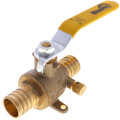
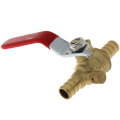
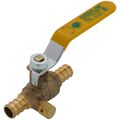
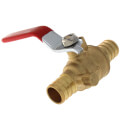
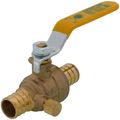

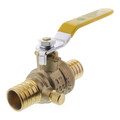
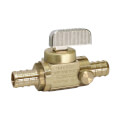
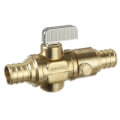

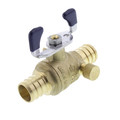
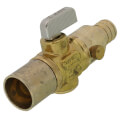
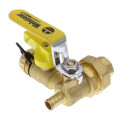


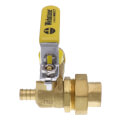

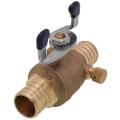
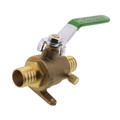

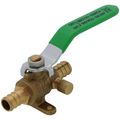
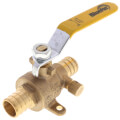
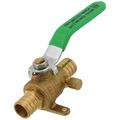
PEX Crimp Ball Valves w/ Drain are shutoff valves built for PEX plumbing systems that include a secondary port for draining a line after the main valve closes. Plumbers install them ahead of fixtures, manifolds, or zones where a line needs to be isolated and emptied for repair or winterization without shutting down the whole system. Bodies are typically chromed lead-free DZR brass with a Teflon seat that resists scale buildup over years of service, and they're rated for up to 200 psi and 200 degrees Fahrenheit, covering both potable water and hydronic heating applications. The crimp connection uses a copper ring or stainless clamp over a barb fitting, meeting ASTM F877 and F1807 standards for PEX tubing. Many models also include a mounting pad so the valve can be screwed to a stud or blocking rather than supported by the tubing alone, which keeps the connection from stressing under repeated use.
Subcategories
- 1/2 Inch PEX Crimp Ball Valves w/ Drain: Half-inch crimp ball valves with drain are sized for individual fixture supply lines, like a sink, toilet, or washing machine connection. They're rated for up to 200 psi and 200 degrees Fahrenheit, matching the rest of the line they're installed in. The drain port lets a plumber empty just that branch for a fixture repair without draining the whole house. The half-inch size shows up often on service and repair calls where isolating one fixture cuts down on water loss during the job.
- 3/4 Inch PEX Crimp Ball Valves w/ Drain: Three-quarter-inch crimp ball valves with drain handle larger branch lines and mains, carrying the same 200 psi and 200 degree Fahrenheit rating as the half-inch size. The larger bore supports higher flow to multiple fixtures or a zone rather than a single point of use. A plumber isolating a bathroom group or a hydronic zone typically reaches for this size over the half-inch option. The drain port still allows that section to be emptied for repair or seasonal shutdown.
- Valves with Mounting Pads: Many PEX crimp ball valves with drain include a molded mounting pad alongside the valve body, giving an installer a flat surface to screw into a stud or blocking. Fixing the valve in place this way keeps the crimp connections from bearing the weight of the valve and handle during operation. The pad also holds the valve steady while the handle gets worked during shutoff, which matters on valves that see frequent use. The mounting pad feature is standard on both the half-inch and three-quarter-inch sizes.
- DZR Brass Body Valves: The valve body on these products is chromed lead-free DZR brass, a dezincification-resistant alloy that holds up to mineral-heavy water without the zinc leaching that shortens the life of ordinary brass. A Teflon seat rides inside the ball to prevent scale buildup from affecting the shutoff seal over time. The combination gives the valve third-party certification to NSF 61 for potable water use. Contractors specifying valves for well water or hard water regions look for this construction over standard brass.
Buying Guide
Sizing the valve to the line it's replacing is the starting point, since half-inch valves cover individual fixture branches while three-quarter-inch valves handle mains and multi-fixture zones. Both sizes on the market share the same 200 psi and 200 degree Fahrenheit rating, so pressure and temperature aren't usually the deciding factor between them. The drain port is the feature that separates these valves from a standard PEX ball valve, and it earns its keep on any line that might need draining for a repair, a fixture swap, or winterizing a seasonal property. Skipping the drain feature on a valve installed at a low point in the system means pulling out a bucket and a wet/dry vac every time that section needs to be opened up. Body material matters next. DZR brass resists the dezincification that can affect standard brass in aggressive water conditions, which extends valve life in well water or hard water areas. A Teflon seat keeps the ball sealing properly as scale builds up over years of service. Mounting pads round out the decision: a valve with a pad can be screwed to a stud or blocking, which takes the load off the crimp connections and keeps the assembly from shifting when the handle gets worked. PEX Crimp Ball Valves w/ Drain that check all four boxes, correct size, adequate rating, drain port, and a mounting pad, hold up better over years of repeated use than a valve chosen on size alone.
Frequently Asked Questions
What does the drain port on a PEX ball valve do?
The drain port is a secondary opening on the valve body that lets water be released from the downstream side of the line after the main valve closes. It's used for isolating a fixture or zone for repair, or for draining a line ahead of winterizing a seasonal property, without shutting down the rest of the plumbing system.
What size PEX crimp ball valve with drain fits a typical fixture line?
Half-inch valves cover most individual fixture branches, like a sink or toilet supply line, while three-quarter-inch valves handle mains and multi-fixture zones. Both sizes carry the same 200 psi and 200 degree Fahrenheit rating, so the choice comes down to the line size being connected.
What is DZR brass and why does it matter for these valves?
DZR stands for dezincification-resistant, an alloy that holds up better than standard brass in water with high mineral content. Valve bodies built from chromed lead-free DZR brass resist the zinc leaching that can weaken standard brass fittings over time, which extends service life in well water or hard water conditions.
Do these valves need a mounting pad?
A mounting pad isn't required for the valve to function, but it gives an installer a flat surface to screw the valve to a stud or blocking. Securing the valve this way takes stress off the crimp connections and keeps the assembly steady when the handle is being operated.
What standards do PEX crimp ball valves with drain meet?
These valves are built to ASTM F877 and F1807, the standards covering PEX tubing and crimp-style fittings, and they carry NSF 61 certification for potable water use. The crimp connection itself uses a copper ring or stainless clamp over a barb fitting on the valve body.
