



'/%3E%3C/svg%3E)
 --%3E %3Csvg version='1.1' id='Fill' xmlns='http://www.w3.org/2000/svg' xmlns:xlink='http://www.w3.org/1999/xlink' x='0px' y='0px' viewBox='0 0 100 100' enable-background='new 0 0 100 100' xml:space='preserve'%3E %3Cpath fill='%23F15C02' d='M79.44,0.95H20.56C9.78,0.95,0.95,9.78,0.95,20.56v58.87c0,10.79,8.82,19.61,19.61,19.61h58.87 c10.79,0,19.61-8.83,19.61-19.61V20.56C99.05,9.78,90.22,0.95,79.44,0.95z M65.38,58.24l9.38,29.58L49.69,69.78L24.5,87.82 l9.34-29.6L8.8,39.6l30.73-0.17c0,0,6.98-19.61,10-28.93c0.54,1.36,9.88,29.1,9.88,29.1H91.2L65.38,58.24z'/%3E %3C/svg%3E)


MANUALS (5)
'/%3E%3C/svg%3E)
Product Highlights


Description
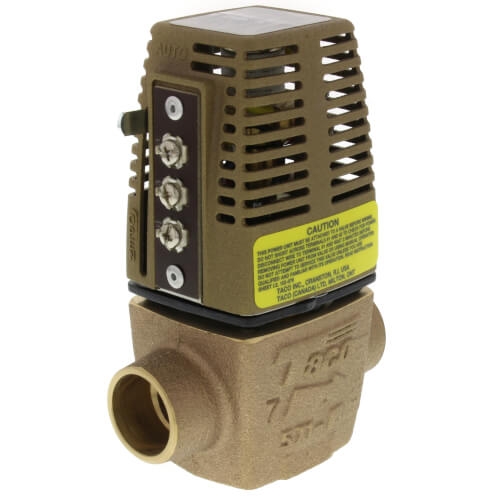
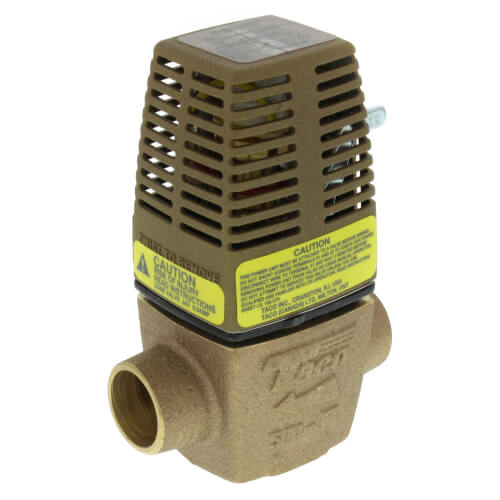
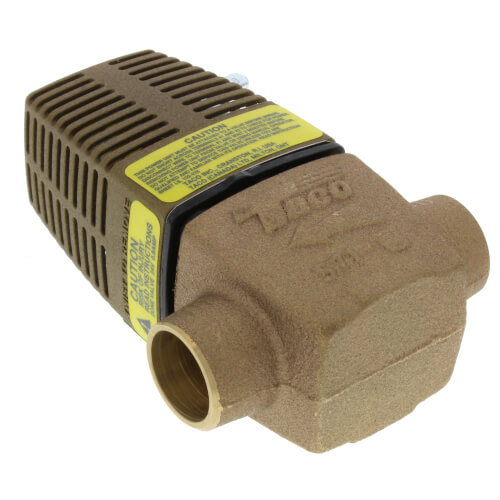
When you want the industry standard for hydronic heating applications, choose Taco's 570 Gold Series. Designers prefer these valves for their quiet and dependable operation. Installers appreciate the open lever and twist-off head that makes installation and service easy.
Available in 1/2" - 1 1/4" sweat connections.
Specs
| Application: | Zoning |
|---|---|
| Size: | 3/4" |
| Position: | Normally Closed |
| End Switch: | Yes |
| Voltage: | 24V |
| Connection Type: | Sweat |
| Body Pattern: | 2-Way |
| Flow Range (GPM): | 4.5 to 6 GPM |
| Height: | 4-13/16" |
| Max Flow (GPM): | 6 |
| Material: | Bronze |
| Min Flow (GPM): | 4.5 |
| Flow Capacity (Cv): | 6.1 |
| Width (Inches): | 3-3/8" |
| Amperage: | 0.9 |
| Depth (Inches): | 2" |
| Max Pressure (PSI): | 125 |
| Wiring: | 3 Wire Terminal Block |
| Hertz: | 60 |
| Temperature Range (F): | 40°F - 240°F |
| Min Temp (F): | 40°F |
| Max Temp (F): | 240°F |

Questions?
Compare Similar Products
You May Also Need
2 Replacement Parts

Need help finding a replacement part?
Product Reviews
Most Liked Positive Review
Reliable valuve
Most Liked Negative Review
 --%3E %3Csvg version='1.1' id='With-RB' xmlns='http://www.w3.org/2000/svg' xmlns:xlink='http://www.w3.org/1999/xlink' x='0px' y='0px' viewBox='0 0 100 100' enable-background='new 0 0 100 100' xml:space='preserve'%3E %3Cpath fill='%23FBC8B4' d='M79.44,0.95H20.56C9.78,0.95,0.95,9.78,0.95,20.56v58.87c0,10.79,8.82,19.61,19.61,19.61h58.87 c10.79,0,19.61-8.83,19.61-19.61V20.56C99.05,9.78,90.22,0.95,79.44,0.95z M65.38,58.24l9.38,29.58L49.69,69.78L24.5,87.82 l9.34-29.6L8.8,39.6l30.73-0.17c0,0,6.98-19.61,10-28.93c0.54,1.36,9.88,29.1,9.88,29.1H91.2L65.38,58.24z'/%3E %3C/svg%3E)
Seat fail in 3+ years
Great product
I would use them again in a second.
Valve replacement
yes
I will be ordering all my plumbing supplies from here
yes I would
Great Valves
Cheaper than the rebuild kit.
Just what I needed
Worked like a charm
Product Q&A
28 QuestionsQ: will a taco zone valve operate properly with the arrow pointing toward the boiler?
Asked by geo. 10 years ago
Add your answer
Verified Reply- SupplyHouse StaffThe arrow indicates the direction of flow of the water into the system, so that sounds like it would not operate properly if pointing towards the heater. It should be facing out towards where the water will be flowing to.
The arrow is the direction of water flow. This needs to be determined to be installed correctly. Sent from my iPhone
Q: What is the outside diameter of a 1 inch copper pipe? My inch copper pipe reads 1.17 + or - Just want to make sure 1 inch sweat will work! Thanks
Asked by Marc 11 years ago
Add your answer
Verified Reply- SupplyHouse StaffThe outside diameter of 1 inch pipe would be 1-1/8". Yes, this sweat zone valve will connect to 1" copper tubing.
Q: CAN I REVERSE THE POWER HEAD SO THE SCREWS ARE ON THE OTHER SIDE? THANKS!
Asked by Jarhead 12 years ago
Add your answer
Yes you can, the valve installs only one direction for water flow but the power head can be rotated 180 degrees as needed.
Yes head can be turned over Take power head off when installing so rubber inside does not melt.
Q: When power is off does it close
Asked by sharon 12 years ago
Add your answer
Yes.
My Answer is YES .
I've used these Zone Valves for over 25 years at my house (I have 8 zones) and find them very dependable. Yes, if the power goes out, the zone valves will close. I have a generator for power outages, and have the circuit configured so it not only will power up the boiler, but ALSO power to the circuit for the transformers/thermostats/zone valves. Hope that helps! ~Steve C. Btw, be aware that if you force the zone valves on with the lever, you will risk damage to the zone valve coil when they are re-energized. Instructions say that if you use the manual override, then you should remove the low voltage wire that energizes them. Again, that isn't a problem for me because if power goes out, everything is out, including the circulator pumps, so nothing will happen using the manual control anyway. But when using generator to fire up the boiler, if you don't have a way to power the thermostats, then you would have to open the zones manually (assuming the boiler power also will fire up the circulator but not the zones).
Q: Will there be a problem using the 573 on the return line
Asked by tommy 12 years ago
Add your answer
Verified Reply- PexSupply StaffNo, there wouldn't be. Installing zone valves on the return line is usually a good idea because it can reduce water-hammer noise.
I believe it should always be mounted on the return line Sent from my iPad
It is best practice to install zone valve on the supply line IMO. If it is the only place you can put it the location should not affect the resistance in the pipe. It is easier to purge the heating zone with the zone valve on the supply. If you put a zone valve on the return you should add a purge before and after the zone valve to insure that you do not have air in system. Ed K
I always install my zone valves on the return side of the boiler. The reason that I do it is because the temperature of the return water is a little cooler then the supply side. Also I noticed I have less problem with the valve when they were installed on the return side. Just be aware of the direction of the arrow on the valve, it must be towards the border if on the return side. Sent from my iPad
Tommy. I dont see any problem installing a zone valve on the return of a heating system. Sometimes valves are flow direction sensitive so I would make sure the flow is going the same way as the arrow on the side of the valve. Good Luck. Bryan GO HAWKS
Best on supply with the circulator on supply and pumping away from expansion tank. But what you are suggesting will work.
Q: My plans specify a 3/4" zone valve in the 3/4" copper distribution line, at the manifold. However, the flow rate is only 2.63 gpm and I see in the specs for the 3/4" 571 valve that minimum flow is 4 gpm. Will this valve work or did my designer miss something?
Asked by Skywagon211 13 years ago
Add your answer
Hello, Your setup should work. The zone valve simply opens or closes once it receives a signal from the thermostat, and opens to the 3/4 dia opening ie all the way open or all the way closed, not modulated. Your supply flow rate will go through regardless of the zone valve flow rate once the thermostat opens fully. If anything the zone valve rating may be a max flow rate not a min.
Valve will work just fine, If it was a non-electric valve you would run into problems because back pressure is needed to open valve. This 24 volt valve will open and its operation does not matter on back pressure. You pump is the most important factor. I like using 3-speed pumps because they cure a lot of design sins. If you are short on GPM then you can go to fasters speed. If zone is cycling too much you can go down to a slower speed. That my opinion Ed Kodzis M.A.I. Energy Contractors/Consultants
The zone valve simply opens and closes based on the electrical signal it receives. I don't know why it wouldn't work at a lower flow rate.
You will be fine with this valve. If you went to a smaller valve it would restrict your flow. Better to have a valve that is a little larger than you need than one that is too small. Ray
Q: I have the Taco 571-2 valve but it is not working, can i just replace the top part of the valve so I dont have to get a plumber to cut out and sweat the pipes. Thank you.
Asked by Joe new home owner 14 years ago
Add your answer
Verified Reply- PexSupply StaffThe power head for this zone valve is available as a separate replacement part. It is part number 555-050RP.
Yes, the power head can be replaced without needing to replace the valve body. You can also replace valve parts without needing to re-sweat anything. If you need to replace any valve parts, you will have to turn off the water and drain the system. But for the power head alone, that doesn't even need to be done. Some basic info from Taco: http://www.taco-hvac.com/uploads/FileLibrary/100-3.2a.pdf
The answer is yes
You have to find out whats not working. Usually the valvprophets stuck and the actuator fails due to an overload. I'd recommend replacing the valve and actuator to resolve the problem right the first time. Robert Piszczek
YES YOU CAN
Hope this isn't too late, but yes you can just replace the actuator (top). It will most likely fix the problem. Hope this helps.
Q: I have three zones using the 571-8. Two zones work fine. The third zone has never work properly. Its the basement and while I can live without it there are times that I would like heat. The system is 22 years old. This value has been replaced many times so I not sure how old it is. Is there some way to operate this manually?
Asked by Anonymous 14 years ago
Add your answer
Pull down the lever on the zone valve to manually open the valve. The picture shows it in the closed position.
You can install a Taco 570 series valve and use the manual bypass lever to turn the zone on when needed. Not very elegant. You could also connect to a 24V supply + switch. You could then use the switch to turn zone on remotely. Better yet, install a local thermostat and use when you want heat. Turn thermostat off when you don't.
Move the lever next to the terminals from auto to manual. Make sure the circulator is running and see if the pipe heats up. If it doesn't heat up the zone valve may again be defective or the piping is clogged. This email and any files transmitted with it are confidential and intended solely fo rht recipient. If you are not the named addressee you should not disseminate, ditribute, copy or alter this email. Any view or opinions presented in this email are solely those of the author. Although resonable precautions have been taken to ensure no viruses are present in this email the sender cannot accept responsibility for any loss or damage arising from the use of this email or attachments.
Simply pull down on the lever will open the water flow & energize the electrical connection. To turn off just raise the lever Have a great day Joe Trevis
Yes. The valve can be operated manually by pushing the manual lever forward. The lever sticks up on the right of the actuator (head) to the right of the electrical connection screws. Heat should flow. If it doesn't flow, try this: twist off the head by rotating it counterclockwise about 20 degrees. Take a screwdriver and push the valve open manually. It's spring-loaded, so push hard, and keep it open. Check for heat flowing through. If it isn't flowing, the base valve should be replaced. If the valve works, then it is your wiring or thermostat that's the problem.
Q: cAN THIS BE USED IN AN OPEN SYSTEM?
Asked by 14 years ago
Add your answer
Verified Reply- PexSupply StaffThis valve is intended for use only in closed-loop systems. For an open system we'd recommend Taco's geothermal zone valve.
Q: Our Taco 562-5 zone valve does not open...wat do we do now?
Asked by 14 years ago
Add your answer
Verified Reply- PexSupply StaffYou can open it manually for the time being, but you may need to replace the valve head.