




Filters
SORT
Product Availability –
Category –
Brand –
Finish Family –
Flow Rate (GPM) –
Type –
Installation Type –
Handle Style –
Number Of Handles –
Number Of Holes –
ADA –
Approvals –
Series –
Drain Type –
Review Score –
 --%3E %3Csvg version='1.1' id='Fill' xmlns='http://www.w3.org/2000/svg' xmlns:xlink='http://www.w3.org/1999/xlink' x='0px' y='0px' viewBox='0 0 100 100' enable-background='new 0 0 100 100' xml:space='preserve'%3E %3Cpath fill='%23F15C02' d='M79.44,0.95H20.56C9.78,0.95,0.95,9.78,0.95,20.56v58.87c0,10.79,8.82,19.61,19.61,19.61h58.87 c10.79,0,19.61-8.83,19.61-19.61V20.56C99.05,9.78,90.22,0.95,79.44,0.95z M65.38,58.24l9.38,29.58L49.69,69.78L24.5,87.82 l9.34-29.6L8.8,39.6l30.73-0.17c0,0,6.98-19.61,10-28.93c0.54,1.36,9.88,29.1,9.88,29.1H91.2L65.38,58.24z'/%3E %3C/svg%3E)
 --%3E %3Csvg version='1.1' id='With-RB' xmlns='http://www.w3.org/2000/svg' xmlns:xlink='http://www.w3.org/1999/xlink' x='0px' y='0px' viewBox='0 0 100 100' enable-background='new 0 0 100 100' xml:space='preserve'%3E %3Cpath fill='%23FBC8B4' d='M79.44,0.95H20.56C9.78,0.95,0.95,9.78,0.95,20.56v58.87c0,10.79,8.82,19.61,19.61,19.61h58.87 c10.79,0,19.61-8.83,19.61-19.61V20.56C99.05,9.78,90.22,0.95,79.44,0.95z M65.38,58.24l9.38,29.58L49.69,69.78L24.5,87.82 l9.34-29.6L8.8,39.6l30.73-0.17c0,0,6.98-19.61,10-28.93c0.54,1.36,9.88,29.1,9.88,29.1H91.2L65.38,58.24z'/%3E %3C/svg%3E)
Price Range –
Bathroom Faucets


 --%3E %3Csvg version='1.1' id='No-RB' xmlns='http://www.w3.org/2000/svg' xmlns:xlink='http://www.w3.org/1999/xlink' x='0px' y='0px' viewBox='0 0 100 100' enable-background='new 0 0 100 100' xml:space='preserve'%3E %3Cpath fill='%23CECECE' d='M79.44,0.95H20.56C9.78,0.95,0.95,9.78,0.95,20.56v58.87c0,10.79,8.82,19.61,19.61,19.61h58.87 c10.79,0,19.61-8.83,19.61-19.61V20.56C99.05,9.78,90.22,0.95,79.44,0.95z M65.38,58.24l9.38,29.58L49.69,69.78L24.5,87.82 l9.34-29.6L8.8,39.6l30.73-0.17c0,0,6.98-19.61,10-28.93c0.54,1.36,9.88,29.1,9.88,29.1H91.2L65.38,58.24z'/%3E %3C/svg%3E)





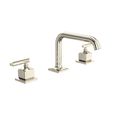


Bathroom Faucets are the fixtures that control water flow and temperature at a bathroom sink, and they're one of the most frequently replaced or upgraded fixtures in both new construction and remodel work. Plumbers and contractors choose a faucet based on how many holes the sink or countertop is drilled for, the handle configuration, and the finish, since these details determine whether a faucet will physically fit the installation without additional drilling or an escutcheon plate to cover extra holes.
The category spans single-hole faucets with one lever, centerset faucets with two handles on a shared base, and widespread faucets with separate handles and spout connected by flexible supply lines under the sink. Getting the hole configuration right before ordering avoids a mismatch that shows up only once the old faucet is already removed.
Subcategories
- Single-Hole Faucets: Faucets with the spout and handle combined into one unit that mounts through a single hole in the sink or countertop. These work well on sinks with only one predrilled hole and give a cleaner look with less hardware to clean around. A single-hole faucet can't be used on a sink drilled for a centerset or widespread configuration without an adapter plate.
- Centerset Faucets: Faucets with two handles and a spout mounted on a single base plate that covers three predrilled holes spaced a standard distance apart. This is the most common configuration in older bathrooms and standard-size vanities. The fixed spacing means centerset faucets aren't adjustable to different hole spreads the way widespread faucets are.
- Widespread Faucets: Faucets with separate hot handle, cold handle, and spout, connected below the sink by flexible supply lines, allowing installation across a range of hole spacings. These are common in higher-end vanities and give more flexibility in layout and design. Because the components are separate, installation typically takes longer than a single-piece centerset or single-hole faucet.
- Wall-Mounted Faucets: Faucets that mount to the wall above the sink rather than to the sink deck or countertop, used with vessel sinks or trough-style basins that don't have faucet holes. These require rough-in plumbing set at a specific height and spacing behind the wall before the sink and countertop go in. They're typically part of a planned remodel rather than a drop-in replacement.
Buying Guide
Measure the existing sink or countertop's hole configuration first, since this determines which faucet types will physically fit. A single hole means a single-hole faucet or an adapter plate for a centerset; three holes at a fixed spacing mean a centerset faucet or a widespread with a matching or adjustable base plate.
Check the finish and confirm it will hold up to how the bathroom is used, since finishes vary in resistance to water spotting and daily cleaning. Matching the faucet finish to other bathroom hardware, such as the towel bar or cabinet pulls, is a common design consideration but isn't required for the faucet to function correctly.
For Bathroom Faucets going into a commercial restroom rather than a residential bathroom, confirm the faucet is rated for that use, since commercial fixtures typically need to withstand higher use frequency and may require different mounting hardware than a residential model.
Check the supply line connections and confirm they match the shutoff valves already in place under the sink, since a mismatch in thread size or connector type means adding an adapter or replacing the supply lines as part of the installation.
Frequently Asked Questions
How do I know if I need a single-hole, centerset, or widespread faucet?
Count and measure the predrilled holes in the sink or countertop. One hole calls for a single-hole faucet, three holes at a fixed spacing call for a centerset, and a wider or adjustable spacing works with a widespread faucet.
Can I install a single-hole faucet on a sink drilled for three holes?
Yes, with an escutcheon or deck plate that covers the extra holes. Without that plate, the unused holes will be left open and exposed.
What's the difference between a centerset and widespread faucet?
A centerset faucet has its handles and spout mounted on one fixed base plate. A widespread faucet has separate handles and spout connected by flexible supply lines, allowing installation across a range of hole spacings.
Do wall-mounted faucets require special plumbing?
Yes. Wall-mounted faucets need rough-in plumbing set at a specific height and spacing inside the wall before installation, which typically makes them a planned remodel item rather than a simple swap.
Will a new bathroom faucet fit my existing supply lines?
Check the connection thread size and connector type on both the faucet and the shutoff valves before installing. A mismatch is common when replacing an older faucet and may require an adapter or new supply lines.
