




Filters
SORT
Product Availability –
Brand –
Type –
Connection Type –
Material –
Review Score –
 --%3E %3Csvg version='1.1' id='Fill' xmlns='http://www.w3.org/2000/svg' xmlns:xlink='http://www.w3.org/1999/xlink' x='0px' y='0px' viewBox='0 0 100 100' enable-background='new 0 0 100 100' xml:space='preserve'%3E %3Cpath fill='%23F15C02' d='M79.44,0.95H20.56C9.78,0.95,0.95,9.78,0.95,20.56v58.87c0,10.79,8.82,19.61,19.61,19.61h58.87 c10.79,0,19.61-8.83,19.61-19.61V20.56C99.05,9.78,90.22,0.95,79.44,0.95z M65.38,58.24l9.38,29.58L49.69,69.78L24.5,87.82 l9.34-29.6L8.8,39.6l30.73-0.17c0,0,6.98-19.61,10-28.93c0.54,1.36,9.88,29.1,9.88,29.1H91.2L65.38,58.24z'/%3E %3C/svg%3E)
 --%3E %3Csvg version='1.1' id='With-RB' xmlns='http://www.w3.org/2000/svg' xmlns:xlink='http://www.w3.org/1999/xlink' x='0px' y='0px' viewBox='0 0 100 100' enable-background='new 0 0 100 100' xml:space='preserve'%3E %3Cpath fill='%23FBC8B4' d='M79.44,0.95H20.56C9.78,0.95,0.95,9.78,0.95,20.56v58.87c0,10.79,8.82,19.61,19.61,19.61h58.87 c10.79,0,19.61-8.83,19.61-19.61V20.56C99.05,9.78,90.22,0.95,79.44,0.95z M65.38,58.24l9.38,29.58L49.69,69.78L24.5,87.82 l9.34-29.6L8.8,39.6l30.73-0.17c0,0,6.98-19.61,10-28.93c0.54,1.36,9.88,29.1,9.88,29.1H91.2L65.38,58.24z'/%3E %3C/svg%3E)
Price Range –
Hot Water Recirculating Pumps


 --%3E %3Csvg version='1.1' id='Half' xmlns='http://www.w3.org/2000/svg' xmlns:xlink='http://www.w3.org/1999/xlink' x='0px' y='0px' viewBox='0 0 100 100' enable-background='new 0 0 100 100' xml:space='preserve'%3E %3Cg%3E %3Cpath fill='%23F15C02' d='M30.05,70.23l3.79-12.01L8.8,39.6l30.73-0.17c0,0,6.98-19.61,10-28.93c0.54,1.36,9.88,29.1,9.88,29.1h1.58 L93.71,7.18c-3.58-3.82-8.66-6.23-14.28-6.23H20.56C9.78,0.95,0.95,9.78,0.95,20.56v58.87c0,5.41,2.22,10.32,5.79,13.88 L30.05,70.23z'/%3E %3C/g%3E %3Cpath fill='%23FBC8B4' d='M93.71,7.18L60.98,39.6H91.2L65.38,58.24l9.38,29.58L49.69,69.78L24.5,87.82l5.55-17.59L6.75,93.32 c3.55,3.54,8.44,5.73,13.82,5.73h58.87c10.79,0,19.61-8.83,19.61-19.61V20.56C99.05,15.4,97.01,10.69,93.71,7.18z'/%3E %3C/svg%3E)

 --%3E %3Csvg version='1.1' id='No-RB' xmlns='http://www.w3.org/2000/svg' xmlns:xlink='http://www.w3.org/1999/xlink' x='0px' y='0px' viewBox='0 0 100 100' enable-background='new 0 0 100 100' xml:space='preserve'%3E %3Cpath fill='%23CECECE' d='M79.44,0.95H20.56C9.78,0.95,0.95,9.78,0.95,20.56v58.87c0,10.79,8.82,19.61,19.61,19.61h58.87 c10.79,0,19.61-8.83,19.61-19.61V20.56C99.05,9.78,90.22,0.95,79.44,0.95z M65.38,58.24l9.38,29.58L49.69,69.78L24.5,87.82 l9.34-29.6L8.8,39.6l30.73-0.17c0,0,6.98-19.61,10-28.93c0.54,1.36,9.88,29.1,9.88,29.1H91.2L65.38,58.24z'/%3E %3C/svg%3E)

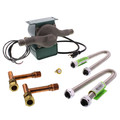
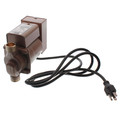

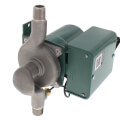
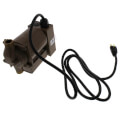
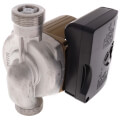
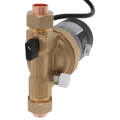

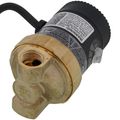
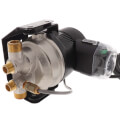
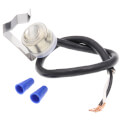
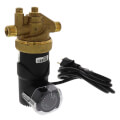
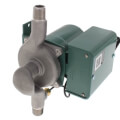
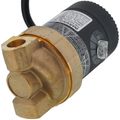
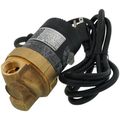
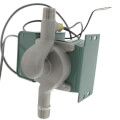

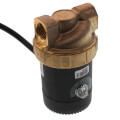
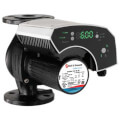
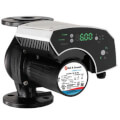
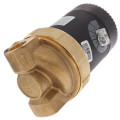
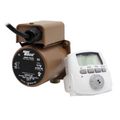
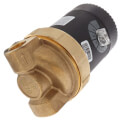
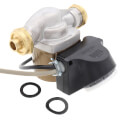
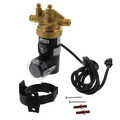
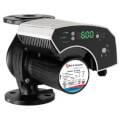


Hot water recirculating pumps keep a supply of heated water moving continuously through a home's hot water piping loop so it arrives at a fixture almost as soon as the tap opens, instead of running cold water down the drain while the line reheats. Plumbers install them in homes with long pipe runs between the water heater and the farthest fixtures, where the wait for hot water can otherwise stretch to a minute or more. A recirculating system pairs a small circulator pump with either a dedicated return line or a valve installed at the farthest fixture that ties the hot and cold lines together under the sink. Homeowners request these systems for comfort and to cut down on wasted water, and builders increasingly spec them into new construction where water conservation codes apply. Systems can run on a continuous cycle, a timer, or an on-demand control activated by a push button or motion sensor, and the control method has a direct effect on both energy use and how quickly hot water reaches the fixture.
Subcategories
- Timer-Controlled Recirculating Pumps: Timer-controlled pumps run on a programmable schedule that matches a household's typical hot water demand, such as running during morning and evening peak hours and shutting off overnight. Programming the schedule around actual usage patterns cuts down on the energy the pump uses compared with continuous operation. These pumps suit households with predictable routines and work well in single-family homes with one main return loop. Adjusting the schedule seasonally, since hot water demand often shifts with the time of year, keeps the system running efficiently.
- On-Demand Recirculating Pumps: On-demand pumps sit idle until activated by a push button, wall switch, or smartphone app, then circulate hot water to the nearest fixture only when someone is about to use it. This approach uses less energy than timer or continuous systems since the pump runs only for the short window needed to bring hot water to the tap. Retrofitting an on-demand system into an existing home usually means installing a sensor valve under the farthest fixture that connects the hot and cold lines. Homeowners who want the water conservation benefit without running the pump all day often choose this configuration.
- Aquastat and Thermostatically Controlled Pumps: Aquastat-controlled pumps use a temperature sensor on the return line to start the pump only when the water in the loop has cooled below a set point, keeping the loop at a consistent minimum temperature without running constantly. This method works well for continuous comfort applications like commercial buildings or larger homes with multiple bathrooms. Because the pump activates based on temperature rather than a fixed schedule, it adapts automatically to changes in ambient temperature or hot water demand throughout the day. Installers mount the aquastat sensor directly on the return line near the pump for an accurate reading.
- Dedicated Return Line Systems: Dedicated return line systems use a separate pipe that runs from the farthest fixture back to the water heater, creating a true closed loop that the pump circulates continuously or on a schedule. This configuration is common in new construction where the return line can be roughed in during framing, before walls are closed up. Retrofitting a dedicated return line into an existing home is more invasive than a crossover valve system since it typically requires opening walls or running the new line through a basement or crawlspace. The closed loop design tends to deliver more consistent performance across a home with several bathrooms compared with a single crossover valve.
Buying Guide
Selecting the right hot water recirculating pump starts with identifying what kind of return path the plumbing already has, or will have. Homes with a dedicated return line already piped in during construction need only a circulator pump and a control method, while homes without one typically call for a crossover valve installed at the farthest fixture that ties hot and cold lines together under the sink. Retrofitting a system into an existing home almost always points toward the crossover valve approach since running new pipe through finished walls adds significant labor cost to the job.
Control method matters as much as the pump itself. Continuous and timer-based operation deliver the fastest hot water response but use more energy keeping the loop warm around the clock, while on-demand and aquastat-controlled systems trade a few extra seconds of wait time for meaningfully lower energy use. Households with predictable morning and evening routines often do well with a timer, while homes with irregular schedules benefit more from an on-demand push-button or app-controlled system.
Pump sizing depends on the length of the hot water loop and the number of fixtures it serves, since a longer loop with more branches needs more flow to maintain temperature throughout. Hot water recirculating pumps also vary in noise level and mounting orientation, both of which matter when the pump will sit near a bedroom or living space rather than a utility room. Checking that the selected pump is rated for potable water circulation, not just general hydronic heating use, avoids a mismatch between the pump's construction and the application.
Frequently Asked Questions
Do hot water recirculating pumps waste energy running all the time?
Continuous operation does use more energy than timer, aquastat, or on-demand control, since the pump keeps the loop warm around the clock rather than only when hot water is needed. Choosing a control method that matches actual household usage patterns cuts down on that energy use substantially. On-demand systems use the least energy since the pump activates only for the short window before a fixture is used.
Can a recirculating pump be added to a home without a dedicated return line?
A crossover valve installed under the farthest fixture from the water heater connects the hot and cold lines, letting the pump push hot water through the existing cold line back toward the water heater without new pipe. This approach is the standard retrofit method for homes built without a return loop. Performance is generally good for single-story homes or ones with fixtures reasonably close together.
How much faster does hot water arrive with a recirculating pump installed?
Wait time drops from what can be a minute or more in a home with long pipe runs down to just a few seconds once the loop is primed and running. The exact improvement depends on the distance between the water heater and the fixture and on which control method is selected. On-demand systems add a short delay while the pump cycles after activation, while continuous systems deliver hot water almost instantly.
What maintenance do hot water recirculating pumps need?
Circulator pumps used in these systems generally need little beyond periodic checks that the impeller spins freely and that any inline check valve is not stuck or leaking. A pump that runs constantly and loudly, or one that has stopped circulating water at all, usually signals a failing motor or seized bearing. Most residential circulator pumps are designed to run for years without maintenance under normal conditions.
Are hot water recirculating pumps compatible with tankless water heaters?
Many tankless water heaters support recirculation, though the water heater's own control logic or a compatible external pump and valve setup needs to be matched to that specific unit rather than assumed universal. Checking the water heater manufacturer's documentation for supported recirculation methods before selecting a pump avoids a mismatch between the two systems. Some tankless models include recirculation control built into the unit itself, which can simplify the installation.
