




Filters
SORT
Product Availability –
Brand –
Product Type –
Gauge –
Capacity –
Review Score –
 --%3E %3Csvg version='1.1' id='Fill' xmlns='http://www.w3.org/2000/svg' xmlns:xlink='http://www.w3.org/1999/xlink' x='0px' y='0px' viewBox='0 0 100 100' enable-background='new 0 0 100 100' xml:space='preserve'%3E %3Cpath fill='%23F15C02' d='M79.44,0.95H20.56C9.78,0.95,0.95,9.78,0.95,20.56v58.87c0,10.79,8.82,19.61,19.61,19.61h58.87 c10.79,0,19.61-8.83,19.61-19.61V20.56C99.05,9.78,90.22,0.95,79.44,0.95z M65.38,58.24l9.38,29.58L49.69,69.78L24.5,87.82 l9.34-29.6L8.8,39.6l30.73-0.17c0,0,6.98-19.61,10-28.93c0.54,1.36,9.88,29.1,9.88,29.1H91.2L65.38,58.24z'/%3E %3C/svg%3E)
 --%3E %3Csvg version='1.1' id='With-RB' xmlns='http://www.w3.org/2000/svg' xmlns:xlink='http://www.w3.org/1999/xlink' x='0px' y='0px' viewBox='0 0 100 100' enable-background='new 0 0 100 100' xml:space='preserve'%3E %3Cpath fill='%23FBC8B4' d='M79.44,0.95H20.56C9.78,0.95,0.95,9.78,0.95,20.56v58.87c0,10.79,8.82,19.61,19.61,19.61h58.87 c10.79,0,19.61-8.83,19.61-19.61V20.56C99.05,9.78,90.22,0.95,79.44,0.95z M65.38,58.24l9.38,29.58L49.69,69.78L24.5,87.82 l9.34-29.6L8.8,39.6l30.73-0.17c0,0,6.98-19.61,10-28.93c0.54,1.36,9.88,29.1,9.88,29.1H91.2L65.38,58.24z'/%3E %3C/svg%3E)
Price Range –
Wire Strippers




 --%3E %3Csvg version='1.1' id='No-RB' xmlns='http://www.w3.org/2000/svg' xmlns:xlink='http://www.w3.org/1999/xlink' x='0px' y='0px' viewBox='0 0 100 100' enable-background='new 0 0 100 100' xml:space='preserve'%3E %3Cpath fill='%23CECECE' d='M79.44,0.95H20.56C9.78,0.95,0.95,9.78,0.95,20.56v58.87c0,10.79,8.82,19.61,19.61,19.61h58.87 c10.79,0,19.61-8.83,19.61-19.61V20.56C99.05,9.78,90.22,0.95,79.44,0.95z M65.38,58.24l9.38,29.58L49.69,69.78L24.5,87.82 l9.34-29.6L8.8,39.6l30.73-0.17c0,0,6.98-19.61,10-28.93c0.54,1.36,9.88,29.1,9.88,29.1H91.2L65.38,58.24z'/%3E %3C/svg%3E)


 --%3E %3Csvg version='1.1' id='Half' xmlns='http://www.w3.org/2000/svg' xmlns:xlink='http://www.w3.org/1999/xlink' x='0px' y='0px' viewBox='0 0 100 100' enable-background='new 0 0 100 100' xml:space='preserve'%3E %3Cg%3E %3Cpath fill='%23F15C02' d='M30.05,70.23l3.79-12.01L8.8,39.6l30.73-0.17c0,0,6.98-19.61,10-28.93c0.54,1.36,9.88,29.1,9.88,29.1h1.58 L93.71,7.18c-3.58-3.82-8.66-6.23-14.28-6.23H20.56C9.78,0.95,0.95,9.78,0.95,20.56v58.87c0,5.41,2.22,10.32,5.79,13.88 L30.05,70.23z'/%3E %3C/g%3E %3Cpath fill='%23FBC8B4' d='M93.71,7.18L60.98,39.6H91.2L65.38,58.24l9.38,29.58L49.69,69.78L24.5,87.82l5.55-17.59L6.75,93.32 c3.55,3.54,8.44,5.73,13.82,5.73h58.87c10.79,0,19.61-8.83,19.61-19.61V20.56C99.05,15.4,97.01,10.69,93.71,7.18z'/%3E %3C/svg%3E)

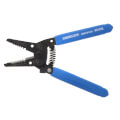


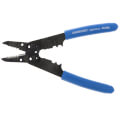


Wire Strippers remove insulation from electrical wire without nicking the conductor, and a self-adjusting model handles a range of gauges without a manual dial adjustment. The Klein Tools 11061 self-adjusting stripper covers 10-20 AWG solid wire and 12-22 AWG stranded wire in a single tool, plus 12/2 and 14/2 NM-B cable. Electricians and HVAC technicians use this style of stripper when a job mixes wire gauges, since the self-adjusting jaw finds the correct depth automatically instead of requiring a gauge-specific notch. A built-in cutter handles wire up to 8 AWG solid, so the same tool trims and strips without swapping to a separate cutter. Reliable, consistent strips matter on every termination because a nicked conductor weakens the wire and can cause a connection to fail inspection or work loose over time.
Subcategories
- Self-Adjusting Wire Strippers: Self-adjusting wire strippers automatically size their jaws to the wire gauge being stripped, removing the need to select a notch for each size. The Klein Tools 11061 covers 10-20 AWG solid and 12-22 AWG stranded wire with a tension adjustment dial for fine control. Electricians use this style on jobs with mixed wire gauges since it speeds up repetitive stripping tasks.
- Combination Wire Stripper/Cutters: Combination stripper/cutters add a built-in cutting blade to the stripping jaws so one tool handles both tasks. The 11061 model's integrated cutter handles up to 8 AWG solid wire in addition to its stripping range. This reduces the number of tools a technician needs to carry on a service call.
- Manual Gauge-Notch Strippers: Manual gauge-notch strippers use fixed notches sized to specific wire gauges rather than an automatic adjustment. Electricians who work primarily with a consistent wire gauge often prefer this style for its simplicity and lower moving-part count. Selecting the correct notch is up to the user, so precision depends on matching the notch to the actual wire gauge.
Buying Guide
Start with the wire gauges most commonly worked with on the job. A self-adjusting tool like the Klein Tools 11061 covers a broad range, from 10-20 AWG solid to 12-22 AWG stranded, which suits electricians moving between different circuit types on the same service call. Wire Strippers built around a fixed gauge notch work fine for technicians who stick to one or two consistent wire sizes, but they slow down work that spans multiple gauges since the jaws don't adjust automatically. Consider whether a built-in cutter is worth having on the same tool. A combination stripper/cutter that handles up to 8 AWG solid wire cuts down on tool switching during a termination, which adds up over a full day of panel or device work. Handle material and grip comfort matter for repetitive use, since a tool used dozens of times a day needs to avoid hand fatigue. Overall tool length and cutter capacity should match the panel or box space being worked in, since a longer tool with more leverage can be awkward in a cramped junction box. Finally, check the tool's rated capacity against the largest wire gauge expected on the job, since forcing an oversized wire through an undersized stripper damages both the tool and the conductor.
Frequently Asked Questions
What gauge range does a self-adjusting wire stripper cover?
The Klein Tools 11061 self-adjusting model covers 10-20 AWG for solid wire and 12-22 AWG for stranded wire, plus 12/2 and 14/2 NM-B cable. Wire Strippers with this range suit most residential and light commercial electrical work without needing a second tool.
Can a wire stripper also cut wire?
Some models, including the Klein Tools 11061, include a built-in cutter capable of handling up to 8 AWG solid wire. This combination design lets a technician strip and cut without switching tools mid-task.
Is a self-adjusting stripper better than a manual gauge-notch model?
A self-adjusting stripper speeds up work that involves multiple wire gauges since the jaws size themselves automatically, while a manual notch stripper depends on the user picking the correct notch. Either style works well for consistent, repetitive stripping of a single gauge, but self-adjusting tools reduce the chance of a mismatched notch nicking the conductor.
What wire types can a self-adjusting stripper handle besides solid and stranded copper?
The Klein Tools 11061 is rated for NM-B cable in 12/2 and 14/2 configurations in addition to standard solid and stranded wire. Confirming a stripper's rated cable types before use prevents damage to sheathed cable jackets that require different jaw pressure than bare conductor.
How does a tension adjustment dial affect stripping quality?
A tension adjustment dial lets a technician fine-tune the pressure the jaws apply to smaller gauge wire, which helps prevent nicking on thinner conductors. Wire Strippers with this feature give more consistent results across a wider range of wire sizes than a fixed-tension design.
