



Filters
SORT
Product Availability –
Category –
Brand –
Product Type –
Fuel Type –
Energy Factor –
Energy Star Rated –
Voltage –
Vent Type –
Installation Type –
BTU (Min) –
BTU (Max) –
Flow Rate At 40F Temp Rise (GPM) –
Flow Rate At 50F Temp Rise (GPM) –
Flow Rate At 60F Temp Rise (GPM) –
Flow Rate At 70F Temp Rise (GPM) –
Phase –
Review Score –
 --%3E %3Csvg version='1.1' id='Fill' xmlns='http://www.w3.org/2000/svg' xmlns:xlink='http://www.w3.org/1999/xlink' x='0px' y='0px' viewBox='0 0 100 100' enable-background='new 0 0 100 100' xml:space='preserve'%3E %3Cpath fill='%23F15C02' d='M79.44,0.95H20.56C9.78,0.95,0.95,9.78,0.95,20.56v58.87c0,10.79,8.82,19.61,19.61,19.61h58.87 c10.79,0,19.61-8.83,19.61-19.61V20.56C99.05,9.78,90.22,0.95,79.44,0.95z M65.38,58.24l9.38,29.58L49.69,69.78L24.5,87.82 l9.34-29.6L8.8,39.6l30.73-0.17c0,0,6.98-19.61,10-28.93c0.54,1.36,9.88,29.1,9.88,29.1H91.2L65.38,58.24z'/%3E %3C/svg%3E)
 --%3E %3Csvg version='1.1' id='With-RB' xmlns='http://www.w3.org/2000/svg' xmlns:xlink='http://www.w3.org/1999/xlink' x='0px' y='0px' viewBox='0 0 100 100' enable-background='new 0 0 100 100' xml:space='preserve'%3E %3Cpath fill='%23FBC8B4' d='M79.44,0.95H20.56C9.78,0.95,0.95,9.78,0.95,20.56v58.87c0,10.79,8.82,19.61,19.61,19.61h58.87 c10.79,0,19.61-8.83,19.61-19.61V20.56C99.05,9.78,90.22,0.95,79.44,0.95z M65.38,58.24l9.38,29.58L49.69,69.78L24.5,87.82 l9.34-29.6L8.8,39.6l30.73-0.17c0,0,6.98-19.61,10-28.93c0.54,1.36,9.88,29.1,9.88,29.1H91.2L65.38,58.24z'/%3E %3C/svg%3E)
Price Range –
Tankless Water Heaters


 --%3E %3Csvg version='1.1' id='Half' xmlns='http://www.w3.org/2000/svg' xmlns:xlink='http://www.w3.org/1999/xlink' x='0px' y='0px' viewBox='0 0 100 100' enable-background='new 0 0 100 100' xml:space='preserve'%3E %3Cg%3E %3Cpath fill='%23F15C02' d='M30.05,70.23l3.79-12.01L8.8,39.6l30.73-0.17c0,0,6.98-19.61,10-28.93c0.54,1.36,9.88,29.1,9.88,29.1h1.58 L93.71,7.18c-3.58-3.82-8.66-6.23-14.28-6.23H20.56C9.78,0.95,0.95,9.78,0.95,20.56v58.87c0,5.41,2.22,10.32,5.79,13.88 L30.05,70.23z'/%3E %3C/g%3E %3Cpath fill='%23FBC8B4' d='M93.71,7.18L60.98,39.6H91.2L65.38,58.24l9.38,29.58L49.69,69.78L24.5,87.82l5.55-17.59L6.75,93.32 c3.55,3.54,8.44,5.73,13.82,5.73h58.87c10.79,0,19.61-8.83,19.61-19.61V20.56C99.05,15.4,97.01,10.69,93.71,7.18z'/%3E %3C/svg%3E)

 --%3E %3Csvg version='1.1' id='No-RB' xmlns='http://www.w3.org/2000/svg' xmlns:xlink='http://www.w3.org/1999/xlink' x='0px' y='0px' viewBox='0 0 100 100' enable-background='new 0 0 100 100' xml:space='preserve'%3E %3Cpath fill='%23CECECE' d='M79.44,0.95H20.56C9.78,0.95,0.95,9.78,0.95,20.56v58.87c0,10.79,8.82,19.61,19.61,19.61h58.87 c10.79,0,19.61-8.83,19.61-19.61V20.56C99.05,9.78,90.22,0.95,79.44,0.95z M65.38,58.24l9.38,29.58L49.69,69.78L24.5,87.82 l9.34-29.6L8.8,39.6l30.73-0.17c0,0,6.98-19.61,10-28.93c0.54,1.36,9.88,29.1,9.88,29.1H91.2L65.38,58.24z'/%3E %3C/svg%3E)

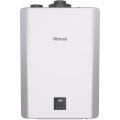
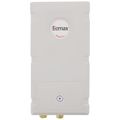
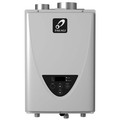

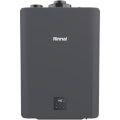

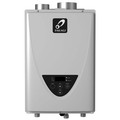
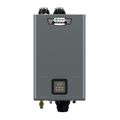
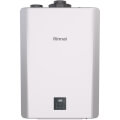



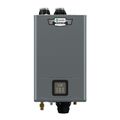
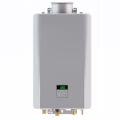
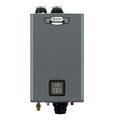
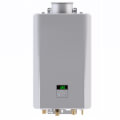
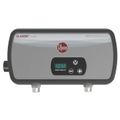
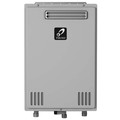
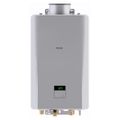
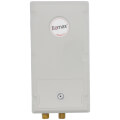
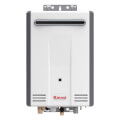
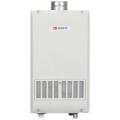
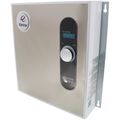
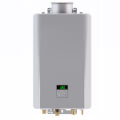

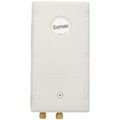
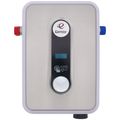
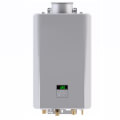
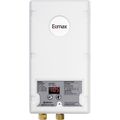
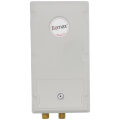
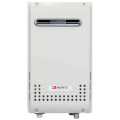

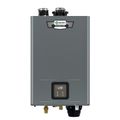
Tankless water heaters are on-demand units that heat water as it flows through a heat exchanger rather than storing a set volume in a tank. Both gas-fired and electric models skip the standby heat loss that comes with keeping a tank full of hot water around the clock, since the burner or heating element only activates when a fixture calls for hot water. Contractors stock whole-house condensing and non-condensing gas units for full-home replacements, along with compact electric point-of-use models for a single sink, shower, or remote fixture that is too far from the main water heater to justify long pipe runs. A tankless unit's smaller footprint frees up floor space in mechanical rooms and closets, which matters on multi-family retrofits and tight utility spaces. Sizing runs on flow rate and temperature rise rather than tank capacity, so matching a replacement to gas line size and venting keeps an installation code compliant and callback free.
Subcategories
- Gas Tankless Water Heaters: Gas tankless water heaters draw from a home or building's natural gas or propane line and use a burner to heat water on demand, making them a common choice for whole-house installations and full water heater replacements. Condensing models capture extra heat from exhaust gas for higher efficiency and vent with PVC or similar plastic pipe, while non-condensing units need stainless steel venting rated for higher flue temperatures. Both configurations need a properly sized gas line and combustion air supply to fire at full capacity, which matters when swapping in a tankless unit for an older tank-style heater. Multi-unit buildings sometimes stack several gas tankless units together to cover higher simultaneous demand across multiple bathrooms.
- Electric Tankless Water Heaters: Electric tankless water heaters use resistance heating elements instead of a burner, which removes the need for gas piping or exhaust venting altogether. Smaller electric models serve a single point of use, such as a bathroom sink or remote shower, while larger whole-house electric units need a dedicated high-amperage circuit and adequate panel capacity. Because electric units do not vent combustion gases, installers can mount them in tighter spaces than gas models, including closets and under-cabinet locations. Panel capacity is the main constraint on whole-house electric tankless installs, since larger units draw significant amperage during operation.
- Point-of-Use Tankless Water Heaters: Point-of-use tankless water heaters mount close to a single fixture, cutting the wait for hot water at sinks, showers, or laundry connections that sit far from the main water heater. Compact electric models are the most common point-of-use option, since they do not require gas venting and fit inside a vanity cabinet or utility closet. Contractors often add a point-of-use unit as a supplement to a whole-house water heater rather than a full replacement, targeting one problem fixture instead of re-piping the whole building. Placement close to the fixture is what makes these units effective, since long hot water runs defeat the purpose of a point-of-use heater.
- Tankless Water Heater Parts & Accessories: Tankless water heater parts and accessories cover the isolation valve kits, venting components, condensate neutralizers, and water filters that keep a unit running and make service calls faster. Isolation valve kits let a technician flush scale out of the heat exchanger without disconnecting the unit from the water lines, which matters in hard water areas where mineral buildup is common. Condensing gas models need a condensate neutralizer to treat the mildly acidic condensate before it reaches a drain. Matching venting components and filters to the specific unit's manufacturer and model keeps warranty coverage intact.
Buying Guide
Choosing between a gas or electric tankless water heater starts with what utilities are already available at the installation site. A home with an existing gas line and proper venting clearance is usually a straightforward swap for a gas unit, while a location without gas service or with limited panel capacity may point toward an electric model or a point-of-use unit instead. Flow rate demand matters more than tank size when sizing Tankless Water Heaters, since the unit needs to keep up with simultaneous fixture use rather than store a set volume ahead of time. Cold climates raise the temperature rise a unit has to deliver, which can push a borderline gas unit into a larger size or a second unit for a whole-house install. Condensing gas models cost more upfront but usually run more efficiently and vent with lower cost PVC pipe, a consideration on longer vent runs. Electric point-of-use units solve a narrow problem, like a remote bathroom or an addition, without the labor of extending gas lines or venting through the building. Whole-house electric units need a hard look at electrical panel capacity before committing, since undersized service is a common reason a project stalls mid-installation. Replacement jobs should also confirm that gas line diameter and venting material match the new unit's requirements, since reusing an old tank heater's undersized gas line is a frequent source of underperformance.
Frequently Asked Questions
Can a tankless water heater run out of hot water like a tank model?
No. A tankless water heater heats water as it flows through the unit, so it does not run out the way a storage tank does. Output is limited by flow rate instead, meaning too many fixtures running at once can drop the water temperature rather than cut off hot water completely.
Do gas tankless water heaters need special venting?
Yes, and the venting type depends on whether the unit is condensing or non-condensing. Condensing units vent with PVC or similar plastic pipe because the exhaust temperature is lower, while non-condensing units need stainless steel venting rated for higher flue temperatures.
Is a bigger tankless unit always better for a whole-house install?
Not necessarily. Oversizing adds cost without improving performance if the flow rate and temperature rise do not call for it, so sizing should match the home's simultaneous fixture use and incoming water temperature rather than defaulting to the largest available unit.
Can an electric tankless water heater replace a gas unit without other changes?
Usually not without an electrical review. Whole-house electric units draw enough amperage that panel capacity needs to be checked first, and a dedicated circuit is typically required, so swapping gas for electric often involves more than a straight unit replacement.
What maintenance keeps a tankless water heater running efficiently?
Periodic descaling through an isolation valve kit clears mineral buildup from the heat exchanger, which matters most in hard water areas. Replacing water filters and checking condensate neutralizer media on condensing models are the other routine tasks that keep a unit performing at its rated efficiency.
